

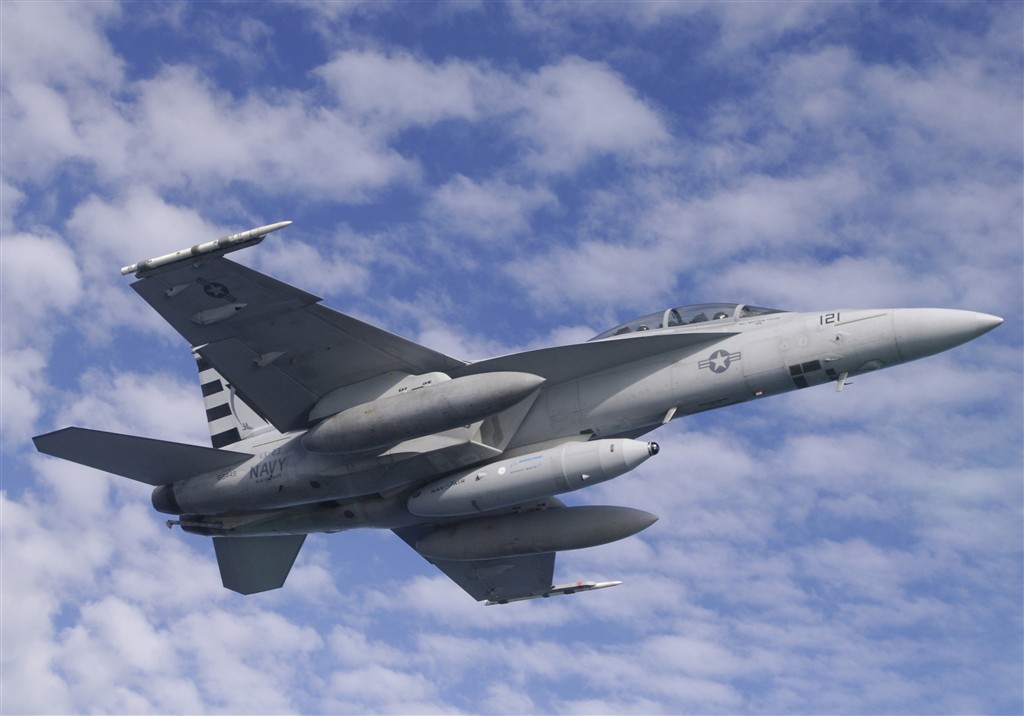
F/A-18 E/F Super Hornet Block IIs fighters are beginning to enter service with the US Navy and Australia, carrying significantly improved AN/APG-79 AESA radars and other electronic upgrades. Recent years have seen another spreading improvement within global fighter fleets, however: Infra-Red Search & Track (IRST) systems that provide long range thermal imaging against air and ground targets. Most of these deployments have been on Russian (MiG-29 family, SU-30 family) and European (Eurofighter, Rafale, Gripen NG) fighters, or special American exports (UAE’s F-16E/F Block 60 Desert Falcons, Korea & Singapore’s F-15K/SG Strike Eagles).

That absence puts American fighters behind an important curve. This IRST approach can defeat radar stealth in some instances, by focusing on engine exhaust, or on the friction of the aircraft as it powers through the atmosphere. As F-14 pilots will recall, long range electro-optics also offer positive identification, conferring the ability to use a plane’s aerial missiles at their full ranges. Best of all, IRST offers a passive way to locate and target enemy aircraft, without triggering the target’s radar warning receivers. When coupled with medium-range IR missiles like some Russian AA-10 variants, France’s MICA-IR, or even future versions of AMRAAM NCADE, an IRST system offers a fighter both an extra set of medium-range eyes, and a stealthy air-to-air combat weapon. Programs are underway to give some American “teen series” fighters this capability, albeit in a somewhat unusual way.
Tanks for the View: The IRST + Fuel Solution

Retrofits into existing aircraft can be tricky, but in July 2007, Boeing’s RFI selection process and tapped Lockheed Martin’s Missiles and Fire Control division in Orlando, FL to supply up IRST systems for F/A-18 E/F Super Hornet Block II aircraft. That began as a Systems Development and Demonstration effort, but the program received Milestone B approval in July 2011, and the EMD contract followed in August 2011. The first production deliveries of up to F/A-18 E/F IRST systems were expected in 2012, with initial operational capability expected in 2013.
Lockheed Martin’s IRST is described as “the next generation of the F-14D AN/AAS-42 IRST that accumulated over 200,000 flight hours aboard U.S. aircraft carriers.” The question for Boeing was where to put it.
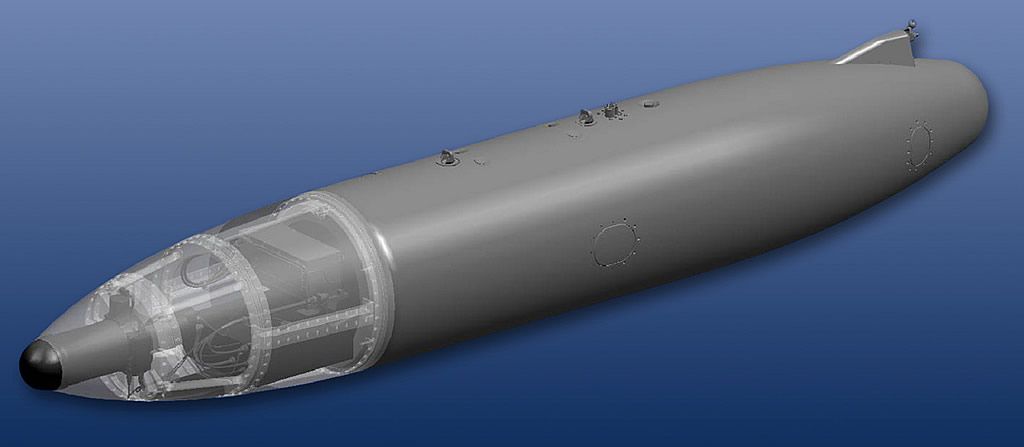
(click to view full)
Instead of modifying the Super Hornet’s airframe’s structure or wiring, the partners will be taking an unusual route: modifying a 480 gallon centerline fuel tank to carry 330 gallons of fuel + the IRST system. The drawback to this approach is that a centerline tank with IRST needs to stay on the airplane in combat, compromising its aerodynamic performance and radar signature.
On the bright side, this approach will allow refits to existing Super Hornets, and indeed to all “teen series” fighters in the US arsenal, once software integration is performed to tie the IRST into each new plane type’s “multisource integration algorithms.” IRST tracking data must be correlated with other sensors like the fighter’s radar, radar warning receivers, etc., in order to make its surveillance and targeting simple enough to be useful to the pilot. MSIA integration ensures this.
Industrial partners in this effort are:
* Boeing IDS (lead contractor)
* Lockheed Martin Missiles and Fire Control (SpectIR IRST sensor)
* General Electric (F/A-18 fuel tank with the sensor housing)
* Meggitt Defense Systems Inc. (IRST unit’s cooling sub-assembly)
IRST Future: A SpectIR for all Teens?
(click to view full)
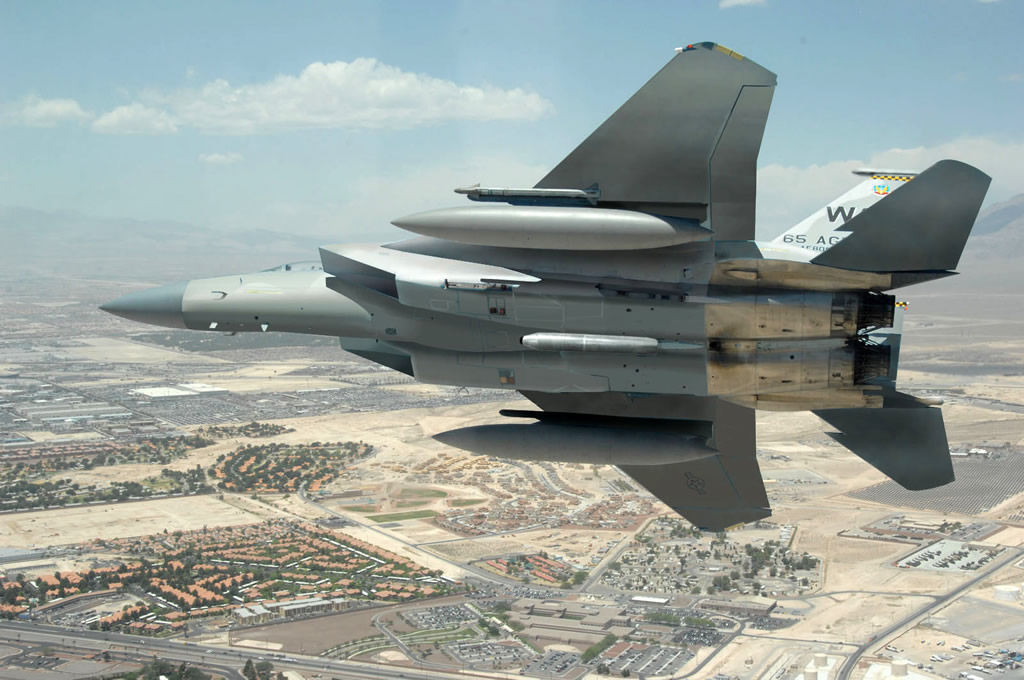
A similar approach was suggested for the USAF’s F-15C/D fleet, but it would have been a full centerline pod, rather than a fuel tank with additional capabilities. The two firms already had a history of cooperation on the F-15. Boeing has already installed Lockheed Martin’s Tiger Eyes system, which includes an IRST as part of its suite, on in Korean F-15K and RSAF F-15SG Strike Eagles.
The Pentagon’s FY 2012 budget proposed to end funding for the F-15 program, but Lockheed Martin and Boeing continued to develop “SpectIR” as an option that “will be transportable across a wide range of platforms.” The FY 2013 Presidential Budget for 2013 shows the USAF F-15C SpectIR program picking back up again in FY 2015, and the Air National Guard has its own options. Because IRST is an open ANG requirement for Homeland Defense, the US ANG can just use National Guard & Reserve Equipment Appropriation (NGREA) funds to buy a system, once it’s ready.
Lockheed Martin has privately funded the SpectIR dedicated IRST pod, and is conducting tests to demonstrate its readiness. They see the market extending well beyond F-15 fleets. Integration work for the team will obviously be easier on Boeing and Lockheed Martin “teen series” fighters like the F-15, F-16 and F/A-18. Nevertheless, other platforms around the world would be eligible, if manufacturers or customers wanted to fund integration.
Another effort, called Talon HATE, is a Boeing pod that combines datalinks for secure communication with stealth platforms, and an IRST sensor up front. That combination fits a critical tactical need, and Boeing is schedule to begin delivery to F-15C squadrons in 2015.
As an interesting aside, there are reports that the USAF’s targeting pods chosen under the new ATP-SE contracts may provide a lesser form of air-to-air IRST capability, alongside the ground surveillance and attack functions.
Contracts and Key Events
Boeing re-announcement of LRIP shows product positioning. Six weeks after the military approved and announced the approval of low rate initial production, Boeing sent out a release that got some coverage. Most interesting in the release is the continued drumbeat of the message that the F/A-18 is evolving a modern capacity that continues its relevance via technology upgrades. Boeing terms it “another example of how we continue to evolve Super Hornet capabilities to ensure it outpaces future adversaries.”
2018
Super Hornet pod receives EMD contract, begins test flights; USAF backs away from F-15C SpectIR pod, but Lockheed Martin doesn’t.
November 28/18: More Block II Lockheed Martin is being tapped to continue to the next phase of its Boeing F/A-18E/F Super Hornet Block II Infrared Search and Track (IRST) upgrade program. Awarded by Boeing, the $108 million contract allows for the development, platform integration, flight test and qualification of the IRST21 Block II sensor system installed on the US Navy’s Super Hornet fighter aircraft. IRST21 is a multi-function sensor system that has been designed to provide long-range detection and tracking of airborne threats in radar-denied environments. It is a passive, long-range sensor system that uses infrared search and track technology to detect and track heat coming off the engines of enemy aircraft. The IRST21 autonomously detects and tracks airborne targets at long ranges, and can merge the data with the fighters’ other sensors to provide a multi-dimensional view of threats. The Navy plans to field a 170 Block II sensor across its F-18 fleet.
November 8/18: Block II Boeing is receiving a contract modification to support the Navy’s Infrared Search and Track (IRST) program. The additional $12.1 million allow Boeing to incorporate conduct designing, developing, integrating and testing of the Infrared Search and Track System (IRST) Block II, Phase II engineering change. These efforts will be carried out to replace the IRST Block I system. The modification incorporates an engineering development model and upgrades for two sets of IRST Block I system weapon replacement assemblies. IRST is a long-wave infrared detection system that targets airborne vehicles in a radar-denied environment. In the mid-2000s, Lockheed Martin LMT was selected as the winner in the US Navy’s F/A-18E/F IRST competition, which required 170 systems. These were the IRST Block I systems, which are capable of detecting, tracking and ranging targets with weapon-quality accuracy. Now with the advanced version of this IRST system – the Block II version – set to get incorporated in the F/A-18 jets, these aircrafts will be able to perform better in terms of surveillance. Work will be performed in Orlando, Florida and St. Louis, Missouri. The Block II systems are expected to be completed in April 2022.
2011 – 2015
Jan 23/15: Boeing re-announcement of LRIP shows product positioning. Six weeks after the military approved and announced the approval of low rate initial production, Boeing sent out a release that got some coverage. Most interesting in the release is the continued drumbeat of the message that the F/A-18 is evolving a modern capacity that continues its relevance via technology upgrades. Boeing terms it “another example of how we continue to evolve Super Hornet capabilities to ensure it outpaces future adversaries.”
Dec 2/14: Super Hornets. Vice Admiral Paul Grosklags, Principal Military Deputy for the Assistant Secretary of the Navy (Research, Development and Acquisition), approved low-rate initial production (LRIP) of 6 sensor pods. They will be used to conduct more performance and aeromechanical flight tests in order to reach initial operating capability (IOC) and make a full rate production decision “later this decade.”
The program is handled by NAVAIR’s F/A-18 & EA-18G Program Office (PMA-265) whose program manager is Capt. Frank Morley as of this update, and within PMA-265, the Electro-Optics/Infra-Red integrated product led by Michele Moran. Source: US NAVAIR: Infrared Search and Track System achieves Milestone C approval.
Milestone C / LRIP
Sept 16/14: Talon HATE. Boeing Advanced Network & Space Systems, Phantom Works has completed the final design review for the USAF’s Talon HATE pod program, which is designed to enable existing fighters to share information with F-22s over stealth-friendly secure datalinks. The core of this effort integrates the same IFDL datalink used on F-22As with MIDS-JTRS, a Link-16 box whose new software-defined electronics allow it to use different waveforms concurrently. Fighters equipped with the Talon HATE pod can bridge the gap between the F-22A and everyone else, serving as a distribution node over more universal modes like Link-16. As a bonus, pod-equipped fighters also get IRST.
Note that unarmed platforms like the BACN UAVs and business jets can already handle datalink bridging, but you wouldn’t take them into enemy airspace. Hence the fighter pod approach. Tactically, Talon HATE allows the F-22 to act as a “bird dog” forward observer of sorts, transmitting the position of enemy aircraft and key ground systems to pod-equipped legacy fighters, who share the data with the rest of the force. To the extent that legacy fighters employ new missiles with full 2-way datalinks and compatibility with F-22 retargeting, the F-22s could even serve as terminal guidance. The idea isn’t entirely new, and was demonstrated during the Northern Edge 2006 exercise when F-22s were used to find opponents whose positioning behind obstacles made them invisible to standard AWACS (q.v. Key Events, June 9-16/06). What’s new is the ability to do this without giving away the F-22’s position: Talon HATE is an initial effort, and may be followed by a “5-to-4” program.
F-15C air superiority fighters are Talon HATE’s initial platform, but MIDS-JTRS is being deployed on the US Navy’s multi-role F/A-18E/F Super Hornets, as is expected to spread to other fighters as a standard. Boeing is scheduled to deliver several Talon HATE systems to operational F-15C squadrons in 2015. Sources: Boeing, “Boeing Completes Design Review for U.S. Air Force’s Talon HATE Program”.
July 16/14: R&D. FBO.gov posts a USAF pre-solicitation for improved IRST technology:
“This is a Request for Information (RFI) for the Air Force to determine the feasibility of developing a next generation airborne long range offensive IRST that is a staring system based on combinations of innovative optical design, high dynamic range IR large format focal plane array (FPA) technology and advanced processing methods. This exploratory concept is in contrast to current implementations using scanned and smaller format arrays…. Advancements in large format two-dimensional FPAs offer potential advantages in clutter rejection, more frequent updates, longer integration times and multi-frame detection techniques. It is expected that by exploiting these advantages an IRST can be developed that supports long range detection and tracking of targets in cluttered environments with a low false alarm rate over a large field-of-view (FOV).”
Note that this solicitation isn’t specifically aimed at this program; indeed, the focus on large format arrays seems aimed at transferring the equivalent of space-based technologies to larger airborne fleets. With that said, it illustrates an important advantage of the podded approach. Technology advances do filter down, and one of the compensating advantages against a pod’s extra drag is that they offer the most inexpensive swap-out options as new technologies become available. The question is whether technology improvements would boost existing podded IRSTs, or just improve onboard options for ground surveillance & targeting pods lite LITENING and Sniper from partial to full IRST capabilities. Sources: US FBO.gov, “Infrared Search and Track Technologies, Solicitation Number: RFI-RQKS-2014-0001”.
March 4-11/14: FY15 Budget. The US military slowly files its budget documents, detailing planned spending from FY 2014 – 2019. This interesting tidbit came from the US Navy’s detailed RDT&E justifications for PE 0204136N:
“Delays in the schedule for IRST are due to technical challenges with the Fuel Tank which led to additional flight test requirements.”
Feb 18/14: Testing. US Navy flight testing of Boeing’s IRST pod has progressed to Boeing’s Super Hornet, and the pod made its 1st test flight on an F/A-18F at Edwards AFB, CA on Feb 11/14. Sources: US NAVAIR, “You can run, but you can’t hide” | Boeing, “U.S. Navy Tests Infrared Search and Track on Boeing Super Hornet”
April 15/13: F-18. Flight tests have begun for the Super Hornet’s IRST, attached to the nose of a Beechcraft King Air. The advantage of that arrangement is that you can bring a few engineers and their gear along for the ride. Boeing’s Test & Evaluation group sees themselves as a rapid prototyping shop, so that kind of arrangement suits them just fine. Boeing feature.
Feb 24/12: F-15. Lockheed Martin announces that its “SpectIR” IRST pod successfully acquired, tracked and provided a weapons-grade firing cue during a recent Air National Guard (ANG) flight test. It’s part of a privately-funded Lockheed Martin effort, and the US Air National Guard retains an open requirement for IRST capabilities in its fleet.
The transportable pod format used for the F-15 doesn’t have a fuel tank included, and Lockheed Martin is aiming for “plug-and-play use for the F-15, F-16 and other platforms.”
Nov 10/11: Meggitt Defense Systems Inc. announces that it has won approval to move into the engineering and manufacturing development phase of the Super Hornet IRST’s environmental control unit.
Aug 19/11: EMD contract. Boeing in St. Louis, MO receives a $135 million cost-plus-incentive-fee, firm-fixed-price engineering, manufacturing, and development contract, to complete development of the IRST pod and make it ready for production. Work will be performed in St. Louis, MO (57%); Orlando, FL (35%); Santa Ana, CA (4%); and Irvine, CA (4%), and is expected to be complete in September 2015.
This contract was not competitively procured, pursuant to FAR 6.302-1: “Only one responsible source and no other supplies or services will satisfy agency requirements.” US Naval Air Systems Command in Patuxent River, MD manages this contract (N00019-11-C-0036). See also Boeing | Lockheed Martin.
EMD contract
July 21/11: Milestone B. The U.S. Navy’s F/A-18E/F IRST program achieves Milestone B approval to proceed into the Engineering, Manufacturing and Development (EMD) phase. Boeing | Lockheed Martin.
Milestone B
March 15/11: USAF backs off. An Aviation Week report confirmsthe end of the USAF’s F-15C/D IRST program, saving $34.9 million in FY 2012, and $345 million for the total program from development to production and fielding. One interesting passage noted the different services’ takes on the F/A-18 E/F Super Hornet program:
“Air Force officials cite “technical challenges” with the F-15 version as their rationale. However, they also say that a version of the IRST designed for the Navy is “behind schedule.” Navy officials, however, say that the effort is proceeding as planned. “The Navy’s F/A-18 IRST program is meeting program cost and schedule requirements,” says Marcia Hart-Wise, a spokeswoman for the service’s Super Hornet program.”
The USAF’s decision may also be prompted in part by revelations that the LITENING G4-SE surveillance and targeting pod has been found to have air-to-air capabilities in testing. Targeting pod sensors will continue to advance, and if they’re already able serve dual-duty as basic IRST systems, they could be seen as a medium-term solution.
Feb 14/11: The Pentagon releases its FY 2012 budget request, and accompanying documents seem to indicate the end of the USAF’s F-15 IRST retrofit program. See Budget Overview [PDF].
2007 – 2010
Super Hornet development contracts; System for F-15C.

April 28/10: F-15. Lockheed Martin announces a contract from the Boeing Company to continue developing system requirements for a USAF F-15C IRST. The single-seat F-15C Eagle is the USAF’s air superiority model. Company representatives tell DID that this effort will be similar to the Super Hornet’s concept, and will use some common components like the receiver, processor, and IMU(Inertial Measurement Unit, for positioning) but it will be a dedicated centerline pod instead of a converted fuel tank.
Lockheed Martin already has an active IRST production line, and their built-in “Tiger Eyes” system equips some foreign F-15s like Singapore’s F-15SG Strike Eagles.
Nov 16/09: Revisions. Boeing subsidiary McDonnell Douglas Corp. in St. Louis, MO receives a not-to-exceed $28 million modification to a previously awarded cost-plus-fixed-fee delivery order, in order to incorporate a revised specification and statement of work for the Super Hornet’s IRST development effort (N00019-05-G-0026).
Work will be performed in Orlando, FL (50%); St. Louis, MO (40%); Santa Ana, CA (5%); and Irvine, CA (5%), and is expected to be complete in September 2010. The Naval Air Systems Command in Patuxent River, MD issued the contract.
Initial development revised
May 18/09: Lockheed Martin announces a $4 million contract from Boeing for the technology development phase of the F/A-18E/F IRST program. The contract follows a 2-year pre-system design and development program, in which Lockheed Martin was down-selected as the sole source provider (see July 2/07 entry).
The corporate release adds that Lockheed Martin is the only U.S. company with an active IRST production line, and notes that the system “is readily adaptable to a wide range of installation options on various platforms.”
March 11/09: Boeing announces that its IRST tank system has successfully completed a series of 6 flight tests at Naval Air Station Patuxent River, MD, and 4 at Naval Air Weapons Station China Lake, CA. The system successfully demonstrated transfer alignment, long-range target detection, and the ability to operate in a fuel tank.
For the Super Hornet platform, they also tested the IRST’s integration into the plane’s “multisource integration algorithms.” That lets the Super Hornet’s systems correlate IRST tracking data with other sensors like its radar, radar warning receivers, etc., in order to produce a single picture of the battlespace around it. IRST systems need that kind of integration to be effective, and it’s work that may have to be done anew for each new aircraft type that is fitted with this system.
Dec 10/08: Boeing subsidiary McDonnell Douglas Corp. in St. Louis, MO received an $12 million cost-plus-fixed-fee delivery order against a previously issued basic ordering agreement (N00019-05-G-0026) for research and development services in support of the Technology Development phase of an IRST system for the F/A-18E/F Super Hornet.
Work will be performed in St. Louis, MO (50%) and Orlando, FL (50%), and is expected to be complete in October 2009. The Naval Air Systems Command in Patuxent River, MD issued the contract.
Initial development
July 2/07: Lockheed Martin picked. Boeing chooses Lockheed Martin as its IRST partner, and the firms invest more than $10 million of their own money on a risk reduction demonstration, with U.S. Navy participation. They expect to receive a US Navy IRST development contract in the summer of 2008, with a total value of over $500 million through the development and production phases of the program. Boeing release.
Additional Readings
* Lockheed Martin – IRST Sensor System
Tag: IRSTpod, IRSTtank, f-18irst, f-15IRST