

Despite China’s ominous military buildup across the strait, key weapons sales of P-3 maritime patrol aircraft, Patriot PAC-3 missiles, and diesel-electric submarines to Taiwan had been sabotaged by Taiwanese politics for years – in some cases, since 1997. The KMT party’s flip-flops and determined stalling tactics eventually created a crisis in US-Taiwan relations, which finally soured to the point that the USA refused a Taiwanese request for F-16C/D aircraft.
That seems to have brought things to a head. Most of the budget and political issues were eventually sorted out, and after a long delay, some major elements of Taiwan’s requested modernization program appear to be moving forward: P-3 maritime patrol aircraft, UH-60M helicopters, Patriot missile upgrades; and requests for AH-64D attack helicopters, E-2 Hawkeye AWACS planes, minehunting ships, and missiles for defense against aircraft, ships, and tanks. These are must-have capabilities when facing a Chinese government that has vowed to take the country by force, and which is building an extensive submarine fleet, a large array of ballistic missiles, an upgraded fighter fleet, and a number of amphibious-capable divisions. Chinese pressure continues to stall some of Taiwan’s most important upgrades, including diesel-electric submarines, and new American fighter jets. Meanwhile, other purchases from abroad continue.
Tracking the Programs: Patient Progress & Stalled Sales
Fortunately for Taiwan, there is movement beyond the stalled backwaters of F-16 and submarine sales. Can a combination of foreign weapon sales approvals and domestic efforts break Taiwan’s defense equipment logjam? Can the broader US-Taiwan defense relationship be saved, or is it eroding fatally?
Those are questions for the future. This Spotlight article will focus on the here-and-now instead, chronicling key developments and purchases as they arise.
Aerial Acquisitions
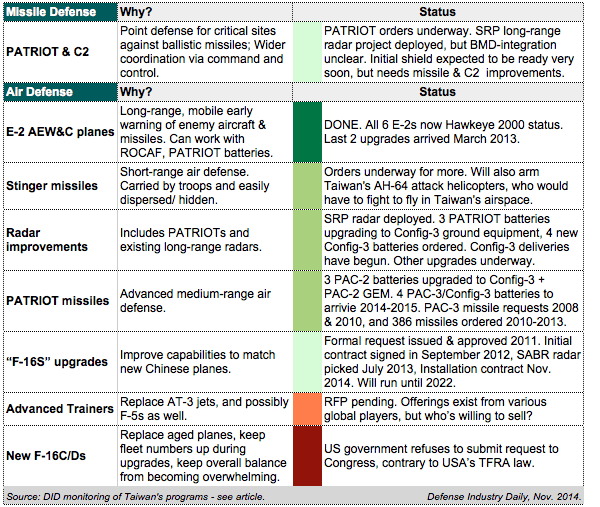
In the modern era, control of the air is the first requirement of effective defense. For an island country, control of the sea, or the ability to deny that control to enemies is equally strategic. Taiwan’s key modernization efforts in both areas remain troubled, which impairs the amount of real deterrence, and security, their military modernization can bring them.
(click to view full)
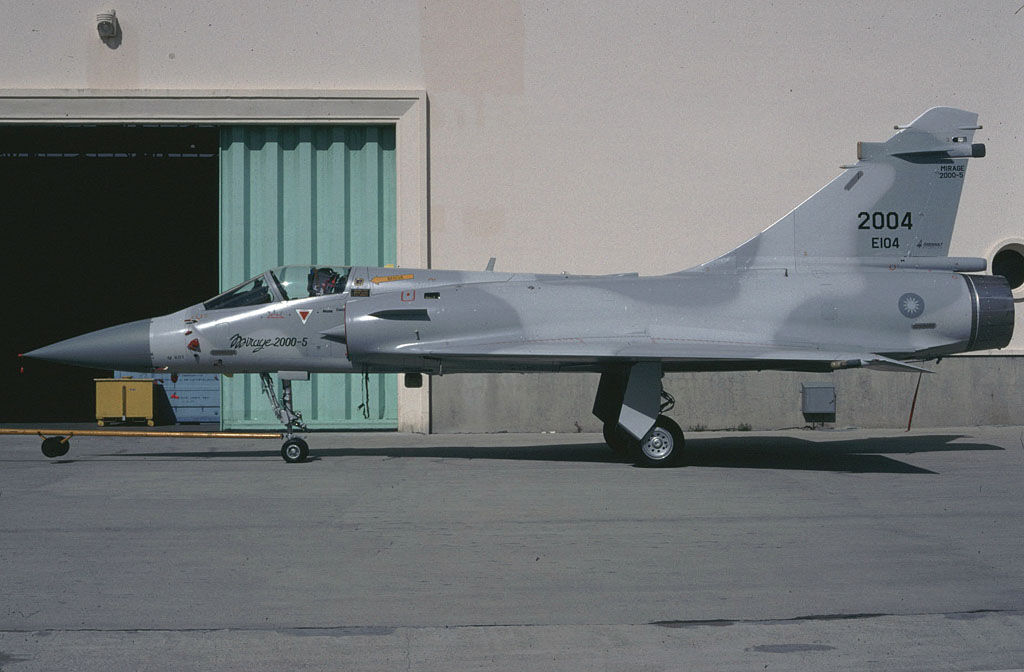
The ultimate issue for Taiwan is one of numbers. In the air, quantity has a quality all its own. Taiwan expects to retire its F-5 and Mirage 2000v5 fighters by 2020. The ROCAF is moving to modernize its old F-16 fighters, but any fighter has a fixed airframe life, measured in flight hours. Modernization is a medium term solution, not a long term one, and does nothing to address the growing numeric imbalance across the strait. Even as US military studies suggest that the USAF and US Navy will find it more and more difficult to fly fighter reinforcements to Taiwan, and keep them in its airspace.
With 24 ROCAF F-16 fighters out of service for upgrades at any point, 16 in the USA for training at Luke AFB, and 30% of the remaining machines (32) unavailable for other maintenance, Taiwan’s fleet of 146 F-16s shrinks to about 74 F-16s in operational service. If equivalent rates hold true for the 71 locally built and upgraded F-CK-1C/Ds, that means about 50 operational Hsiung Ying fighters, for a total available fighter fleet of just 124 machines. Most of which will be 1980s level technology.
Consistent reports indicate that the USA has asked Taiwan to hold off on their request to add 66 new F-16s, in order to avoid a direct “no.” Reports suggest that a strong lobbying effort from China is dooming that effort, even as the PLAAF continues to add aircraft like the 4+ generation J-10, and equally advanced long-range SU-27 family fighters to its arsenal.
The Obama administration confirmed that perception in September 2011, when it opted to approve ROCAF F-16 fleet upgrades, rather than new F-16C/D Block 52 sales. They attempted to thread the needle by offering more advanced technology than the equipment in F-16 Block 52s, which have been sold to countries like China’s ally, Pakistan. The question is whether this is actually a worst-of-all-possible worlds outcome: showing weakness abroad on Taiwan, failing to extend the F-16 production line and American jobs at home, and offering cutting-edge technology that risks falling into the hands of Chinese intelligence.
The USA is also selling Taiwan the newest version of its attack helicopter, the AH-64E Apache Guardian. Its Longbow radar mast allows it to use radar guided, fire and forget missiles, and it also carries Stinger missiles for defense against enemy aircraft. Engine and communications upgrades, including the ability to control UAVs remotely, round out that package. The 30 Apaches would serve alongside Taiwan’s 60+ AH-1W Cobra attack helicopters, as a rapid reaction force able to counterattack beachheads and exploit the hilly island’s natural chokepoints.
Sea Control
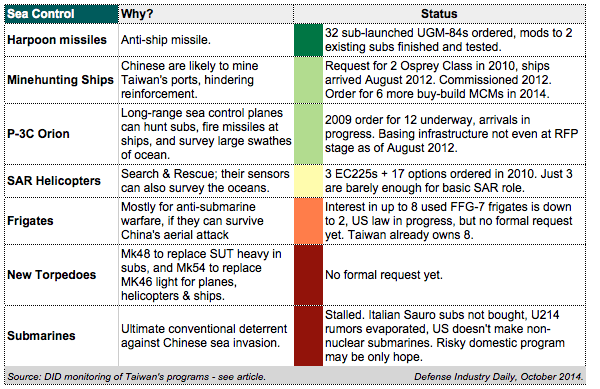
At sea, the situation is simultaneously less overtly perilous, and less hopeful. China’s navy is certainly growing, but is not yet overwhelming. The problem is that without air superiority as cover, no Taiwanese surface navy can expect to survive, in order to maintain control of the seas around Taiwan. Britain faced the same equation in World War 2, and prevailed by winning in the air.
(click to view full)
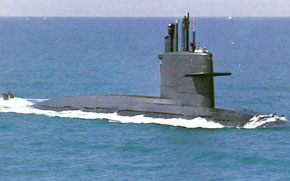
If that isn’t possible, a good submarine force is the classic military solution. Submarines are capable of either destroying efforts to cross the strait, or strangling Chinese trade as it moves through Southeast Asia’s key choke points. Modern missiles give them vastly longer offensive reach, and modern submarines are very difficult to find and target once they put to sea. For a nation like Taiwan, they’re the ultimate conventional deterrent against invasion.
Taiwan’s comprehensive failure to field this trump card stems even more directly from Chinese pressure. The USA approved a sale request in 2001, but they haven’t produced conventionally-powered subs for many decades, and don’t want to be the supplier. Without that option on tap, Chinese diplomacy has utterly strangled Taiwan’s efforts to find a party who is (a) able to make diesel-electric subs; and (b) is willing to sell them to Taiwan. The Republic of China currently relies on 2 submarines that are too old for anything but training missions, and 2 Hai Lung (Sea Dragon) class submarines. The Hai Lungs were ordered from the Dutch firm Rotterdamsche Droogdok Maatschappij (RDM) in 1981, as a derivative of their Zwaardvis (Swordfish) class. A follow-on order for 4 more submarines was blocked by the Dutch government in 1992 thanks to Chinese pressure, and RDM went out of business a few years later.
Since then, Taiwan has explored a number of alternatives to obtain diesel-electric submarines, without success. They are even reportedly considering building their own boats from foreign designs. Australia’s experience suggests that this course may be fraught with peril, and Taiwan has a number of technology gaps to address: ship design technology, torpedoes, sonar, propulsion systems, combat systems, and submarine periscope lenses. On the other hand, if the alternative is no submarines at all, and submarines are one of your most critical national defense needs, the perils of caution may outweigh the risks of inexperience. Taiwan seems determined to face the peril, and a report is expected by June 2014.
Land Defense
(click to view full)
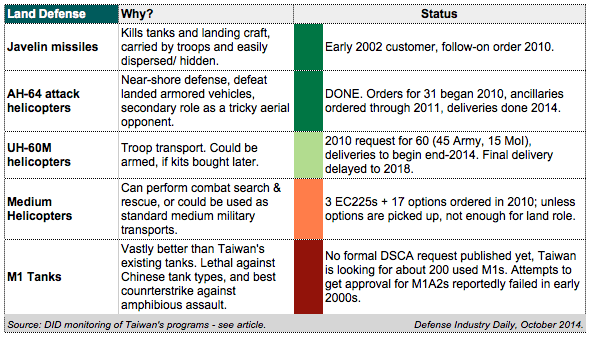
Land defense improvements currently center on portable missiles, mobility, and massed counterattack against amphibious or paradropped beach-heads. The missiles provide dispersed, hard-to-target defenses against enemy aircraft and armored vehicles. Helicopter mobility allows rapid response to enemy airdrops or pre-positioned guerrilla units. Massed counterattack means the heavy armor of tanks, which remain the most important and element for crushing enemy beach-heads.
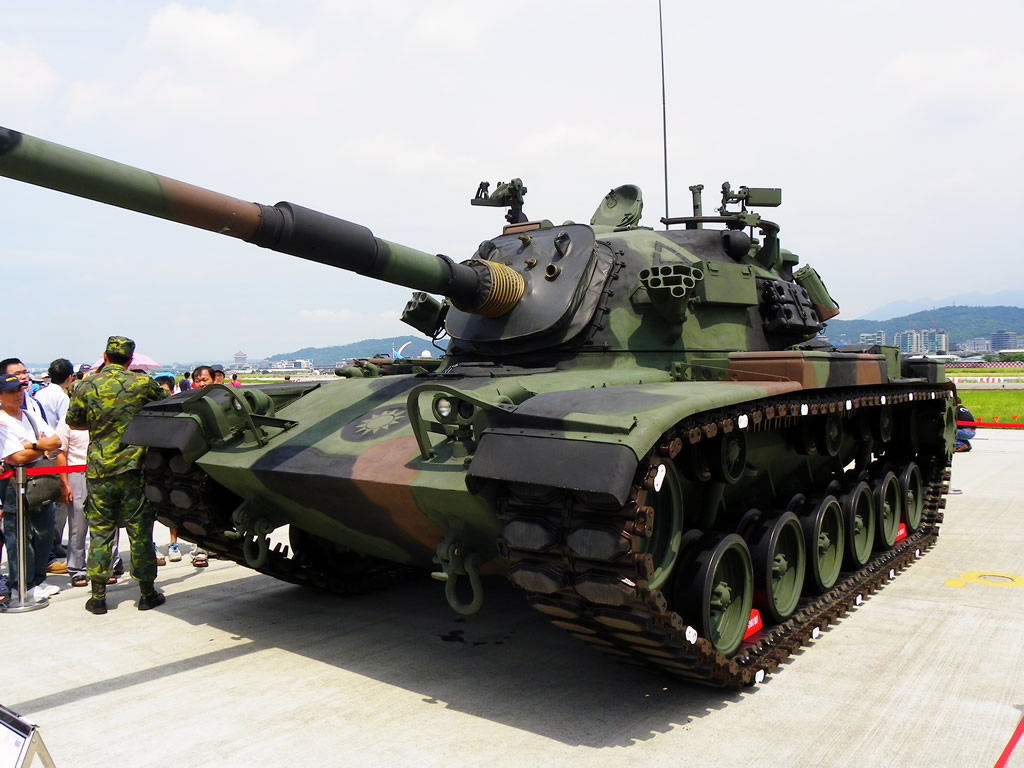
Taiwan’s situation with respect to tanks isn’t very good. The Republic of China Army currently fields about 480 M60A3 tanks acquired in the 1990s, but the M60 first entered US service in 1960, and the A3 version entered US service in the late 1970s. They’re joined by 450 much older CM11s (modified M48H 105mm turrets with improved fire control, mated to M60 hulls), and 300 of the M-48 medium tanks whose base design dates back to the 1950s: 50 M48A3s, and 250 CM12s (modified CM11 turrets mated to M48A3 hulls).
Contracts & Key Events

(click to view full)
This article focuses on foreign imports, and the vast majority come from the USA. The US DSCA references to “the Taipei Economic and Cultural Representative Office in the United States” are diplo-speak for “Taiwan” or “Republic of China”. DID uses the conventional term instead. Note that DSCA requests are not contracts; those are separate announcements, and sometimes years pass between the two events. Having said this, a DSCA request does open the door to contracts as permitted weapons exports through the Foreign Military Sales process, unless Congress moves to block the proposed sale within 30 days.
Note that upgrades to the ROCAF’s locally-designed and built F-CK-1 fighters are covered in a separate article, as an Indigenous Taiwanese program that sits outside this article’s scope.
2014 – 2020

July 27/20: Hai Chien 2 Taiwan’s National Chung-Shan Institute of Science and Technology (NCSIST) is under pressure from the military to complete the Initial Operational Test & Evaluation of its Hai Chien 2 anti-air missile by this year. The Navy wants to start limited production of the missile from March next year so that the Tuo Chiang Class corvettes can have an anti-air capability. Unfortunately for NCSIST, the institute has run into problems integrating the missile with air defense radar. To meet the deadline by next year, it has to start shipborne testing in the next few months. So far, the missile has only been fired at sea once in 2014. Another effort to have the missile fired from the Mk 41 VLS is also delayed as the indigenous Hsun Lien naval combat systems is behind schedule.
November 4/19: C-130H Taiwan will be upgrading the avionics of its C-130H fleet and it is likely that the Rockwell Collins Flight2 system will form the core of the upgrade. National Chung-Shan Institute of Science and Technology will be the project manager and Air Asia plus Canada’s Cascade will be carrying out the upgrades. Taiwan’s Republic of China Air Force has purchased 20 C-130Hs from the United States Air Force. Flight2 is built on architecture compliant with Communications, Navigation, Surveillance and Air Traffic Management Systems (CNS/ATM), supportable and sustainable to meet existing and future aviation mandate requirements.
October 22/19: F-16 Program Back on Track Taiwan’s program to upgrade 142 Republic of China Air Force (RoCAF) F-16A/B fighter aircraft to the latest F-16V configuration is back on track. Defense Minister, Yen Teh-fa told lawmakers that all problems with the Ministry of National Defense’s Phoenix Rising Project, which was launched in 2016 and aims to upgrade 142 ROCAF A/B Fighting Falcon combat aircraft to the F-16V configuration by 2023, have been resolved, the South China Morning Post reports. The program is being carried out by Lockheed Martin and its local partner AIDC, with the first upgraded F-16V aircraft being delivered to the RoCAF in October 2018. First unveiled at the Singapore Airshow in 2012, the F-16V features the Northrop Grumman AN/APG-83 Scalable Agile Beam Radar (SABR) active electronically scanned array (AESA) radar, a new Raytheon mission computer, the Link 16 datalink, modern cockpit displays, an enhanced electronic warfare system, and a ground collision avoidance system.
September 16/19: Taiwan Wants To Move Quickly Taiwan is working quickly to clear the hurdles for the purchase of 66 F-16s from the United States, Bloomberg reports. Local lawmakers are expected to approve a draft bill to create a special budget for the purchase. The bill is likely to be cleared by end of next month. The department on August 20 formally notified the US Congress that it approved the F-16 sale, which includes munitions, defensive electronics and a top-of-the line fire-control radar that would allow precision-guided missiles and bombs to be launched from greater distances. Once the deal is approved by Congress — and there has been no sign it will be blocked — Taiwan must submit a formal Letter of Offer and Acceptance that would be translated into a signed contract with delivery dates.
September 3/19: DB-110 Reconnaissance Pod Variant For F-16 Taiwan plans to buy a new variant of the DB-110 reconnaissance pod for its F-16 fleet. The current pod has no night imaging capability and did not allow Taiwan to photograph Chinese aircraft carrier Liaoning during its night time transit over the Taiwan Strait. According to local reports, the 109th annual budget of the Ministry of National Defense was sent to the Legislative. The Air Force Command plans to purchase long-distance, full-air and day-night surveillance capabilities and real-time image transmission functions in order to meet the difficulties of logistics maintenance and the lack of nighttime surveillance capabilities.
August 19/19: F-16 Sale Reportedly Approved The Trump Administration approved the F-16 fighter jet deal to Taiwan. The deal is worth $8 billion. According to the Washington Post, the move will likely anger China amid the deepening trade dispute between Washington and Beijing. The DoS reportedly submitted the package to Congress for informal review late Thursday, and it is not expected to meet opposition. This would be the largest and most significant sale of weaponry to Taiwan in decades. The State Department has not yet publicly commented on the proposed arms sale to Taiwan. “We are aware of media reports regarding a possible sale of F-16 fighter aircraft to Taiwan,” a State Department official said on August 16. “As a matter of policy, the US government does not comment on or confirm potential or pending arms sales or transfers before they have been formally notified to Congress.”
July 5/19: F-16 Deal Reviewed Lara Seligman from Foreign Policy Magazine reported that Taiwan’s request to buy F-16V jets was expected to move forward this month, but the Ministry of Foreign Affairs yesterday said that the request is still only being reviewed by the US. According to the article, although the deal for 66 F-16 Block 70 jets has been stalled, it is expected to move forward before the US Congress begins its traditional recess next month. The negotiations over price and configuration of the aircraft had led to the deal taking longer than expected, Seligman wrote. However, Taiwan’s request must still be converted into a formal proposal by the US Department of Defense and Department of State, and then Congress officially notified, after which lawmakers would have 30 days to block the sale if they want.
May 27/19: Peace Phoenix Rising Program FMS F-16 The Air Force awarded Lockheed Martin a $16.4 million contract modification to support the Taiwan F-16 Peace Phoenix Rising program. Taiwan kicked off its modernization program at the beginning of the year and called for 144 Lockheed Martin F-16 A/B Fighting Falcon’s to be upgraded under the Taiwan F-16 Peace Phoenix Rising program. The F-16 Fighting Falcon is a single-engine, multi-role fighter jet that is primarily used for air-to-air and air-to-surface missions. The modification provides for miscellaneous support work identified during performance of the in-country aircraft modification program, use and maintenance of product support aircraft, and additional support necessary for the successful completion of modification installs. Lockheed will perform work in Fort Worth, Texas and Taiwan and expects completion by the end of May, 2023.
May 10/19: F-16 Pilots are moving The training ground for the Taiwanese F-16 pilots at Luke Air Force Base in Arizona will be relocated to Tucson International Airport within the next two years. The relocation will cost Taiwan approximately $8 million. Taiwan’s pilots have trained at Luke Air Force Base for more than 20 years since the country purchased the first batch of F-16 fighter jets from the US. The transfer of the 21st Fighter Squadron, where Taiwanese pilots are trained to fly F-16 jets, will begin in 2020, to provide space for new F-35 fighters.
November 3/18: Viper instead of F-35? Taiwan’s air force is hoping that the US approves its requested purchase for new F-16V fighter jets. The air force sees the F-16V as a platform that would increase the country’s air defense capabilities, while also being a cheaper alternative to the costly F-35. Defense Minister Yan Defa minded that the service must evaluate the platform based on its combat strength and supplement capability to the other three aircraft types in service, he also reassured that any proposed platform that meets the operational requirements will be taken into consideration. Taiwan’s main fighter platforms are the F-16, AIDC F-CK-1 known as Indigenous Defense Fighter and the Mirage 2000, all of which are about 20 years old. Past requests for the purchase of 66 F-16C/D fighters were rejected by the US government. As an alternative the US proposed the delivery of F-16Vs which have a comparable performance to the C/D variants. Hong Kong-based military commentator Song Zhongping told the South China Morning Post that ‘the US had considered selling the production lines of its discontinued F-16 and F-18 fighter jets to India, and it was possible it may also sell the F-16 production line to Taiwan’.
October 5/18: Viper incoming The Taiwanese Air Force will soon be able to fly the first batch of upgraded F-16s. The first four planes to be delivered are currently undergoing ground-testing at Taiwan’s state-owned Aerospace Industrial Development Corp. Taiwan is currently in the process of upgrading its fleet of 144 F-16 A/B jets to the Viper configuration. The $3.64 billion program is considered the most important modernization program ever undertaken by the Air Force and significantly enhances its war fighting capabilities. Upgrades in the V-variant include new mission computers, navigation equipment, large color multifunction displays, Advanced Identification Friend or Foe (AIFF) transponders, updated electronic warfare suite, and the Link-16 tactical data link, as well as an AN/APG-83 Scalable Agile Beam Radar (SABR).
September 26/18: Package The US Defense Security Cooperation Agency is green lighting a military sales package to Taiwan. The approved sale is valued at $330 million and provides for the delivery of spare and replenishment parts needed to keep Taiwan’s F-16s, C-130s and F-5s operational. This package is part of a US contribution to Taiwan’s Force Modernization program, aimed at breaking the country’s defense equipment logjam. Taiwan expects to retire its F-5 and Mirage 2000v5 fighters by 2020. To mitigate this decrease in fighter numbers, Taiwan is modernizing its fleet of F-16s, this is however a medium term solution, not a long term one, and does nothing to address the growing numeric imbalance across the strait.
September 10/18: ROCAF budget increase The Taiwanese government plans to significantly boost its F-16 budget. The Ministry of National Defense will need about $4.6 billion to maintain parity between the upgraded F-16s and the Chinese People’s Liberation Army Air Force’s tactical fighters. A large chunk of the budget will be spend on a variety of air-to-air missiles and automated ground collision avoidance systems. The ROCAF has a total of 115 F-16s, of which 24 are out of service for upgrades at any point and 16 are in the USA for training at Luke AFB. By 2023 Taiwan will have an updated fleet of F-16Vs. The latest variant of the fighter jet integrates advanced capabilities as part of an upgrade package to better interoperate with fifth-generation fighters, including the F-35 and the F-22. The Viper can be deployed in suppression of enemy air defense missions, air-to-ground and air-to-air combat, and deep interdiction and maritime interdiction missions.
July 18/18: US FMS The government of Taiwan is set to receive support for its fleet of F-16 fighter aircraft as part of a US foreign military sale. URS Federal Services will provide a maintenance and supply support to meet all of the 21st Fighter Squadron mission objectives under this firm-fixed task order valued at $7.3 million. Taiwan is currently in the middle of a modernization program that seeks to improve the island’s ability to control the sea and deny enemies to take that control. The ultimate issue for Taiwan is one of numbers. In the air, quantity has a quality all its own. The current fighter jet availability is quite low with just 74 out of 146 F-16s considered to be operational. This task order provides safe, efficient and effective maintenance for sortie production of Taiwan’s 14 Block 20 F-16 aircraft for the Taiwan Air Force. Work will be performed at Luke Air Force Base, Arizona, and is expected to be completed by end of July, 2019.
December 29/17: Ground Tests-F-16V USAF test pilots are in Taiwan as part of ground testing of Republic of China Air Force (RCAF) F-16V Viper fighter aircraft modernized by the Aerospace Industrial Development Corp (AIDC). Four models have currently been upgraded to the V standard from their original A/B configuration, with improvements to include new mission computers, navigation equipment, large color multifunction displays, Advanced Identification Friend or Foe (AIFF) transponders, updated electronic warfare suite, and the Link-16 tactical data link, as well as an AN/APG-83 Scalable Agile Beam Radar (SABR). Flight testing is to take place in 2018. Also expected next year, are deliveries of AIM-9X Sidewinder air-to-air missiles, which have an improved seeker head capable of high off-boresight cueing via a helmet mounted display, and are more maneuverable and have more range than existing air-to-air missiles currently in Taipei’s arsenal.
September 05/17: Taiwan has completed integration of the AN/ALQ-131 pods with Digital Radio Frequency Memory (DRFM) technology on its F-16s. The electronic warfare pods are part of a series of upgrades to bring its fleet of F-16A/B aircraft up to the V-model standard, improving the fighters’ air-to-air and air-to-ground surveillance capabilities and combat capability to meet the needs of advanced warfare. However, while Taipei had initially planned to acquire 42 pods from the US at a cost of $160 million, rising development costs had eaten up the budget and Taiwan could only afford to buy 12 pods.
April 11/17: Taiwan is in need of five types of submarine technology for their domestic submarine program, according to local defense analysts. Modern torpedo tubes and periscopes are believed to be some of the tech missing by Taipei, as well as the possible need for air-independent propulsion technology or an equivalent to allow the submarine to be practically silent when operating in a submerged environment. The government has allocated spending of $94.81 million for the program’s design phase, due to run until December 2020, and have already dispatched delegations to find foreign suppliers of the technology it requires. While several nations have established submarine programs, most may shy away from selling such tech to Taiwan for fear of upsetting relations with China.
January 18/17: Taiwan’s military has laid out a timeline for their indigenous advanced jet trainer program, with the aircraft slated to make its flying debut in June 2020. State-owned Aerospace Industrial Development Corporation (AIDC) is currently on a hiring spree, looking to recruit additional engineers in order to get blueprints completed by the middle of this year. Taipei expects to have a working prototype rolled out by September 2019 and into production by 2021. AIDC has also begun work on the Republic of China Air Force’s F-16V upgrade program. Under the Phoenix Rising Project, the team will upgrade Taiwan’s F-16A/B fleet by 2023.
September 2/16: Sikorsky is to produce and deliver 24 UH-60M Black Hawk helicopters to Taiwan. The $135 million sale will see the aircraft uniquely configured for the Taiwanese government with delivery by October 2018. This follows a recent $158 million contract modification to produce 14 more Black Hawks for the US Army.
April 20/16: Taiwan is currently embarking on a project to develop its own indigenous fighter engine. Work is being undertaken by the country’s National Chung-Shan Institute of Science and Technology (NCSIST) and is seen as part of the incoming Democratic Progressive Party’s (DPP) push to prioritize Taiwan’s defense industry. The engines are being developed for locally produced jets such as the Indigenous Defense Fighter (IDF) and AT-3 trainers. While about 90% of the IDF and AT-3 are produced in Taiwan, some key technologies such as its engine is built in cooperation with foreign companies before the plane is assembled domestically.
March 3/16: Taiwan’s new government is keen on developing their own indigenous jet trainer aircraft to replace its AT-3s. The military fears however, that the Aerospace Industrial Development Corporation (AIDC) lacks the skills necessary for the development, alongside Taiwan’s inability to manufacture its own engines. The military may instead prefer the acquisition of the Alenia Aermacchi M346, with the AIDC participating in a 20% workshare of the project.
July 21/15: Lockheed Martin and Alenia Aermacchi have both responded to a Request for Information for Taiwan’s advanced jet trainer, according to Taiwanese media [Chinese]. The US company is expected to offer the T-50 Golden Eagle aircraft, in conjunction with South Korea’s Korea Aerospace Industries (KAI), whilst the Italian firm will likely push the M-346 AJT. Taiwan’s defense ministry is expected to make a decision regarding the purchase of new trainers to replace the current fleet of F-5E/F and AT-3 aircraft next year, with the winning aircraft design likely to be assembled in Taiwan by Aerospace Industrial Development Corp.
Dec 09/14: Frigates. Taiwan has a NT$5.5 billion ($176M) budget approved and ready to acquire 2 Perry-class frigates whose sale is well on its way to finally be approved by the US, after years of stalling (q.v. Sept 10/14). The US Senate approved S. 1683 on December 4, and since a similar bill (HR. 3470) had already been passed by the House in April, a reconciled law should be on the President’s desk soon.
China is not happy, but they’re making a lot of fuss for 2-4 weaponless ships that the US Navy gave up upgrading and Australia found tough to modernize.
Sources: Reuters: “Taiwan says to buy two U.S. frigates despite China anger” | Xinhua: “China firmly opposes US arms sale to Taiwan“.
[youtube:v=ABVIcKWflmA]
Nov 3/14: Lockheed Martin in Fort Worth, TX receives a $271.8 million firm-fixed-price modification to install 142 F-16S aircraft upgrade kits. The total cost is, of course, much larger, since the kits must also be bought – which is at least a $1.85 billion proposition (q.v. Oct 1/12). Work will be performed in Taiwan, and is expected to be complete by May 31/22.
This award is the result of a sole-source acquisition. The USAF’s Life Cycle Management Center, Wright-Patterson Air Force Base, Ohio, is the contracting activity (FA8615-12-C-6016, PO 0006).
F-16 upgrade installation
Oct 29/14: UH-60M. A Taiwanese Army official tells a legislative committee that UH-60Ms will begin to arrive soon, with the first 6 to arrive in mid-December 2014, and the rest of the 60 arriving in 6 more batches into 2018. Of the 60 UH-60Ms, 45 will be used by the Army, and the other 15 will be used for disaster relief by the Ministry of the Interior’s National Airborne Service Corps.
In other news, the 2 pilots who crashed their AH-64 onto a city roof are “still undergoing a series of flight tests before they can resume training missions.” Could be a while, guys. On the P-3 front, a flight simulation system has recently become operational in Taiwan to help train people for the sea control plane. Sources: Focus Taiwan, “Taiwan to take delivery of first batch of Black Hawks in December”.
UH-60 contract schedule
Oct 28/14: Minehunters. Italy’s Intermarine S.p.A. and Lockheed Martin win a contract to support local construction of 6 mine countermeasures vessels (q.v. Sept 5/12), which will be built at a brand-new Ching Fu Shipbuilding facility in Kaohsiung, Taiwan. The ships are expected to be about 52m long and 700t.
Intermarine will build the 1st hull at its shipyard near La Spezia, Italy, but Ching Fu will finish it and build the remaining 5 ships. Lockheed Martin’s role is focused on the combat system. Sources: Intermarine SpA, “Mine Countermeasure Vessels” | Defense News, “New Spanish Frigate Detailed, Deal for Taiwan Minesweepers Announced”.
6 minehunters
Oct 23/14: Jet Trainers. Defense Minister Yen Ming says that Taiwan wants to buy advanced trainers. Right now, the progression out of basic flight training goes from T-34 turboprops, to the AT-3 jet trainer, to the supersonic F-5E/F as a Lead-In Fighter Trainer. The T-34s will remain for now, but the AT-3s and F-5E/Fs would be retired.
The announcement comes right after a dual-crash of AT-3 jet trainers during a routine aerobatic training mission in Kaohsiung, southern Taiwan. Lt. Col. Chuang Pei-yuan was killed.
The question is which trainer will be available to Taiwan, given the likelihood of Chinese counter-pressure. The big 4 are Britain’s Hawks, Italy’s M-346 Master, Korea Aerospace/ Lockheed’s supersonic T-50 Golden Eagle family, and Russia’s Yak-130. Beyond, Czech firm Aero is releasing new L-159T and L-169 trainers, which can perform the same air policing and light attack roles as the Hawks, Yaks, and Golden Eagles; and Boeing & Saab are supposedly working on their own jet trainer offering. Since even Boeing & Lockheed have international partners, which of these countries will have the fortitude and willingness to offer them to Taiwan?
On the other hand, if Taiwan moves some of its indigenous F-CK-1 fighters into the F-5F’s LIFT role, their advanced AT-3 trainer replacement options would expand to include Brazil’s Super Tucano, Swiss Pilatus trainers, and Beechcraft’s T-6 family from the USA. Sources: Focus Taiwan, “Taiwan set to purchase advanced trainers in 2017: defense minister”.
Oct 19/14: Submarines. The Taiwanese submarine Hai Hu (Sea Tiger) launches a pair of UGM-84 Harpoon missiles, demonstrating a successful upgrade that vastly increases the submarine’s reach to over 100 nautical miles. Taiwan now employs all 3 types of Harpoon missile, launched from its frigates, F-16s, and submarines. Sources: Agence France Presse, “Taiwan tests submarine-launched missiles: report”.
Subs: Harpoon capability
Oct 19/14: AH-64E. Taiwan receives the last 6 helicopters, completing delivery of the 30 it ordered under the TWD 59.31 billion ($1.95 billion) contract. It now has 29 available for service (q.v. April 25/14). Sources: Focus Taiwan, “Taiwan takes final delivery of Apache helicopters”.
A-64Es all delivered
Oct 14/14: PATRIOT. Lockheed Martin Missiles and Fire Control in Grand Prairie, TX receives a $595.5 million foreign military sales contract modification, covering FY 2014 production for Kuwait, Taiwan, Qatar, and the UAE. They’re selling 152 PAC-3 cost reduction initiative missiles, 15 PAC-3 launcher modification kits, and the associated ground equipment, tooling, and initial spares. $543 million is committed immediately.
The PAC-3 CRI missile was used as the base for the PAC-3 MSE missile, but the MSE missile also added a number of new technologies, and changed the missile’s structure. In contrast, PAC-3 CRI missiles offer PAC-3 performance at a slightly lower cost.
Work will be performed in Grand Prairie, Lufkin, and El Paso, TX; Camden, AR; Chelmsford, MA; Ocala, FL; Huntsville, AL; and Anaheim, CA; and will continue until May 31/16. Army Contracting Command in Redstone Arsenal, AL (W31P4Q-14-C-0034, PO 0008).
PAC-3 missiles: Kuwait, Qatar, Taiwan, UAE
Sept 10/14: Frigates. Taiwan won’t get its 2 Oliver Hazard Perry Class frigates (q.v. Aug 5/10, April 22/12, Nov 13/13) on schedule, because the US Senate can’t be bothered to authorize the sale. That will keep 2 aging Know Class frigates in continued service until 2016. The Chinese-language United Daily News reported Tuesday that the frigates were expected to be delivered in 2016, under a project budgeted at NTD 5.56 billion ($185.42 million) in total.
Note that the frigates being decommissioned by the USA had all major weapons removed long ago, making them essentially large Coast Guard cutters with sonar and torpedoes. Source: Taiwan’s Want China Times, “Delivery of US Perry-class frigates to Taiwan could be delayed”.
Sept 10/14: Submarines. US CNO Admiral Jonathan Greenert confirmed that he had a conversation with Taiwanese officials during a recent visit, covering the sale or provision of submarines to Taiwan. Neither he nor the Taiwanese would talk about the content of that conversation.
The best case scenario would involve the USA transferring a few key technologies like periscope lenses, torpedoes, and combat systems, albeit at technology levels that don’t surpass what they believe China to have. That way, stolen technologies wouldn’t matter. The worst case scenario is that the issue was discussed, and Greenert explained why no help is likely.
The event was held by the Carnegie Endowment for International Peace, and focused on the US’s Asia Pacific rebalancing strategy. Sources: Taiwan’s Want China Times, “US chief of naval operation discusses sub deal with Taiwan”.
Sept 2/14: P-3Cs. Weapons for Taiwan’s P-3Cs become an issue:
“The Chinese-language China Times yesterday cited a recent report by the Control Yuan’s National Audit Office as saying that…. 12 P-3C Orion maritime surveillance aircraft from the US cost US$1.96 billion and are under the operational command of the Air Force 439 Composite Wing unit…. [but] the US disagreed with a plan to have the aircraft carry ordinances, such as mines and depth charges, made by Taiwanese manufacturers.”
Taiwan’s P-3s can carry Harpoon anti-ship missiles, but they really need modern torpedoes in order to engage enemy submarines successfully. Depth charges can be used against submarines, but their limit of 50m handicaps them. Meanwhile, mines would turn them into a potent blocking force if they can survive long enough over the Taiwan Strait. Taiwan has American Mk-46 lightweight torpedoes available for use aboard its destroyers and frigates, but until the P-3s are ready and able to deploy their own torpedoes, CNA News quotes a ROCAF commander who says that submarine contracts from Taiwan’s P-3s would be passed on a nearby ship. If there is one.
Aug 30/14: Tien Kung. Lin Yu-fang of the parliament’s defense committee says that Taiwan plans to spend TWD 74.8 billion (about $2.5 billion) from 2015 – 2024, buying the locally-made Tien Kung 3 (Sky Bow 3) medium range air defense missile system to replace the aging Hawk batteries, and defend the island against aircraft and cruise missiles.
That will make the Tien Kung 3 Taiwan’s lower-tier air defense counterpart to its new PATRIOT missiles, but the country denies that the Tien Kung 3 will be used to equip its 10,500t, American-built Kee Lung (Kidd) Class destroyers. Those ships will continue to rely on Raytheon’s SM-2 missiles for protection. Sources: Defense News, “Taiwan to spend $2.5 billion on anti-missile systems” | Taiwan’s Want China Times, “Taiwan denies Tien Kung missiles to be deployed on destroyers”.
Aug 20/14: AH-64E. Deliveries are a bit delayed. Taiwan is set to take delivery of 6 more AH-64E Apache attack helicopters in late August, which would bring their fleet to 23. This batch was supposed to arrive in May, and the delay is reportedly due to shipping issues. The final batch is now expected in October. Sources: Focus Taiwan, “Taiwan set to take August delivery of more Apache helicopters”.
Aug 20/14: F-16S: Lockheed Martin announces a successful Critical Design Review for integration of Northrop Grumman’s SABR radar in an F-16 (q.v. July 31/13). The SABR AESA radar will equip Taiwan’s F-16S upgrade, as well as Lockheed Martin’s global F-16V offering. Lockheed Martin is now describing Taiwan as the F-16V’s launch customer. Sources: Lockheed Martin, “F-16V Completes Major Capability Milestone”.
Aug 11-12/14: Fighters, incl. F-35B? Taiwan’s MND reaffirms its continued interest in F-16C/D or better fighters, while openly stating their goal to acquire F-35s at some point:
“Ministry of National Defense spokesman Maj. Gen. Luo Shou-he said Taiwan’s Air Force is ideally looking for aircraft with short-take off and vertical-landing capabilities and acknowledged that “it is our goal to acquire F-35s.” He admitted that it would be nearly impossible to obtain the fighters in the short term, “but we will continue to make effort on this issue.”
That seems to point clearly to F-35Bs, which make excellent sense when facing an opponent with thousands of runway-damaging ballistic missiles. The MND also denied China Times reports that the Mirage 2000-5 fleet was had maintenance issues because the French weren’t cooperating, leading to cannibalization of existing fighters. The MND said the fighters were being well-maintained by the French – the question is how much credence to give that assertion. Sources: Focus Taiwan, “Taiwan to seek U.S. sales of more advanced fighter jets: official” and “F-16C/D jet fighters still a consideration: Defense Ministry”.
July 15/14: Crash investigation. The AH-64E crash (q.v. April 25/14) is ruled as pilot error:
“The investigation report shows that the primary causes of the accident were the combination factors of human errors and environment,” Maj. Gen. Huang Kuo-ming told reporters.
The environment refers to fast descending clouds, which disoriented the pilots while they were flying at a low altitude. Still, they should have checked the instruments to maintain adequate height. Taiwan has received 18 of their 30 helicopters, though they only have 17 now. Sources: Defense News, “Pilots Blamed for Taiwan Apache Crash”.
June 3/14: Submarines. ROC Ministry of National Defense (MND) Navy Command Headquarters has confirmed that Taiwan will try to replace part of the pressure hull on one of its existing Tench/ Guppy-II Class submarines. The boats were modernized to Guppy II standards in 1949, and transferred to Taiwan without torpedo systems in 1973, for use in anti-submarine training. Once in Taiwan, they were renamed SS-791 Hai Shih (ex-Cutlass) and SS-792 Hai Pao (ex-Tusk). Attempts to restore their torpedo firing capability reportedly failed, leaving them as surveillance and training vessels only.
The first problem is that they’re the world’s oldest serving submarines. While their core diving mechanism is simple and reliable, their continued safety under the compressing water pressure of a dive is a concern. MND has said that China Shipbuilding Corp (CSBC) and the Ship and Ocean Industries Research and Development Center (SOIC) have been appointed to oversee replacement of SS-791 Hai Shih’s lower pressure hull, in an TWD 450 million (about $15 million) program that will take place at a Navy Maintenance Command dry dock. Some old piping may also be replaced.
SS-791’s problem is the entire pressure hull, and its external hull would still be 70 years old after the replacement. A mistake would kill the boat, and even success may not leave Taiwan with an operational training submarine. But perhaps that isn’t the point. This is a good initial step, if the goal is moving CSBC and SOIC toward the capabilities they need to build a design provided by the USA, or to lead a local project to reverse-engineer and build a new submarine. If an unsafe submarine is sacrificed in the process, that may be seen as an acceptable “last hurrah.” Sources: China Post, “Old Taiwanese submarine to get new pressure hull: MND” | Taipei Times 2007, “Feature: World’s longest-serving sub feted” | San Francisco Maritime National Park Association, “Museum documents an operating US, WW II built submarine in Taiwan”.
[youtube:v=wh7ZpOFe-3g]
April 25/14: Crash. During a training exercise, a Taiwanese AH-64E crash-lands on the roof of a low-rise residential building in Taoyuan county. Guys, that’s not what we were supposed to be training today.
The Helicopter is a complete wreck, but the pilots suffer only minor injuries, and no residents are hurt. Sources: The Daily Mail, “How did they get out alive? Lucky escape for pilots of Apache attack helicopter after it crashes into a housing block in Taiwan” | South China Morning Post, “Two Taiwan pilots injured as Apache chopper crashes into building”.
AH-64E crash
April 10-14/14: Frigates. The US House of Representatives passes HR.3470, a bill authorizing the sale of 4 decommissioned US frigates to Taiwan. It also officially reaffirms US support for the Taiwan Relations Act, which has lately found itself honored mostly in the breach. The bill was passed by voice vote, so there are no exact totals. The next step is consideration by the US Senate, which requires cooperation from Senate Foreign Relations committee chair Bob Menendez [D-NJ].
Success would bypass the State Department’s DSCA and make the USS Taylor [FFG-50], USS Gary [FFG-51], USS Carr [FFG-52], and USS Elrod [FFG-55] available to Taiwan, though Defense Minister Yen Ming has said that Taiwan would only buy 2. Taiwan would also have to add weapons back if they want anti-aircraft or anti-ship capabilities. The frigates have some residual value as anti-submarine platform without that, but Chinese control of the air and prominent use of missile attack craft would give them very short lifespans unless these capabilities are restored in some way. Taiwan was happy for the gesture, while China followed with predictable staged theatrics. Sources: GovTrack on HR 3470 | The Diplomat, “US House Approves Frigate Sale to Taiwan” | Focus Taiwan, “Taiwan planning to buy two warships from U.S.: defense minister” | Reuters, “China angered by latest U.S. arms sale plan for Taiwan” | Taiwan Ministry of Foreign Affairs [in Chinese].
April 5/14: F-16. A CNA report says that the ROCAF will begin the process of upgrading its F-16 fleet in the second half of 2016, after the initial jets that are in the USA for compatibility testing etc. are finished. They don’t have an end date for the conversions yet. Sources: Taiwan’s Want China Times, “Taiwan air force to start upgrading F-16s from 2016”.
April 4/14: Submarines. So, good news?
“Minister of National Defense Yen Ming told a legislative committee that the United States “is willing to help us build the submarines together.”
The question is, what does that actually mean? the US hasn’t disavowed helping Taiwan acquire submarines over the past 8 years, they just haven’t done anything. Sources: Kyodo News International, “Washington agrees to help Taiwan build attack submarines”.
Feb 5/14: P-3s. Despite problems with the flight control systems in some recent deliveries (q.v. Jan 2/14), the ROCAF says that their overall delivery timetable will not be delayed, and could even be ahead of schedule. Sources: FOCUS Taiwan, “U.S. delivery of P-3C aircraft to Taiwan on schedule: military”.
Jan 27/14: F-16s. There are rumors that the USAF will remove the The Combat Avionics Programmed Extension Suite (CAPES) program from the 2015 budget request, in favor of a general F-16 service-life extension program (SLEP). We’ll know more in early March 2014. Taiwan was already complaining about having to pay most of the integration costs for the new configuration, but a USAF pullout would raise prices again. With the economy going soft, that could become a problem.
One option would be to make a troublesome switch from riding the USAF’s coat-tails and adopt the South Korean model for a BAE-led upgrade, which will integrate a different set of avionics that includes Raytheon’s RACR AESA radar instead of Northrop Grumman’s SABR AESA. Unfortunately, South Korea is still in the study phase, so even the ROKAF couldn’t tell Taiwan what’s involved in a switch. Singapore has also formally requested upgrades to its F-16 fleet, but the RSAF doesn’t seem to have decided on their exact configuration either, and their use of Israeli technology in some areas could be hard to duplicate.
Unless NGC strongly believes that Singapore will pick their SABR radar over Raytheon’s RACR, they’re the contractor with the most to lose if Taiwan’s upgrade fails. Can they deploy enough lobbying resources to keep CAPES, and hence their confirmed foothold in F-16 radar replacement? Stay tuned. Sources: Defense News, “F-16 Upgrade Dropped From US Budget Proposal, Sources Say”.
Jan 22/14: AH-64E. The China Post reports:
“The Army Aviation Special Forces Command yesterday said the grounding of the Apaches is set to be lifted in mid-February following the six-day Chinese New Year holiday that runs from Jan. 31 to Feb. 4, once they replace the main transmission boxes. So far, the command has received several batches of new main transmission boxes and has installed them in half of the 12 AH-64E Apache attack helicopters.”
A subsequent report moves that date back a bit. The groundings will be lifted during the week of Feb 10/14. Sources: Taiwan’s China Post, “Army to lift grounding order on Apache helicopters after CNY” | “Grounding order for Apache helicopters to be lifted next week”.
Jan 21/14: Size cuts. Taiwan’s Defence Minister Yen Ming (KMT Party) proposes to cut Taiwan’s military by 20%+, from a current size of 215,000 to 170,000 – 190,000. There doesn’t seem to be a firm plan, only vague statements that cuts would take place across all 3 services, “in stages contingent upon the government’s budgets, the acquisition of new weapons and demographic changes.”
The news report touts it as “the latest sign of warming ties with former rival China”, which would cast this as a foolish move. Before jumping on that, however, we’d refer readers to the demographic reference. There has been a small widening at the very bottom of Taiwan’s population pyramid lately, but the proportion of children aged 0-14 has dropped from a 1990 census of 26.9% to 15.65% in 2010. If you’re trying to recruit a military, that matters. As StrategyPage recently noted:
“Some Taiwanese politicians, desperate to find volunteers for the military have proposed that the descendants of Chinese soldiers who fled to northern Burma and Thailand after the communists won the Chinese Civil War in 1949, be granted Taiwanese citizenship if they join the Taiwanese Army…. Taiwan, like many other nations during the last two decades, is finding that moving from conscription to an all-volunteer military is not easy. For two years now the military has been only able to recruit 30 percent of the soldiers it needs to be all-volunteer by 2014.”
This issue isn’t specific to American equipment, of course, but it will affect those buys. Recruitment shortfalls usually indicate that the high-end of the recruiting pool is suffering the most – exactly the people who will be needed to operate and maintain advanced new equipment. Sources: Channel NewsAsia, “Taiwan to slash armed forces by up to 20 percent” | StrategyPage, “Attrition: Taiwan Wants To Recruit From The Lost Army”.
Jan 2/14: P-3Cs. Taiwan’s 2nd P-3C sea control aircraft arrived on Dec 12/13, but 2 more were still hung up in Guam by a malfunction in the flight control system. P-3C #3 received a fix and arrived on Dec 17/13, but #4 is still waiting in Guam as of this date.
Why the delay? No P-3C supply facility at the military base in Guam, and U.S. personnel on Christmas vacation. At least Taiwan isn’t paying for the repairs; since that’s true, we can also expect corrective action within the refurbishment process. The rest of the 2013 – 2015 delivery schedule remains intact (q.v. Oct 31/13), but Taiwan’s 40 year old fleet of 11 twin-engine S-2T Trackers won’t formally retire until 2017. Focus Taiwan, “Malfunction delays U.S. delivery of P-3C aircraft to Taiwan”.
Jan 2/13: AH-64Es. A 2nd batch of 6 attack helicopters arrives, but none of the new helicopters are cleared for flight yet. Taiwan has checked its own AH-64Es and found no obvious problems, but they’re still waiting for the US Army report that will clarify why the US AH-64E’s main transmission failed in December. Training will take place in simulators until then.
AH-64Es #13-18 will arrive in March 2014, #19-24 will arrive in May 2014, and #25-30 will arrive in July 2014. Sources: Focus Taiwan, “Taiwan to receive six more Apache choppers Thursday”.
2013
Long-range radar ready; National programs to develop a new fighter and a submarine gain traction; The real American problem with submarines for Taiwan.
[youtube:http://www.youtube.com/watch?v=vpz18HrHjZY]
click for video
Dec 17/13: AH-64Es. Taiwan’s Army is notified of a main transmission failure in a US Army AH-64E attack helicopter. They respond by grounding all 6 Apache helicopters, pending a full investigation by the U.S. into the cause of the malfunction. Sources: Defense News, “Taiwan Grounds New US-Made Apache Helos Over Malfunction Fears” | Focus Taiwan, “Taiwan to receive six more Apache choppers Thursday”
AH-64Es grounded
Dec 17/13: BMD Radar. Raytheon IDS in Sudbury, MA, has been awarded a $6.9 million cost-plus-fixed-fee, firm-fixed-price, cost-reimbursement contract modification to create a testing environment related to the Taiwan Surveillance Radar program. The TSR is a huge, fixed radar installation based on an improved version of the PAVE PAWS system, used to track ballistic missiles thousands of kilometers away. Taiwan reportedly shares its data with the USA.
The technical term for this contract is “follow-on support string upgrade engineering change proposal.” In English, they’ll create a controlled site-like testing environment in the USA to test modifications, and perform system troubleshooting. You certainly don’t want to use the main radar for that. Work will be performed in Sudbury, MA and is expected to be complete by Nov 8/17. The USAF Life Cycle Management Center/HBNA at Hanscom AFB, MA manages the contract (FA8730-13-C-0003, PO 0005). The same contract was also posted on Dec 13/13.
Dec 9/13: Submarines. Taiwan’s United Daily News reports that defense minister Yen Ming and Navy Command Headquarters chief Adm. Chen Yung-kang are strong supporters of a made-in-Taiwan submarine program. Partisan wrangling over the USA’s request for a NT$ 10 billion “contract design fee” (about $340 million) is generally seen as the key obstacle to progress on the 2001 sale approval, but the report also cites:
“…the U.S. Navy’s reluctance to build diesel-electric submarines at a U.S. shipyard because it fears that Congress would ask it to buy the conventional submarines to save money if an American shipyard had the capability to build such a ship.”
Taiwan’s shipbuilding industry association is scheduled to come up with a comprehensive assessment report by June 2014, and the military is reportedly doing its own due diligence in parallel. This won’t be easy. Taiwan would need to update its ship design technology, and would neither either considerable help or external sources for torpedoes, sonar, propulsion systems, combat systems, and submarine periscope lenses. Sources: FOCUS Taiwan, “Talk of the Day — Taiwan thinking of building its own submarines”.
Nov 13/13: On the list. Submarines remain high on Taiwan’s agenda, but they aren’t the only items. The ROCN will replace 2 of its FF-1052 Knox Class anti-submarine frigates in 2014, using 2 refurbished FFG-7 Oliver Hazard Perry Class frigates. The rest may be replaced with local catamaran corvettes that have more of a surface warfare bent. The ROCN also seem to like the new minehunters, as they reportedly want to build some local MCM ships based loosely on their 2 new Ospreys. That’s a smart decision, and feasible for smaller shipyards.
Taiwan’s Marines reportedly want to buy another 48 AAV-7 amphibious personnel carriers, bringing their total fleet to 102 and allowing them to retire their ancient LVTP-5A1s.
The Air Force would like precision strike weapons, but if they’re thinking in terms of JDAM-type weapons, that won’t help them get inside Chinese air defenses. They’ll probably need to use their own weapons for that, and JDAMs are approved for export but the Air Force has delayed the purchase until 2014 or later. The ROCAF plans to go outside the USA entirely for its new jet trainer, but replacements for the AIDC AT-3 Tzu Chung have been canceled before. The last AT-3 was delivered in 1990, but South Korea’s T-50 family is reportedly quite tempting. China has been antagonizing South Korea lately, and a TA-50 sale would also provide Taiwan with a local interceptor and light attack jet. Sources: Defense News, “Taiwan Still Hungry for More US Arms”.
Nov 4/13: AH-64. Taiwan’s first 6 AH-64E attack helicopters have been re-assembled in Taiwan’s Kaohsiung Harbor, after arriving by ship. Four were flown to the Aviation and Special Forces Command in Tainan’s Guiren Township for initial flight testing, and the other 2 will arrive as part of the official ceremony on Nov 7/13. The US reportedly asked Taiwan’s military authorities not to reveal the AH-64E’s cockpit layout or configuration in its public display. If only it were that easy (q.v. Oct 28/13).
The helicopters will become operational in April 2014, with Guiren Air Force Base in Tainan serving as a training and basing focal point. More than 60 Taiwanese pilots and maintenance personnel returned to Taiwan in August 2013, after completed 20 months of training in the USA that will let them act as instructors. Still, there were limits, which echoed circumstances surrounding the delivery of Taiwan’s AH-1W Cobras over a decade ago:
“While Taiwanese pilots and maintenance personnel managed to get a full understanding of the aircraft software and hardware, the pilots were unable to obtain training in certain special flight skills. The Taiwanese trainees were asked to leave the classroom or training site whenever the American instructors were giving lectures on certain critical courses or special flight maneuvers, the officials said.”
They’ll have to figure those out on their own. A 2nd batch of Apache helicopters is scheduled for delivery in late December 2013, and 3 more batches of 6 will complete deliveries by the end of 2014. Sources: Focus Taiwan, “Taiwan takes delivery of first Apache choppers” | Focus Taiwan, “Talk of the Day — AH-64E Apache choppers debut in Taiwan” | Flight International, “Taiwan receives first batch of AH-64E Apaches” | Focus Taiwan, “Apache choppers to bolster Taiwan’s combat capability: expert”.
AH-64Es arrive
Oct 31/13: P-3Cs. President Ma Ying-jeou yesterday touted the P-3’s capabilities, during an official ceremony at Pingtung Air Base. The delivery schedule is supposed to fly in planes #2-4 by the end of 2013, planes #5-9 in 2014, and #10-12 in 2015, when the full P-3 squadron will be commissioned. Taiwan’s aged S-2Ts are scheduled to be decommissioned by 2017. Sources: Taipei Times, “President hails P-3C patrol aircraft”.
Oct 26/13: Espionage. Taiwan’s MND announces that a Major and 12 other officers are under investigation for selling details concerning Taiwan’s upgraded E-2C 2000 (aka. E-2K) AEW&C air surveillance planes. The last 2 planes only arrived in Taiwan on March 8/13.
E-2Ks aren’t the most modern version, but they are the most widespread type in the US Navy, so compromising their radar system or battle management system is a problem for the US Navy, as well as for Taiwan. National Party Rep. Ting Shou-chung acknowledged to Voice of America that this kind of leak could make the USA more reluctant to share advanced technology with Taiwan, but basically, it’s too late to fix the damage. Poor security has been a problem in Taiwan for some time now (q.v. Additional Readings). Even so, recent years have seen authorization and delivery of the USA’s most modern attack helicopters (AH-64E) and air defense missiles (PATRIOT PAC-3), a large ballistic missile defense radar, and some of America’s most modern AESA fighter radar technology for Taiwan’s F-16s. More significant technologies aren’t likely to be available to Taiwan anyway, the USA can’t take back what’s already given, and it’s more than unlikely that the USA would derail existing contracts. Sources: MND announcement [in Chinese] | Epoch Times, “Taiwanese Major Sells Military Secrets to China”.
Espionage: Hawkeye 2000 compromised
Sept 23/13: P-3Cs. Taiwan will be receiving its first P-3Cs at Pingtung AB within the next day or two, depending on Typhoon Usagi’s progress and course. Four of the 12 planes are expected by the end of 2013.
Subsequent reports indicate that the plane arrived on Sept 25/13. Sources: Taipei Times, “P-3C maritime patrol aircraft to arrive in Taiwan”.
Aug 8/13: AH-64E. Boeing in Mesa, AZ receives a $92.3 million firm-fixed-price contract modification, as part of Taiwan’s AH-64E buy and associated support. The Pentagon says that this brings the cumulative total face value of this contract to $716.7 million. The original DSCA request, including 30 helicopters, weapons and 6 years of support, had a maximum of $2.532 billion (q.v. Oct 3/08).
FY 2009 procurement funds are being used, which was the year Taiwan placed the order. US Army Contracting Command in Redstone Arsenal, AL acts as Taiwan’s agent (W58RGZ-09-C-0147, PO 0025).
[youtube:v=JZnrtB9rRT8]
click for video
July 31/13: F-16s. Raytheon’s RACR AESA may have won the South Korean F-16 upgrade contract, but refits for Taiwan and the US military will use Northrop Grumman’s SABR instead. It will also become the standard radar for Lockheed Martin’s “F-16V” new-build/ upgrade offering, replacing Northrop Grumman’s own APG-80 AESA used in the F-16E/F.
The Taiwanese deal still needs a firm radar contract, but this is a 10-figure combined opportunity. It’s a huge win for Northrop Grumman, whose AESA radars also equip USAF F-22A (APG-77) and global F-35 family (APG-81) fighters. Northrop Grumman.
SABR AESA radar picked
July 28/13: Submarines. US Under Secretary of Defense James Miller responds to Rep. Robert Andrews’ [D-NJ] letter by repeating what we already know. Taiwan’s government approved full funding for an American study re: diesel submarine design and feasibility in 2008, but the State Department and Pentagon still haven’t agreed to conduct one.
He adds, disingenuously, that “Taiwan has not submitted any requests for technical assistance or export licensing support pertaining to a submarine program.” First, the State Department’s DSCA would have to allow such a request to go forward to the Pentagon. Second, export licensing support and technical assistance would have their parameters defined by a feasibility study. Taipei Times.
May 14/13: Support. Bell Helicopter Textron Inc. in Hurst, TX receives a maximum $85.4 million cost-plus-fixed-fee, foreign military sales (FMS) contract for engineering and technical support services to Iraq and Taiwan. Orders will be placed as required.
Iraq operates Bell IA-407s, and also has a handful of UH-1N twin-Hueys. Taiwan’s heliborne strike force currently relies on OH-58D Kiowa Warrior scouts and AH-1W Super Cobra attack helicopters, and a dwindling stock of aging single-engine UH-1H Hueys remains the backbone of their utility helicopter fleet. It’s reasonable to assume that most of these funds will be spent in Taiwan.
The bid was solicited through the Internet, with 1 bid received by US Army Contracting Command in Redstone Arsenal, AL (W58RGZ-13-D-0131).
April 25/13: PATRIOT PAC-3. Deputy Defense Minister Andrew Yang says that Taiwan has already deployed a PATRIOT PAC-3 battery in the north, which is ahead of the expected 2014 date. He adds that Taiwan will deploy the next 3 PAC-3 batteries in the south. Focus Taiwan.
April 24/13: AH-64. A $19.6 million firm-fixed-price contract modification, as part of Taiwan’s order for AH-64E helicopters and related support. The Pentagon says that this order brings the total cumulative face value of this contract to $624.4 million, of the maximum $2.532 billion noted in the October 2008 DSCA request. DID is having a hard time squaring that with known announcements.
Oddly, the Pentagon’s notice cites FY 2009 procurement contract funds as the source; presumably, they’re referencing Taiwan’s original order funding. The US Army Contracting Command in Redstone Arsenal, AL acts as Taiwan’s FMS agent (W58RGZ-09-C-0147, PO 0022).
April 9/13: Keep an eye out. It didn’t take long for Taiwan’s long range mountaintop radar in Hsinchu County to come in handy. The Americans have reportedly asked the ROCAF to strengthen radar sweeps toward Northeast Asia for possible missile launches, and relay surveillance information. The Hsinchu radar is in the BMEWS class, with the ability to detect and track ballistic missiles from a range of up to 5,000 km. China Post.
(click to view full)
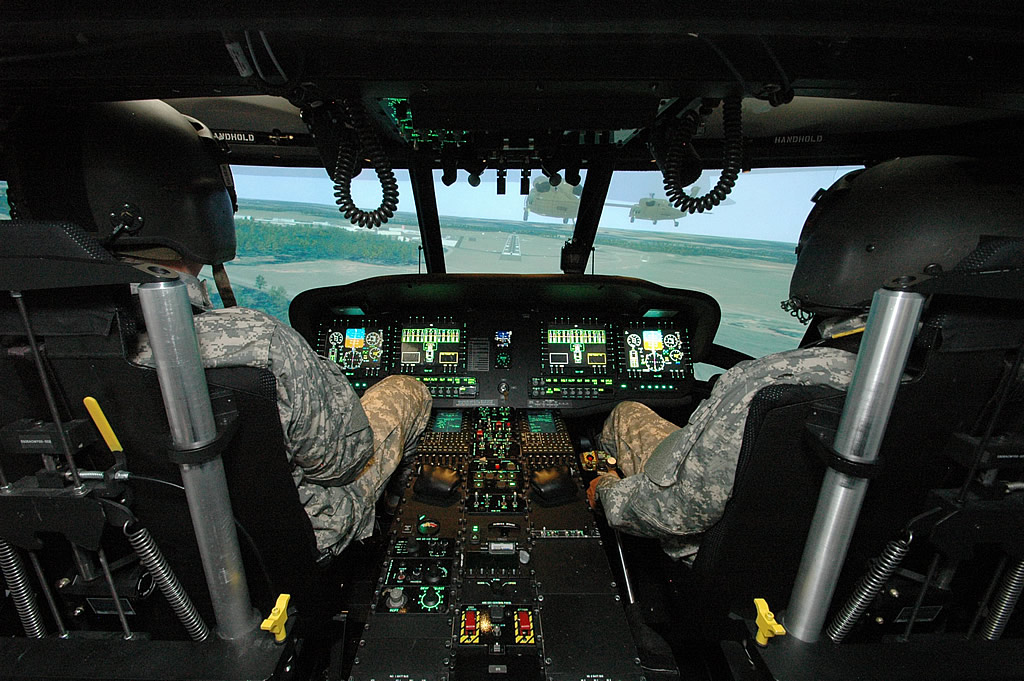
April 8/13: UH-60M. L-3 Link Simulation & Training announces a contract for 2 Taiwan Army UH-60M Operational Flight Trainers (OFTs). The contract is the result of a letter of agreement between the U.S. and the Taiwan Army, and is the 1st export of their UH-60M OFT. The 1st trainer will be operational at Shinshou Training Facility in Q4 2014, and the 2nd will follow in Q1 2015. A companion contract provides for 1 year of support, with a 1-year extension option. The US Army’s Program Executive Office for Simulation, Training and Instrumentation (PEO-STRI) will manage the purchase as Taiwan’s agent.
The OFTs are mostly similar to those used in the US Army’s Flight School XXI program. A 6-degree of freedom electric motion system is coupled with a supplemental motion system that simulates helicopter vibration. High-fidelity software is designed to accurately simulate each platform’s engine, electrical, hydraulic, navigation and communications systems, and even aircraft survivability equipment. It’s even compatible with night vision goggles. The big difference will be a Taiwan geo-database, for faithful reproduction of flights over their home terrain.
April 5/13: As the US DSCA submits South Korea’s request for stealth-enhanced F-15SE Strike Eagles and F-35A stealth fighters, US-Taiwan Business Council president Rupert Hammond-Chambers points to that process as a clear example of the political weakness in Washington. “The threats the [South] Korean air force face are the same as those of Taiwan’s air force,” and the argument that China could easily ground Taiwan’s F-16s by staging a massive missile attack on air bases applies equally to North and South Korea. Taipei Times | Read “Korea’s F-X Multi-Role Fighter Buys: Phases 2 & 3” for full coverage of South Korea’s fighter modernization.
March 13/13: Beyond F-16s. Citing a newly released quadrennial defense review, Taiwan’s media say that the ROCAF wants to step beyond their upgraded F-CK-1s, and develop a new fighter with features like lower radar cross-section, long-range, and aerial refueling receiver, as well as the ability to launch missiles against land targets or ships.
Taiwan’s military currently estimates that the fighter and small submarine development programs will cost about NT$500 billion (about $16.9 billion). Which means they’ll be lucky to keep the real total below $20 billion. Senior officials are also careful to add that they haven’t given up on getting more F-16s, which could squeeze development budgets for something new.
On the other hand, Liberty Times quotes KMT Legislator Lin Yu-fang statements that “For our national survival, we need to build up our defense capability under our own steam,” as a result of the USA’s increasing reluctance to assist Taiwan. Focus Taiwan.
March 13/13: Submarines. Taipei’s MND responds to reports that Taiwan has given up on buying new submarines abroad, by confirming that they’re “reviewing the relevant plans and budgets” for a 4-year local development project that was brought to the TWD 7 billion (about $236 million) National Defence Industrial Development Foundation in late 2012.
The ROCN actually foresees a budget closer to TWD 10 billion (about $340 million) to fund design, equipment acquisition, building industrial capability, and testing for a 1,000t – 2,000t submarine. Even that figure seems awfully low for a country that hasn’t built submarines before, and probably won’t be able to use an existing design as a base. Asia One.
March 8/13: E-2 AWACS. The last 2 upgraded Hawkeye 2000s arrive at Kaohsiung International Airport Station in southern Taiwan for follow-up tests and inspections (q.v. Nov 8/11 entry). This completes Taiwan’s E-2T Hawkeye upgrades, and restores its militarily critical AWACS fleet to full strength. Focus Taiwan.
All E-2 upgrades delivered
Feb 19/13: P-3s. StandardAero-San Antonio Inc. in San Antonio, TX receives a $10.6 million firm-fixed-price, indefinite-delivery/ indefinite-quantity contract modification, exercising an option for the overhaul of 16 T56-A-14 propulsion systems for the Government of Taiwan under the Foreign Military Sales Program.
That model of the T56 is unique to the P-3 family, and that number of engines would equip 4 refurbished P-3s. Or serve as fleet spares, which is more likely.
Work will be performed in San Antonio, TX and is expected to be complete in February 2014. All funds are committed immediately, and the US Naval Air Warfare Center Aircraft Division in Lakehurst, NJ manages the contract on behalf of its FMS client (N00019-09-D-0014).
Feb 8/13: P-3s. Lockheed Martin Mission Systems and Training in Owego, NY receives a $9.3 million firm-fixed-price contract modification to incorporate engineering change proposals (ECPs) in Taiwan’s 12 P-3 aircraft. Upgrades will improve both Harpoon Block II compatibility, and improved radar and signals emission location.
Specifically, the ECP implements the Complimentary Navigation Message, which updates RINU-G and Control Display Unit software with a message set that helps the radar/GPS guided Harpoon Block 2 Missile with precision targeting. They’ll also replace the standard AN/ALR-95 Electronic Support Measures system with the more advanced AN/ALR-97. The final modification upgrades technical publications to reflect the “Mode-T” software instead of the “Mode “4” software.
Work will be performed in Owego, NY (31%); Jacksonville, FL (18%); Van Nuys, CA (16%); Aberdeen, MD (14%); Cedar Rapids, IA (13%); McKinney, TX (3%); Marietta, GA (3%); and Woodland Hills, CA (2%), and is expected to be complete in February 2014. All Foreign Military Sales contract funds are committed immediately, and will be managed by the US Naval Air Warfare Center Aircraft Division in Lakehurst, NJ on behalf of their ROC client (N00019-09-C-0031).
Feb 1/13: Long-Range Radar. Agence France Presse reports that Taiwan’s US-made long-range early warning radar is now deployed near the northern county of Hsinchu, on its mountaintop perch. The NT$40.9 billion (about $1.35 billion at 2013 conversions) project loks similar to existing Pave Paws stations, and reportedly has a 5,000 km range. The added warning time for ballistic missile attacks is just minutes, but it matters a bit more when minutes were all you had before. The ability to add a bigger picture view on top of the short range PATRIOT radars is very important for national command and control.
As a bonus, the radar’s ability to see into Chinese airspace, and even to monitor North Korean launches, makes it an equally valuable asset to the USA. If Taiwan decides to share that data, which is a reasonable assumption, it becomes a more valuable ally. AFP.
SRP long-range radar deployed
2012
F-16 upgrade program begins; A domestic submarine program?; Budget for 4 frigates in 2013?; Stinger missiles; Harpoons prepped.
[youtube:v=S3MsZGKDYNU]
click for video
Oct 24/12: Planes? No tanks. Defense Minister Kao Hua-chu tells a legislative hearing that the cost of Taiwan’s F-16 upgrades is the reason for delays to tank purchases and self-propelled artillery upgrades. He adds that before requesting the 70-ton M1s, they would have to conduct a compatibility evaluation on the country’s infrastructure, such as roads, highways and bridges.
It’s certainly possible for large purchases to squeeze out less important items, within a defense budget. Then again, it’s also pretty common for a party that doesn’t really want to implement stronger defenses to use this sort of thing as an excuse to avoid doing what needs to be done. The KMT’s recent record makes it hard to tell which interpretation is the truth. Focus Taiwan.
Oct 1/12: F-16s. Lockheed Martin announces a contract valued at up to $1.85 billion to begin upgrading 145 ROCAF F-16A/B Block 20 fighters to the “F-16S” (not T?) configuration, including an Active Electronically Scanned Array (AESA) radar, embedded global positioning, electronic warfare upgrades, and other avionics improvements. Note Lockheed’s use of the word “begin”; the complete upgrade is very likely to cost more than $1.85 billion.
The F-16S upgrades will follow the Sept 21/11 DSCA request, which Lockheed Martin has firmed up into a global offering. The firm’s proposed F-16V was announced at Singapore’s airshow in February 2012.
Contract: F-16 upgrade
Sept 5/12: Minehunters. The ROCN plans to spend TWD $35.9 billion ($1.2 billion) to buy 6 domestically built minehunting ships over a 12-year period, but that budget has yet to obtain final legislative approval:
“Although information on the People’s Liberation Army Navy (PLAN) mine warfare capabilities remains sketchy, naval analysts, including James Bussert of the Naval Surface Warfare Center in Dahlgren, Virginia, believe each of the three PLAN fleets comprises one squadron of mine layers. The US Navy estimates the PLAN uses as many as 30 types of mines (including submarine-launched) and has an inventory of between 50,000 and 100,000…. Taiwan has strategic oil reserves of approximately 1.45 million kiloliters of crude, which would last the nation for about 30 days. Besides disrupting shipments of crude and natural gas, which could bring Taiwan to a standstill, the mining of Taiwanese harbors and waterways would severely undermine the confidence of global cargo fleets and thereby cause serious damage to Taiwan’s economy.”
The question is whether they will build their own design to accompany the new Osprey Class (q.v. Aug 2-10/12), or a foreign design. Sources: Taipei Times, “Taiwan plans to build six minehunting Navy ships”.
Aug 28/12: PATRIOT. The Taipei Times reports that new PATRIOT PAC-3 defense sites will begin construction in September 2012 around Greater Taichung and Greater Kaohsiung cities. A private contractor will handle the NT$ 61.4 million (about $2 million) contract, but the move has a significance that’s out of proportion to its size.
The PAC-3 systems would join Taiwan’s 3 upgraded PAC-2/ Config-3 units, currently deployed around the capital city of Taipei in Wanli, Nangang, and Sindian. The 4 new PAC-3 batteries from the October 2008 notification are reportedly being considered for a number of sites, including Greater Taichung’s Dadu Mountain, Greater Kaohsiung’s Jenwu District, Greater Tainan’s Hutoupi, protection for Taiwan’s E-2 2000 Hawkeye early-warning planes at Pingtung’s airport, and possibly the small airport terminal at Chiayi. About 386 missiles have been ordered so far, and the full PAC-3 systems are scheduled to arrive in 2014-2015. Another 2 PAC-3 batteries would follow under the 2010 DSCA request, as part of a future purchase phase.
Aug 2-10/12: Minehunters. Taiwan’s 2 Osprey Class minehunting ships arrive after their 2-year refurbishment and training period in the USA, and are inducted into the ROCN in welcoming ceremony at the Zuoying naval base, in the southern port city of Kaohsiung.
Taiwan’s fleet of minehunters now numbers 10 ships, but these are by far the newest and most capable. Designed in the 1990s instead of the 1950s, Osprey Class ships are equipped with an array of mine-hunting devices including Raytheon AN/SQQ-32 sonar, remotely-operated AN/SLQ-48 Mine Neutralizing Vehicles (MNV), video sensors, remotely-controlled mine detonators, cable cutters, and a pair of .50 caliber machineguns. The minehunters have a cruising speed of 10 knots, and mission endurance of 15 days. China Post | Taiwan Today | Defense Update.
2 Minehunters arrive
Aug 3/12: P-3s. The good news is, a Taiwanese P-3C Orion aircraft recently completed its 1st functional trial flight in late July 2012, and Taiwan should begin receiving its new P-3C sea control aircraft in 2013. The bad news is, the military’s plan to build a hangar at an air base in Pingtung County in southern Taiwan has gone nowhere.
The ROCAF says that the new planes could be placed in C-130H hangars, but that isn’t a long-term solution. The problem appears to be lack of jurisdictional clarity between the ROCAF and Navy over who will control the planes, and hence who will issue the RFP. Focus Taiwan.
July 24/12: Tanks. The Taipei Times reports that Taiwan is looking to join countries like Morocco, and try to obtain refurbished M1 Abrams tanks. The tanks used in Iraq and Afghanistan need major maintenance overhauls, and one option for the Army would be to sell the tanks to allies, and let them pay for the RESET costs.
“Ministry of National Defense spokesman Major General David Lo… told local media yesterday that efforts to acquire used battle tanks from the US were currently under evaluation… Deputy Minister of National Defense Chao Shih-chang… [said] the Army was seeking to procure 200 tanks to bolster its forces, adding that the great bulk would be deployed in Hukou Township… [with] the 584th Armored Brigade… Taiwan’s efforts to procure the 70-tonne main battle tank go back to the early 2000s, when it requested M1-A2s from the US, a request that Washington turned down.”
July 13-22/12: Upgrade MoU signed. Reports indicate that the US and Taiwan have signed the $3.7 billion MoU to upgrade Taiwan’s F-16s, with upgrades occurring at a rate of 24 fighters out of service at a time, beginning in 2016 and continuing to 2028. The actual Letter of Acceptance (contract) is expected to be finalized within a couple of months, but it has a number of reported twists and conditions that are puzzling.
One of the oddest is that Taiwan will have no say in which radar (Northrop Grumman SABR or Raytheon RACR) is picked in 2013-2014, and then installed. Meanwhile, Lockheed Martin’s recent agreement with state-run AIDC appears to have shut BAE out of the picture, without the opportunity to compete or be evaluated.
Another odds proviso is that Taiwan won’t recover it’s engineering costs to integrate the new AESA radars, if the US Air National Guard adopts the same radar and methods to retrofit its own F-16s. Taiwanese sources told Defense News that the MoU allows “some” reimbursement if other F-16 customers adopt the same retrofit. The most likely near-term customers are Korea and Singapore. AIDC [in Chinese] | Defense News | Defense Update | Reuters India (abridged) | Reuters, via Aviation Week.
July 11/12: LMCO-AIDC MoU. At the 2012 Farnborough Air Show, Taiwan’s AIDC and Lockheed Martin sign a memorandum of understanding to expand their strategic relationship, and jointly explore opportunities for the Taiwan F-16 A/B Retrofit Program.
The MOU defines potential collaboration on F-16 retrofit modifications, F-16 component parts manufacture and other potential offset projects. Its practical effect is to shut BAE Systems out of any competition (vid. March 14/12 entry). Lockheed Martin | Reuters.
F-16 upgrade MoU
June 25/12: F-16s. Reports from Taiwan indicate that the Ministry of National Defense is giving the USA’s May 2012 draft Letter of Acceptance for F-16 modernization some hard thought, as it screens the items and prices in the USA’s rumored $3.8 billion response. A decision is expected by the end of July.
The United Evening News reports that the $600 million cost for the AESA radars in particular has created unease among “senior government officials,” who are reportedly asking for other options. There’s certainly precedent for installing previous-generation APG-68v9 radars in early-model F-16s instead, as is being done for Pakistan. It would be a major improvement on Taiwan’s current radars, and equal other F-16C/D Block 52 fleets around the world, but would remain a generation behind AESA performance. Both Raytheon and Northrop Grumman are touting their RACR/SABR next-generation radars as drop-in refits for older F-16s, but Taiwan is being told that additional system engineering work would be required. The Pentagon has reportedly promised to remit some of those custom design costs, if other countries choose to add AESA radar systems to their F-16A/Bs in the future. The China Post | Focus Taiwan | Agence France-Presse.
May 29/12: AH-64 helicopters. Boeing in Mesa, AZ received a $97.3 million firm-fixed-price contract modification “of an existing contract to procure Block III Apache AH-64D attack helicopters in support of Foreign Military Sales.” Which means Taiwan. Work will be performed in Mesa, AZ, with an estimated completion date of Dec 30/17. One bid was solicited, with 1 bid received by the U.S. Army Contracting Command in Redstone Arsenal, AL (W58RGZ-09-C-0147).
This brings total ROC Apache Block III contracts to $683.8 million so far, of the maximum $2.532 billion noted in the October 2008 DSCA request. This current total includes equipment like fire control radars and air-launched Stinger missiles, which were part of that request.
May 17/12: Minesweepers. Taiwan’s CNA reports that the former USS Oriole and USS Falcon Osprey Class coastal minehunting ships are scheduled for delivery to Taiwan in July after being refitted and reactivated. They are due to be commissioned into service in October 2012.
May 17/12: F-16s. The US House of Representatives approves Rep. Kay Granger’s [R-TX-12] amendment to the 2013 National Defense Authorization Act (H.R. 4310), which requires the Obama administration to approve the sale of 66 new F-16s to Taiwan. It’s 1 of 19 amendments that passes on a voice vote, before the House passes HR 4310.
Granger’s amendment is companion legislation to her House Bill (H.R. 2992) that “Directs the President to carry out the sale of no fewer than 66 F-16C/D multirole fighter aircraft to Taiwan”, and to Sens. Cornyn and Menendez’ Taiwan Airpower Modernization Act of 2011 (S.1539). Unless the Senate also passes a similar amendment to the 2013 budget, however, it won’t matter. Neither HR 2992 nor S 1539 has passed individually, and the final 2013 defense budget needs to pass both the House and the Senate with the same text. The wording is also somewhat questionable, as the President isn’t really the decider, and can always offer the excuse that the State Department never forwarded a request. Which is true – the State Department is blocking that request. Forcing approval of that request, either by State’s DSCA or via legislation removing this request from DSCA’s hands, might have been a better tactic. Rep. Granger | The Hill.
May 6/12: UH-60Ms. Sikorsky Aircraft Corp. in Stratford, CT received a $43.2 million firm-fixed-price contract for engineering services, to convert 4 more UH-60M Black Hawk helicopters “to the specific unique configuration for Taiwan.” In other words, to finish the 4 helicopters bought on June 30/11. This brings the total cost of those 4 helicopters to $91.8 million, or $23 million per machine so far.
Work will be performed in Stratford, CT, with an estimated completion date of Oct 31/14. One bid was solicited, with 1 bid received by Taiwan’s FMS agent, the US Army Contracting Command in Redstone Arsenal, AL (W58RGZ-08-C-0003).
4 UH-60Ms
May 2/12: Link-16. Data Link Solutions in Cedar Rapids, IA receives a $9.4 million firm-fixed-price delivery order to Taiwan of MIDS-LVT terminals, as a Foreign Military Sale transaction.
Work will be performed in Wayne, NJ (50%), and Cedar Rapids, IA (50%), and is expected to be complete by Dec 31/14. This contract was competitively procured via FBO.gov and the SPAWAR E-commerce website, with 2 offers received. The competition was real, as Taiwan has shifted its buys back and forth over time. US Space and Naval Warfare Systems Command in San Diego, CA manages the contract, on behalf of its FMS client (N00039-10-D-0031).
April 27/12: F-16s. Sen. John Cornyn [R-TX] has lifted his hold on the confirmation of former Obama aide Mark W. Lippert, as Assistant Secretary of Defense for Asian and Pacific Security Affairs. It comes after Obama’s Director of the Office of Legislative Affairs, Robert L. Nabors II, sends a letter that promises to consider sales of new F-16s to Taiwan. Careful reading shows that this is all it promises, and Obama’s former aide will play a large role in any decisions. Unless there’s another reason to believe in a policy about-face, therefore, it’s unreasonable to expect any change, despite this language:
“We understand your desire to see Taiwan’s air force modernized with the addition of new F-16C/Ds… especially given the pending retirement of F-5s… [The new ASD] would use the position as the U.S. Chair of the U.S.-Taiwan Defense Review Talks and the interagency Monterey Talks to oversee the development of a combined review of Taiwan’s long-term defense strategy and resourcing plan, to include on Taiwan’s air and missile defense needs… We recognize that China has 2,300 operational combat aircraft, while our democratic partner Taiwan has only 490… The Assistant Secretary, in consultation with the inter-agency and the Congress, will play a lead role as the Administration decides on a near-term course of action on how to address Taiwan’s fighter gap, including through the sale to Taiwan of an undetermined number of new U .S.-made fighter aircraft.”
April 22/12: More frigates? Media reports say that Taiwan may look to increase its fleet of FFG-7 Oliver Hazard Perry Class frigates from the current set of 8. The defence ministry has reportedly briefed President Ma Ying-jeou, and is said to be ready to include a budget for 4 more in 2013.
These frigates are generally sold for very little money, except the cost of refurbishment. Taiwan’s FFG-7 frigates are fully armed, and include the original pop-up launcher for SM-1 air defense and Harpoon ship attack missiles. The US Navy has removed missiles from its own frigates, however, so adding them back would be part of the refurbishment contract, if Taiwan wants that. Bangkok Post. See also Aug 5/10, Jan 10/10.
March 20/12: Cracked AMRAAMs. The Taipei Times reports that the ROCAF currently has 120 AIM-120C-5 and 218 AIM-120C-7s in inventory, with deliveries that began in 2004. Unfortunately, some of them were experiencing cracking in their pyroceramic radome nose cones. American investigators concluded that Taiwan’s high humidity, plus the pressure created by supersonic flight, were the problem. The ROCAF will respond by improving storage and rotation cycles.
The Taipei Times does note that Taiwan’s radar-guided MBDA MICA and locally-built Tien Chien II missiles aren’t having this problem, despite being exposed to the same conditions.
March 14/12: F-16s. Lockheed Martin and BAE are both pushing to perform Taiwan’s F-16 upgrades, as part of a wider competition in this area between the 2 firms. BAE’s recent wins in providing fire-control and advanced ethernet capabilities for 270 US ANG F-16s, and upgrades for some Turkish F-16s, sends notice that Lockheed can expect competition in Taiwan, South Korea (up to $1.6 billion for 134 KF-16s), and Singapore (70 F-16C/Ds).
Taiwan will be a challenge for BAE, because its armed forces and government have a long-standing relationship with Lockheed Martin that they may be loath to jeopardize. Defense Update.
March 13/12: Thai Submarines. Thailand has dropped plans to buy 4 second-hand German U206A submarines, and let their option rights expire on Feb 29/12. Reports say that Thai Defence Minister Sukumpol Suwanatat refused to approve the deal, after several reviews of the navy’s submarine purchase plans.
The tiny 550t submarines are especially well-suited for shallow, constricted waters and near-coast operations. They’re old, but they’d fit Taiwan’s needs extremely well, offering a bridge buy whose layout and plans would also help teach Taiwanese designers. Or, the stealthy, shallow-water U206s may find another global buyer who values their unique specialties, and has a near-term need. Colombia has already bought 2 of the 6 submarines available. Europe Online.
Feb 27/12: Submarines. Taiwan’s Ministry of National Defense officially denies a magazine report saying that Taiwan was going to buy Greece’s U214 Papanikolis Class submarines, since Greece couldn’t pay.
The Hong Kong-based Chinese-language magazine, Asian Week (probably “Yazhou Zhoukan”), added that HDW officials has visited Taiwan in October 2011, and been told that a deal was possible for under $800 million each, plus 10-20 years guaranteed support, and US approval. The report added that HDW had officially informed the US about the proposal. Taipei Times.

(click to view full)
Feb 22/12: Harpoons for subs. Modernizations will allow Taiwan’s navy to arm its 2 submarines with UGM-84 Harpoon missiles, beginning in 2013. The move will greatly increase their submarines’ reach, allowing attacks from up to 70 miles away. That makes it much harder for enemies to protect themselves against a submarine attack, by widening the required search field.
Taiwan already equips its F-16s and some navy ships with other variants of this missile, but a submarine’s stealth adds a new level of difficulty for Taiwan’s enemies. Local reports indicate that integration will involve the addition of a stand-alone fire-control system for the missiles, to avoid the added time and expense of full integration. It will also require either changes to the torpedo tube mechanisms, or conversion/addition of a dedicated torpedo tube. For tactical reasons, it’s much better to have all torpedo tubes missile-capable, as this allows fast salvos of multiple missiles. Since firing a missile announces the submarine’s presence and location rather loudly, attacks on well-defended naval groups (like, say, an invasion force) will be much more effective as a missile swarm, rather than using the classic kung-fu movie approach where the attackers conveniently fight the defender one at a time. If, indeed, the submarine lives long enough to keep launching more attacks. See also July 29/10 entry. Taipei Times | 9abc | India’s Zee News.
Sub modernization
Feb 21/12: Submarines. The Taipei Times reports confirmations from the ROC Navy that it will begin a domestic submarine program in 2013, with “assistance from one or a number of foreign countries”, in order to create a small 1,000t – 1,500t design. The goal is reportedly to deliver a prototype within 3-4 years, and the ROCN would reportedly seek budgets for the program within 2 months.
Semi-native sub program?
Feb 13/12: PATRIOT. The USA’s FY 2013 budget documents include information about Taiwan’s PATRIOT PAC-3 missile orders. Looking through past years as well, one sees 386 PAC-3 missiles ordered from FY 2010-2013: 96 in FY 2010, 96 in FY 2011, 154 in FY 2012, and 40 missiles for FY 2013.
Feb 7/12: Minesweepers. An article about the Iranian mine threat to the Strait of Hormuz notes that the former US Navy Osprey Class minehunting ships Oriole and Falcon have been authorized for sale to Taiwan (vid. Jan 29/10 entry), but are still being refurbished in Texas.
Jan 5/12: Stingers. Raytheon Missile Systems in Tucson, AA receives a $7.8 million firm-fixed-price contract, to buy FIM-92H Block 1 Stinger missiles for Taiwan. The designation FIM-92H refers to FIM-92D missiles, which have been upgraded to the current FIM-92 RMP Block I standard. They can be used with air-to-air launchers on helicopters, or they can equip troops on the ground.
Work will be performed in Tucson, AZ, with an estimated completion date of Dec 31/16. One bid was solicited, with one bid received by Taiwan’s contract agents at US Army Contracting Command in Redstone Arsenal, AL (W31P4Q-09-C-0520).
2011
$5.3b F-16 upgrade program; Taiwan is a security risk for secrets; Political dogfight over F-16s in USA; Taiwan to try building submarines itself?; Major PATRIOT missile buy; AH-64D Block III attack helicopter buys; Upgraded E-2 surveillance planes returning; 1st 4 UH-60M helis ordered; Plans for new torpedoes.

fires AGM-65 Maverick
(click to view larger)
Dec 30/11: PATRIOT. Raytheon Integrated Defense Systems in Andover, MA receives a $34.3 million firm-fixed-price contract, providing initial funding for 3 Taiwanese Patriot fire units and training equipment. DID is investigating possible connections to the Dec 16/11 announcement.
Work will be performed in several locations within Alabama, Arizona, California, Connecticut, Florida, Georgia, Illinois, Indiana, Maryland, Massachusetts, Minnesota, Missouri, New Hampshire, New Jersey, New York, North Carolina, Ohio, Oklahoma, Pennsylvania, Rhode Island, Utah, Washington, Italy, Greece, and Canada, with an estimated completion date of Dec. 31, 2016. One bid was solicited, with one bid received. US Army Contracting Command in Redstone Arsenal, AL manages the contract, incl. services as Taiwan’s agent (W31P4Q-12-C-0069).
Dec 30/11: PATRIOT. Lockheed Martin in Grand Prairie, TX receives a $606 million firm-fixed-price and cost-plus-fixed-fee contract for FY 2012 PATRIOT requirements – which includes missiles, launchers, and ground support for Taiwan. Within the PATRIOT system, Lockheed Martin produces the PAC-3 missile, the missile canister 4-packs, a fire solution computer, and the Enhanced Launcher Electronics System (ELES).
Work will be performed in Grand Prairie, TX; Camden, AR; Lufkin, TX; Chelmsford, MA and Ocala, FL, with an estimated completion date of July 30/15. One bid was solicited, with one bid received by US Army Contracting Command, Redstone Arsenal, AL manages the contract, as Taiwan’s FMS agent (W31P4Q-12-C-0002).
Dec 30/11: AH-64D. Longbow Limited Liability Corp. in Orlando, FL receives an announced $64.3 million firm-fixed-price contract modification, but Longbow LLC pegs its actual value at $181 million, with options to extend performance past 2015, to 2017.
It’s said to include 15 Longbow Block III Fire Control Radar assemblies for Taiwan’s AH-64Ds, marking the Block III version’s 1st export order.
For the US Army, the order includes 14 Block III Radar Electronics Units, which are smaller then their predecessors, and offer lower weight, maintenance and power requirements. The Army is also buying 14 Unmanned Aerial System Tactical Common Data Link Assembly (UTA) systems and spares, which provide a 2-way, high-bandwidth data link that lets the helicopter crew control nearby UAV flight paths, sensors and lasers at long ranges, while receiving high-quality imagery from the UAVs on the helicopters’ own displays.
Work will be performed in Orlando, FL, with an estimated completion date of Sept 30/15. One bid was solicited, with 1 bid received by US Army Contracting Command in Redstone Arsenal, AL manages the contract, including its work as Taiwan’s FMS agent (W58RGZ-10-C-0005). Lockheed Martin | Northrop Grumman.
Dec 30/11: AH-64D. Raytheon Missile Systems in Tucson, AZ receives a $13.9 million firm-fixed-price contract modification to fund FIM-92H Block-1 Stinger missiles and their air-to-air launchers for Taiwan. China’s near-certain air superiority in the event of a conflict makes aerial combat weapons for Taiwan’s attack helicopters a smart move. Their maneuverability and near-earth flight profile would make them a very difficult foe for many fast jets.
Taiwan’s DSCA request was for up to 173 missiles, which will be used on its AH-64 helicopters (q.v. Oct 3/08 entry). A $45.4 million contract has already ordered 171 of the missiles, plus ancillary equipment that included 24 of 35 requested Stinger Captive Flight Trainers with live guidance systems, but no rocket motors (q.v. June 25/09).
Work will be performed in Tucson, AZ, with an estimated completion date of Dec 31/16. One bid was solicited, with one bid received. US Army Contracting Command in Redstone Arsenal, AL manages the contract, as Taiwan’s FMS agent (W31P4Q-09-C-0520).
Dec 27/11: E-2s. Northrop Grumman Systems Corp. in Bethpage, NY receives a $6.9 million delivery order modification exercising an option for sustainment, engineering and technical services, and travel in support of ROCAF E-2Cs.
Work will be performed in Bethpage, NY (70%), and Pingtung Air Force Base, Taiwan (30%), and is expected to be completed in January 2013. The US Naval Air Warfare Center Aircraft Division in Patuxent River, MD manages the contract on behalf of its FMS client.
Dec 19/11: E-2s. Taiwan gets 2 of its E-2Ts back as Hawkeye 2000s. The arrival of the 2 planes in Kaohsiung city brings their fleet size back to 4, with 2 more still in the USA for upgrades. Taiwan News.
Dec 16/11: PATRIOT. Raytheon announces a $685.7 million Foreign Military Sales (FMS) contract from Taiwan for additional PATRIOT fire units, featuring current electronics, an improved man-machine interface, and claims of lower life-cycle costs. The firm adds that this award is in addition to the 2009 contract for new systems, and the 2008 contracts to upgrade Taiwan’s existing systems. Work under this contract will be performed at Raytheon’s Integrated Air Defense Center in Andover, MA; El Paso, TX; and Huntsville, AL.
When queried, the firm clarified that this order will be built from the ground up as PATRIOT PAC-3, and that “fire unit” means the complete system, including radars, generators, antenna, ECS command module, and missile launchers. Taiwan is already beginning to build experience with the equipment, as Raytheon recently delivered the first upgraded Configuration-3 radar system, 10 months ahead of the original requested program plan. See also Taipei Times.
Major PATRIOT contract
Dec 15/11: Submarines. More reports that Taiwan is moving toward its own submarine program, per the Sept 19/11 entry below. The story adds one expert’s recommendation that the money and time might be spent on fast-attack missile boats like the Chinese Type 022. Which would be a good recommendation, if standard combat scenarios weren’t assuming PLAAF control of the air over the Formosa Straits.
The Taipei Times also reports that Taiwan turned down a proposed 2003 deal to buy up to 8 Sauro Class boats from Italy as they were decommissioned. The Fincantieri submarines had entered service between 1980 and 1992, which means they would have had limited remaining service life, and Taiwan decided that it was better not to buy them. Unfortunately, no deal for new submarines turned up.
Dec 7/11: AH-64 helicopters. Boeing in Mesa, AZ received a $141.3 million firm-fixed-price contract for “services in support of 30 Apache AH-64D attack helicopters for Taiwan.” See also the June 10/11 and Oct 8/10 entries for that order.
Work will be performed in Mesa, AZ, with an estimated completion date of Dec 30/17. One bid was solicited, with one bid received by the U.S. Army Contracting Command in Redstone Arsenal, AL, who is acting as Taiwan’s agent (W58RGZ-09-C-0147).
Dec 7/11: BMD Radar. Raytheon Integrated Defense Systems in Sudbury, MA receives a $42.9 million cost-plus-fixed-fee and firm-fixed-price contract for the Surveillance Radar Program. Specifically, this system includes a UHF phased array radar integrated with Taiwan-furnished Identification Friend-or-Foe beacons; 2 Missile Warning Centers; and communications and interface architecture and protocols to specific nodes within Taiwan’s military communications infrastructure, consistent with US restrictions
The SRP is a Foreign Military Sales Program managed by the USAF Electronic Systems Center at Hanscom AFB, MA, to provide Taiwan with the elements of a missile and air defense capability. Work will be performed in Sudbury, MA, and is expected to be complete by Nov 9/12 (FA8722-05-C-0001, PO 0062).
Dec 7/11: PATRIOT. Raytheon in Andover, MA received a $12.7 million firm-fixed-price, cost-plus-fixed-fee, and cost-reimbursable contract. The award will modify an existing contract for technical services in support of Taiwan’s PATRIOT air defense missile system.
Work will be performed in El Paso, TX, and Taipei, Taiwan, with an estimated completion date of Dec 31/15. by the U.S. Army Contracting Command in Redstone Arsenal, AL, who is acting as Taiwan’s agent (W31P4Q-11-C-0317).
Nov 8/11: E-2s. Taiwan ships its 3rd and 4th E-2T Hawkeyes to the USA for upgrades to Hawkeye 2000 configuration (vid. Oct 3/08 entry). The move leaves Taiwan without any operational E-2Ts, as the first 2 planes aren’t expected to return from their upgrades until the end of 2011.
In their absence, the ROCAF does have 2 newer E-2C+ Hawkeye 2000s to rely on, but the move remains a calculated risk. Taiwan News.
Oct 5/11: PATRIOT. Raytheon IDS in Andover, MA receives a $20.4 million firm-fixed-price and cost-plus-fixed-fee contract, to provide PATRIOT technical assistance services to Taiwan. Work will be performed in El Paso, TX; Taipei, Taiwan, and Andover, MA; with an estimated completion date of Dec 31/15. One bid was solicited, with 1 bid received (W31P4Q-11-C-0317).
Nov 18/11: F-16 dogfight. Sen. John Cornyn [R-TX] sends a letter to President Obama, that also clarifies Taiwan’s current position re: the F-16s:
“Shortly after your Administration announced the F-16 A/B upgrade package, I wrote to President Ma to ask him for clarification on Taiwan’s military requirement for new F-16C/Ds. On Oct. 14, I received an unequivocal response, stating that Taiwan needs both the upgraded F-16A/Bs and the new F-16C/Ds to fulfill its “self-defense needs in qualitative and quantitative terms.” The sale of new F-16C/Ds to Taiwan also has the backing of 47 Democrats and Republicans in the Senate and 181 Democrats and Republicans in the House of Representatives who this past year have sent letters of support to your Administration. In your recent speech to the Australian Parliament, you stated that “The United States is a Pacific power, and we are here to stay.” I applaud this rhetoric, but it will ring hollow unless it is followed by meaningful action…”
Nov 14/11: A day after the New York Times publishes an editorial urging President Obama to sell out Taiwan, Rep. Ed Royce [R-CA-40] tells a Formosa Foundation group in Los Angeles that Congress is not contemplating abandonment. That may seem like harsh language, but the New York Times op-ed reads:
“President Obama… should enter into closed-door negotiations with Chinese leaders to write off the $1.14 trillion of American debt currently held by China in exchange for a deal to end American military assistance and arms sales to Taiwan and terminate the current United States-Taiwan defense arrangement by 2015.”
“Sell out” is a perfectly appropriate description. New York Times | Taipei Times.

(click to view full)
Sept 21/11: F-16 Block… 59s? The US DSCA issues up to $5.95 billion in ROCAF F-16 related upgrade and support requests, over 3 separate notifications. The procedure for Foreign Military Sale mode requests is that if Congress doesn’t block the sale within 30 days, negotiations and contracts can commence. The US military is technically the buyer and contract manager, but they do so on behalf of their FMS client. The exact DSCA requests include:
Pilot Training: Many foreign militaries train their combat pilots in the USA, taking advantage of America’s larger swathes of open airspace for training, and of training alongside combat-proven American pilots. Taiwan already trains its F-16 pilots at Luke AFB near Glendale, AZ, and a buy request worth up to $500 million would continue funding this program over the long term.
The training provides a “capstone” course that takes experienced pilots and significantly improves their tactical proficiency. Funding would cover flight training, supply and maintenance support, spare and repair parts, support equipment, program management, publications, documentation, personnel training and training equipment, fuel and fueling services, and other related program requirements.
L-3 Communications Corporation in Greenville, TX would be the lead contractor for this service, but there would be about 90 U.S. contractors providing various forms of aircraft maintenance and logistics support at Luke AFB. US DSCA [PDF].
Spare Parts: This Foreign Military Sales Order II program (FMSO II) request would provide funds for blanket spare parts orders, under the Cooperative Logistics Supply Agreement (CLSSA), to support Taiwan’s F-16A/B Falcon, F-5E/F Tiger II, and F-CK IDF Ching Kuo fighters, and C-130H Hercules transport aircraft. The estimated cost is up to $52 million.
Procurement of these items will be from many contractors providing similar items to the U.S. forces, and implementation of this sale will not require the assignment of any additional U.S. Government or contractor representatives. US DSCA [PDF].
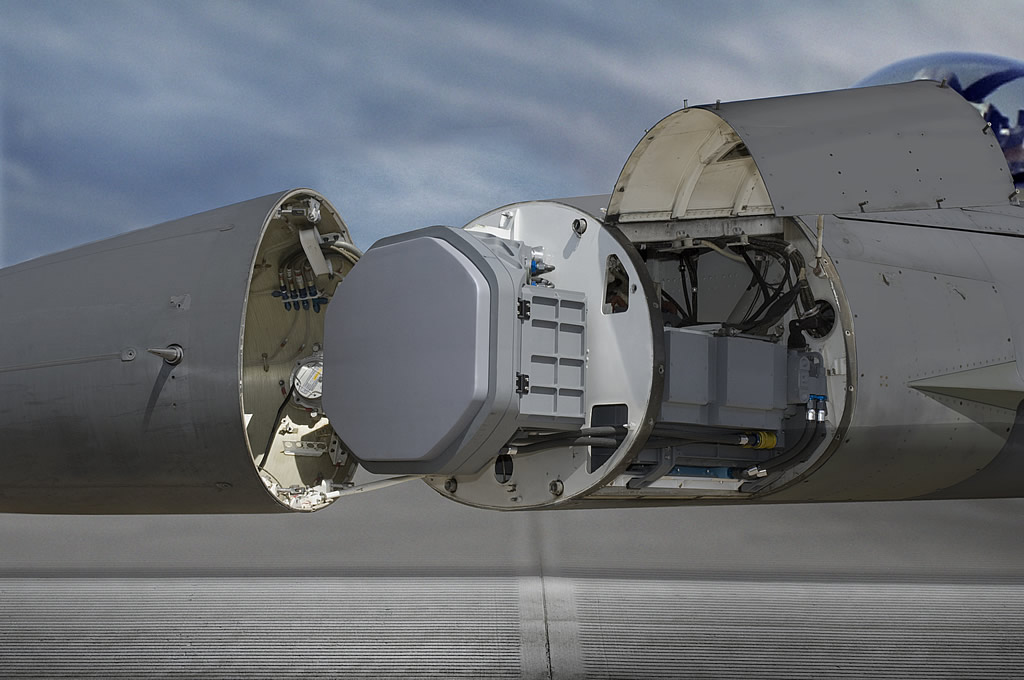
(click to view full)
F-16 Fleet Retrofit: This request [PDF] would retrofit up to 145 F-16A/B Block 20 fighters. The technologies involved in some aspects of this retrofit are something of a surprise, as they go beyond the new F-16C/D Block 52 aircraft Taiwan was said to be looking for – a type that was recently sold to China’s ally Pakistan. These retrofits are more advanced than that, rising to a technology level that would be ahead of any F-16 the USAF flies, and similar to (but not the same as) the UAE’s unique F-16E/F Block 60 Desert Falcons.
The estimated cost is up to $5.3 billion. The most advanced gear includes:
* 176 Active Electronically Scanned Array (AESA) radars. The only F-16s currently flying with AESA radars are the UAE’s F-16E/Fs, which carry Northrop Grumman’s AN/APG-80. Northrop Grumman (SABR) and Raytheon (RACR) are both offering AESA radars that retrofit into the same nose space as the original F-16 radars, while offering 2x-3x performance improvements over even the Block 52’s AN/APG-68v9 radar. Despite their retrofit target market, a sale would hand over some of America’s most advanced fighter radar technologies, derived from platforms like the Navy Super Hornets’ APG-79 (RACR) and the F-35’s APG-81 (SABR).
* 176 Electronic Warfare Management systems, incl. possible upgrades to 82 ALQ-184 Electronic Countermeasures (ECM) pods to incorporate Digital Radio Frequency Memory (DRFM) technology; and/or 176 of Terma’s AN/ALQ-213 EWMS; or ITT’s new AN/ALQ-211v9 AIDEWS(Airborne Integrated Defensive Electronic Warfare Suite) pods with DRFM; or Northrop Grumman’s AN/ALQ-131 pods with DRFM. DFRM is a major step-change in EW effectiveness. It can do more things at once, do them faster, and is easier to modify with new programming. F-16 sales to Pakistan pointedly specified solutions without DFRM.
* HAVE GLASS II application. This is a special coating that reduces the plane’s radar reflectivity. Recent F-16 sales to Pakistan did not include this technology.
Other performance improvements would involve:
* Engineering and design study on replacing existing F100-PW-220 engines with F100-PW-229 IPE engines, designed for longer life and improved performance.
* 128 Night Vision Goggles
* 176 Embedded Global Positioning System Inertial Navigation Systems
* Upgrade of 158 BAE APX-113 Advanced Identification Friend or Foe Combined Interrogator Transponders. These are the “bird slicers” just ahead of the cockpit.
To improve the plane’s offensive performance, especially in ground strike mode, Taiwan wants the following ancillary equipment and weapons:
* 128 of VSI’s Joint Helmet Mounted Cueing Systems. These Helmet Mounted Displays track the pilot’s head movements, and make a huge difference when using “high off boresight” missiles like the AIM-9X, which has a wide sighting cone.
* 40 Raytheon AIM-9X Sidewinder short range air-to-air missiles. By comparison, recent F-16 Block 52 sales to Pakistan pointedly specified previous-generation AIM-9M missiles.
* 56 AIM-9X Captive Air Training Missiles, with no motor or warhead
* 5 AIM-9X Telemetry kits, with a working motor, but telemetry instead of a warhead
* 153 LAU-129 Launchers with missile interface, which can fire AIM-9X Sidewinder or medium range AIM-120 AMRAAM missiles
* 16 GBU-31v1 Joint Direct Attack Munition (JDAM) GPS-guidance kits for existing 2,000 pound bombs.
* 80 GBU-38 JDAM kits for existing 500 pound bombs.
* 64 CBU-105 Sensor Fused Weapons with Wind-Corrected Munition Dispensers (WCMD). These are GPS-guided cluster bombs, whose tuna-can shaped submunitions spin out to hunt and destroy enemy vehicles and tanks over a wide area.
* 112 Dual Mode/ Global Positioning System Laser-Guided Bombs, either Raytheon’s Enhanced Paveway, or Boeing’s Laser JDAM.
** 16 x 2,000 pound: GBU-10 Enhanced Paveway II or GBU-56 Laser JDAM
** 16 x 2,000 pound: GBU-24 Enhanced Paveway IIIs, with longer glide range and “bunker buster” penetrator warheads
** 80 x 500 pound: GBU-12 Enhanced Paveway II or GBU-54 Laser JDAM
* 86 tactical data link terminals; especially useful for ground support strikes
* Upgrade 28 of Lockheed Martin’s electro-optical infrared targeting Sharpshooter pods.
* Buy another 26 of Lockheed Martin’s AN/AAQ-33 Sniper or Northrop Grumman’s AN/AAQ-28 LITENING targeting & surveillance pods. The most current SE variants of these pods offer major advances in performance; the question is whether Taiwan would get those.
Also included in the buy request: More 20mm ammunition, alternate mission equipment, update of Modular Mission Computers, new cockpit multifunction displays, communication equipment, Joint Mission Planning Systems, maintenance, construction, repair and return, aircraft tanker support, aircraft ferry services, aircraft and ground support equipment, spare and repair parts, publications and technical documentation, personnel training and training equipment, and other forms of U.S. Government and contractor support.
F-16 manufacturer Lockheed Martin Aeronautics Company in Fort Worth, TX would be the prime contractor, but additional contracts could include:
* BAE Advance Systems Greenland, NY
* Boeing Integrated Defense Systems in St Louis, MO
* Goodrich ISR Systems in Danbury, CT
* ITT Defense Electronics and Services in McLean, VA
* ITT Integrated Structures in North Amityville, NY
* ITT Night Vision in Roanoke, VA
* L3 Communications in Arlington, TX
* Lockheed Martin Missile and Fire Control in Dallas, TX
* Lockheed Martin Simulation, Training, and Support in Fort Worth, TX
* Marvin Engineering Company in Inglewood, CA
* Northrop-Grumman Electro-Optical Systems in Garland, TX
* Northrop-Grumman Electronic Systems in Baltimore, MD
* Pratt & Whitney in East Hartford, CT
* Raytheon Company in Goleta, CA
* Raytheon Space and Airborne Systems in El Segundo, CA
* Raytheon Missile System in Tucson, AZ
* Symetrics Industries in Melbourne, FL
* Terma in Denmark
Taiwanese sources state that these buys would be paid for over a period of 10-12 years, once contracts are negotiated. Implementation of this sale will require at least 5 contractor representatives for engineering and technical support, over the first 2 years of the program. Another 2 trips per year will be required for U.S. Government personnel and contractor representatives for the duration of the program, for program and technical support. See also: Focus Taiwan | Bloomberg | Reuters.
Sept 21/11: Reactions Sen. John Cornyn [R-TX] is among those who remain unimpressed by the upgrade offer. He has added a Senate rider that incorporates the language of his “Taiwan Airpower Modernization Act” (vid. Sept 12/11), as an amendment to H.R. 2832, the House Trade Adjustment Assistance bill that’s now making its way through Senate concurrence. The core of his disagreement is that upgrades don’t meet Taiwan’s request, and confirm Chinese influence on weapon sales that violates of the 1979 Taiwan Relations Act. This also seems to be the widespread perception in Taiwan, though the KMT is defending the deal as expected.
Upgrades also won’t keep the F-16 production line rolling in Cornyn’s state past mid-2013, whereas a 66-plane order would add several years of continuation for about 2,000 jobs.
Cornyn’s amendment fails in the Senate. On the other hand, Rep. Kay Granger, [R-TX-12, which is Fort Worth] has introduced an S.1539 companion bill in the Republican-controlled House. If it passes there, it could find itself back in the Senate as a stand-alone bill. See also Focus Taiwan re: Taiwanese politics | Sen. Cornyn statement | Rep. Granger statement | Rep. Duncan Hunter [R-CA] op-ed | US-Taiwan Business Council [PDF] | Associated Press | Breitbart Big Peace op-ed re: security issues | Houston Chronicle | Miami Herald | Fort Worth Telegram Sky Talk re: House bill | WSJ Washington Wire || Special addition: FP magazine offers Taiwanese YouTube editorial animation videos.
DSCA: F-16 upgrade request

Sniper, Paveways
(click to view full)
Sept 19/11: Fighter Plan B – Go VTOL/STOVL! The Washington Times reports that a U.S. Defense Department study has concluded Taiwan’s best response to the threat of massive Chinese missile strikes against its airfields, is by buying short-takeoff and vertical-landing jets such as the V/STOL(Vertical/ Short Take Off and Landing) AV-8B Harrier II, or the new F-35B Lightning II STOVL(Short Take-Off, Vertical Landing capability) model. Read “Plan B: A V/STOVL Fighter for Taiwan?” for the full analysis and report.
Sept 19/11: Submarines. Focus Taiwan reports that Taiwan is considering building its own diesel-electric attack submarines:
“The military has commissioned a local shipbuilder to contact a non-U.S. country capable of building submarines for cooperation in building conventional submarines… sources said the Naval Shipbuilding Development Center has been very busy studying the blueprint of the country’s two… submarines… Moreover, naval authorities are preparing to send personnel abroad to study production technology or negotiate technology transfers for building pressure-resistant hulls, the most difficult part in submarine production, the sources said. Initially, the military may start from building small submarines weighing in the hundreds of deadweight tonnages.”
Maybe they can get a real deal from Germany for its 500t U-206As?
Sept 14/11: F-16 dogfight. Foreign Policy magazine reports that Sen. John Cornyn will not stall Senate confirmation of Ashton Carter as the Deputy Secretary of Defense. That kerfuffle had nothing to do with the Taiwanese sale; instead it involves assurances of Carter’s full support for the F-35 program, which faces strong budget pressures, and is assembled in Fort worth, TX.
Sept 12/11: F-16 dogfight. Amid rumors that the Obama administration will refuse Taiwan’s F-16 request, Sens. John Cornyn [R-TX] and Robert Menendez [D-NJ], introduce S.1539, The Taiwan Airpower Modernization Act of 2011. It would remove the decision from the administration’s hands, and force the USA to approve the sale of 66 new F-16s to Taiwan. This would not force a sale itself, of course, since Taiwan must choose to buy. But it would remove all approval road blocks.
The bill’s co-sponsors include Sens. Richard Blumenthal [D-CT] and Joe Lieberman [I-CT], Sens. Tom Coburn and James Inhofe [both R-OK], and Jon Kyl [R-AZ]. It has been referred to the Senate Committee on Foreign Relations, who must then approve it for submission to the Senate. GovTrack for S.1539 | Bloomberg | Fort Worth Star-Telegram | Texas Insider.
Aug 30/11: Security Sieve. The Wall St. Journal publishes Taiwan is Losing the Spying Game, by Taipei Times deputy news chief and Jane’s Defence Weekly correspondent J. Michael Cole. Key excerpt:
“…another factor may be at work: the penetration of almost every sector of Taiwanese society by Chinese intelligence. For the U.S. government and defense manufacturers, any arms sale to Taiwan carries the risk that sensitive military technology will end up in Beijing… Anyone who has followed developments in Taiwan over the years knows how deeply Chinese forces have infiltrated Taiwan’s military, especially its senior officers… Taiwan’s reputation has not been helped by a string of embarrassing cases involving members of the armed forces or civilians who spied for China… Even more damaging are the instances when culprits got away with a light sentence… Whether warranted or not, Taiwan is increasingly perceived as leaking secrets like a sieve.”
Taiwanese leaks
August 17/11: F-16 dogfight. According to the Taipei Times, President Ma Ying-jeou said the island was still seeking to acquire F-16C/Ds while the Ministry of National Defense denied having been notified by Washington officials of a refusal to proceed with the sale. The US State Department is saying no decision has been made yet. Vice President Joe Biden was in China until yesterday but this issue was not on the agenda, according to the Washington Times.
August 14/11: F-16 dogfight. No sale? That’s what Republic of China MND officials say that a US DoD delegation told them at the Taipei Aerospace and Defense Technology Exhibition. This would confirm reports from June 2011, though the decision remains to be officially confirmed by US sources – something expected to happen by October 1st. In an interview with Defense News, deputy defense minister Andrew Yang said just last week:
“If we don’t get the F-16C/Ds to replace our vintage fighters, then we lose our leverage and immediately face the challenge of fulfilling our responsibility of preserving peace and stability in the region. [..] Otherwise, the U.S. has to send its own military to replace our daily patrols in the region.”
Instead, retrofits on older F-16A/Bs are being offered, reportedly including ASEA radars, targeting pods and other upgrades. After all, even the USAF is considering upgrading its F-16 fleet to guarantee a smooth bridge until it has enough F-35s. Whether all, or only some, of the 146 jets would be upgraded appears to still be up in the air. AviationWeek | DefenseNews | Taipei Times.
July 14/11: F-16 dogfight. The US State Department is trying to convince Sen. John Cornyn [R-TX] to lift his hold on the nomination of Bill Burns as deputy secretary of state. Cornyn is demanding that the administration (and the State Department, who handles formal sales requests) clarify its policy on Taiwan arms sales first. Foreign Policy magazine.
June 30/11: UH-60s. A $48.6 million firm-fixed-price contract for 4 “green” (basic) Black Hawk helicopters and government-furnished equipment to contractor-furnished equipment in support of Foreign Military Sales to Taiwan. Work will be performed in Startford, CT, with an estimated completion date of May 30/13. One bid was solicited, with one bid received (W58RGZ-08-C-0003).
A series of queries that ended up with the US Army have confirmed that these are UH-60Ms, and are just the basic airframes plus installation. That still leaves key items like engines (which will be installed, but are bought separately), defensive systems, training, and spares to be handled by other contracts, and leaves the prospect of modifications by the receiving country for that country to address. This is also the pattern used by Sweden’s recent CSAR/MEDEVAC buy. Note that there is a larger Taiwanese UH-60M request outstanding (vid. Jan 29/10 entry).
June 27/11: F-16 dogfight. Defense News reports that Taiwan’s June 24 petition to submit a letter of request (LoR) for new F-16 fighter jets was blocked by the U.S. State Department, under orders from the U.S. National Security Council.
Current US laws require Taiwan’s defense needs to be the sole criterion for judging military sales requests. This request could be worth more than $8.5 billion, and would extend the F-16 production line for several more years beyond its current planned closure, in 2013.
June 14/11: The Taipei Times reports that:
“A senior military official who requested anonymity said the Ministry of National Defense had been forced to return NT$1 billion (US$34 million) allotted for military equipment purchases to the national treasury because Washington was stalling on a decision to sell the submarine plans and F-16C/D aircraft long requested by Taipei… starting next year, it would only allocate the “lowest operational necessity” costs for the potential purchase of the submarine plans and F-16C/Ds, the official said, adding that the funding would very likely be lowered to about US$10 million and become symbolic funding rather than actual funding. This does not mean that the Republic of China government has grown pessimistic about or is no longer interested in acquiring the F-16C/Ds and submarine plans from the US, the official said…”
June 10/11: AH-64s? Reports surface that Taiwan has signed a contract for 30 AH-64D Apache Longbow Block III attack helicopters under its Sky Eagle program, making it the type’s 1st export customer.
Per earlier contracts & requests, Taiwanese AH-64s will include Hellfire Longbow fire-and-forget light strike missiles and Stinger anti-aircraft missiles among its weapon options. In exercises, helicopters have proven to be very challenging opponents for fixed-wing aircraft, and the growing aerial imbalance over the China Strait makes some form of aerial engagement capability a necessity for any Taiwanese attack helicopter. The Dec 3/08 DSCA entry set a maximum estimated price of $2.532 billion for 30 helicopters, all associated equipment and initial support, and requested stocks of Stinger and Hellfire Longbow missiles.
US Army AH-64 project manager Col. Shane Openshaw is quoted as the source for the news, and says that Taiwan’s helicopters will be delivered from 2012-2013. The contract signing is consistent with April 2011 reports, and this will be treated as the full contract signing – but see also April 12/11, Oct 8/10, July 26/10, April 12/10, June 25/09, and Oct 3/08 entries, plus Flight International | Rotorhub | Asian Skies blog.
AH-64E attack helicopter order
May 26/11: F-16s 45 American Senators (out of 100) write to President Obama, supporting Taiwan’s request to buy 66 F-16C/D Block 50/52 fighters, in order to help keep pace with China’s buildup. Its authors include Senate Taiwan Caucus heads Robert Menendez (D-NJ) and James Inhofe (R-OK), as well as Senate China Working Group leaders Mark Kirk (R-IL) and Joe Lieberman (I-CT). Expressed concerns include both the imbalance created by China’s buildup of advanced fighters, and the economic benefits of the F-16 production line. The President is expected to ignore the letter, however, and the US State Department continues to stall the necessary approvals for the request to go forward. Full text [PDF] | Foreign Policy magazine | Flight International.
May 24/11: Harpoons for subs. US FBO.gov discusses the ongoing effort to arm Taiwan’s 2 submarines with Harpoon missiles:
“The Naval Air Systems Command, Precision Strike Weapons – PMA-201, intends to award a sole source contract to The Boeing Company, St. Louis, MO, for the acquisition of Encapsulated (ENCAP) Harpoon Certification Training Vehicle (EHCTV) Servicing Site and Weapons Station (WS) Support Equipment (SE) in support of the Taiwan Navy ENCAP Harpoon program. It is anticipated that a Firm Fixed Price (FFP) delivery order against Blanket Ordering Agreement N00019-11-G-0001 will be issued. This acquisition is being pursued on a sole source basis under the statutory 10 U.S.C. 2304(c)(1), as implemented by Federal Acquisition Regulation (FAR) 6.302-1, only one responsible source and no other supplies or services will satisfy agency requirements. It is anticipated that a Firm-Fixed Price type contract will be issued. THIS NOTICE IS NOT A REQUEST FOR COMPETITIVE PROPOSALS.”
May 23/11: Submarines. Taiwan’s government denies that it has backed off of its program to buy 8 diesel-electric submarines, amidst reports that the program has been scaled down to 4 boats. The USA agreed to the 8-boat sale in 2001.
Nevertheless, the main problem remains, no matter how many are ordered. Despite policy papers from think-tanks like the neo-conservative AEI, The USA doesn’t produce diesel-electric submarines, and the countries who do make them have been too intimidated by Chinese threats of trade retaliation to supply them. Asia Times believes the rumors may be a political ploy by the Ma KMT government, which sees its support slipping before the 2012 elections and knows that defense is a weak issue. Floating the rumor and then responding looks like action, though it changes nothing. Iran’s Press TV | Asia Times.
May 16/11: Torpedoes. Taiwan’s military reportedly plans to budget $860 million to purchase new Mk54 and Mk48 torpedoes over the a 10-year period.
$300 million will reportedly be used to buy 600 Mk54 lightweight torpedoes, replacing existing Mk46s. They’re designed to launch for ships, and from aircraft like Taiwan’s incoming P-3C Orion sea control planes.
Another $160 million will be spent on the purchase of 40 Mk48s, replacing the existing German-made SUT heavyweight torpedoes Taiwan acquired with its 2 Hai Lung II (Zvaardis) Class subs built by the Netherlands. Another $400 million would cover 100 Mk48s, if Taiwan finds a way to source and purchase the 8 diesel-electric submarines it wants. See also July 20/10 entry, Focus Taiwan.
May 10/11: Defense committee member Rep. Lin Yu-fang [Nationalist Party] is quoted as saying that Taiwan intends to push back the due date for buying Patriot missiles from 2014 to 2017, and postpone buying Black Hawk helicopters from 2016 to 2019-2020. He says that those monies will be spent instead on the transition and recruitment costs associated with scrapping conscription, and fielding an all-volunteer force by 2015.
Defense Ministry spokesman Luo Shou-he cited the reason as production delays by U.S. defense contractors, but the contractors don’t seem to think so. Agence France Presse, via My Sinchew | AP, via Washington Post.
April 12/11: Defense News reports that representatives from the U.S. government and Boeing will arrive in Taipei in May 2011, to wrap up the AH-64 Block III Foreign Military Sale deal. Author Wendell Minnick.
March 23/11: P-3 MPA. CAE announces a series of military contracts in more than 10 countries valued at approximately C$ 100 million, including a contract to build P-3C training devices for the Taiwan Navy. They’ll design and manufacture a P-3C Level D operational flight trainer (OFT) as well as a P-3C operational tactics trainer (OTT) for the P-3’s sensor operators. Both training devices will be delivered to Taiwan in 2014.
Feb 17/11: AMRAAM missiles. Focus Taiwan covers a ROCAF report on the May 2010 AMRAAM International Users’ Conference, in which the USAF’s 649th Armament Systems Squadron raised the issue of “Diminishing Manufacturing Sources and Material Shortages (DMSMS).” In English, that means people who manufacture some parts of the missile are either going out of business or ceasing production. The 649th ARSS said component shortages could begin as soon as 2012, and recommends that countries revise their AMRAAM support contracts to include maintenance and warranty clauses.
The longer term hope is to issue contracts for Raytheon to develop replacement components, as part of a joint logistics support plan extending to around 2030. Taiwan will join some other AMRAAM users in raising the issue of humidity, which makes it harder to store and maintain the missiles, and could accelerate their spares problem.
Jan 6/11: P-3C. Lockheed Martin Maritime Systems and Sensors Tactical Systems in Eagan, MN receives a $47.6 million firm-fixed-price contract modification for the initial outfitting of 12 Taiwanese P-3Cs with new avionics components.
Work will be performed in Eagan, MN, and is expected to be complete in December 2012. The US Naval Air Warfare Center Aircraft Division in Lakehurst, NJ manages the contract, on behalf of its foreign Military Sales customer (N00019-09-C-0031).
2010
USA’s non-public Direct Commercial Sales process now open to Taiwan; Major $6+ billion FMS request for 60 helicopters, 2 minehunting ships, sub-launched missiles & PATRIOT air defense upgrades; AH-64 helicopter buy; Sub-launched Harpoon missile buy; ATACMS ballistic missile buy; Up to 20 “Search & Rescue” helis; E-2C early-warning aircraft upgrades; We could use some new tanks; Military balance keeps tilting against Taiwan.

Dec 30/10: E-2C. Northrop Grumman Systems Corp. in Bethpage, NY receives a $6.6 million delivery order modification, exercising an option for engineering, technical and sustaining services in support of Taiwan Air Force E-2C aircraft under the Foreign Military Sales program.
Work will be performed in Bethpage, NY (75%), and at the Pingtung Air Force Base, Taiwan (25%), and is expected to be complete in December 2011. The US Naval Air Warfare Center Aircraft Division in Patuxent River, MD manages this contract on behalf of its Foreign Military Sale customer (N00421-05-G-0001).
Dec 26/10: P-3C. The China times in Taipei reports that Taiwan will receive its first P-3C Orion sea control aircraft in 2011. They end up being about 2 years ahead of themselves. Agence France Presse.
Dec 23/10: E-2 Hawkeyes. Northrop Grumman Systems Corp. in Bethpage, NY receives an $11.9 million firm-fixed-price delivery order to convert 2 E-2T aircraft into E-2C Hawkeye 2000 aircraft. These efforts will also support the transition to an anticipated performance based spares & maintenance solution for the aircraft.
Work will be performed in Bethpage, NY, and is expected to be complete in September 2012. US Naval Air Systems Command in Patuxent River, MD manages the contract on Taiwan’s behalf (N00019-10-G-0004).
Dec 23/10: Missiles. Lockheed Martin Corp. in Grand Prairie, TX receives a $916.2 million firm-fixed-price contract, with some cost-plus-fixed-fee contract line item numbers. They’ll provide 226 ATACMS missiles; 24 launcher modification kits; ground support equipment; contractor field support; and initial spares in Foreign Military Sales to United Arab Emirates, and Taiwan.
This order is probably deliberately ambiguous. ATACMS missiles are used with tracked M270 MLRS (2 pods) and FMTV medium truck-mounted M142 HIMARS (one pod) systems, with the ATACMS missile replacing all 6 of a pod’s 227mm rockets. In exchange, it offers a GPS-guided strike range of around 150 miles – which could technically cross the Taiwan Strait at its narrowest points, but in practice would be limited to the very useful ability to hit any target in Taiwan from a central firing location.
Taiwan doesn’t operate the HIMARS systems the UAE has purchased, or the MLRS. On the other hand, its 57 Thunderbolt 2000 systems mounted on HEMTT heavy trucks do carry rocket pod options that include 2 sets of 6 227mm rockets each, which indicates potential ATACMS compatibility. The UAE’s latest DSCA request included 100 ATACMS missiles and 60 training rockets, but a 2006 request could cover another 200 missiles. This leaves Taiwan’s actual ATACMS order ambiguous, pending more direct clarification.
Work will be performed in Grand Prairie, TX; Lufkin, TX; Ocala, FL; Camden, AR; and Chelmsford, MA, with an estimated completion date of Nov 30/13. One bid was solicited with one bid received by U.S. Army Contracting Command, AMCOM in Redstone Arsenal, AL (W31P4Q-11-C-0001).
DSCA: ATACMS missiles
Oct 8/10: AH-64 order. Boeing in Mesa, AZ receives a $141.7 million firm-fixed-price contract for 31 AH-64D Apache helicopters and 2 fixed-site Longbow crew trainers, matching “the Taiwan AH-64D aircraft configuration.” Work is to be performed in Mesa, AZ, with an estimated completion date of July 30/15. One bid was solicited, with one bid received by the US Army’s AMCOM Contracting Center at Redstone Arsenal, AL (W58RGZ-09-G-0147).
This is just the initial contract. The amount is enough to get work started, but won’t even come close to paying for 31 helicopters. See April 12/10, and also Oct 3/08, which identified the helicopters as AH-64D Block IIIs. Past experience, and the specifics of this Pentagon announcement, strongly imply that Taiwan’s AH-64D Block IIIs may not be the same as other nations who order the type.
Sept 13/10: Lockheed Martin Missiles and Fire Control in Dallas & Grand Prairie, TX received a $7.8 million firm-fixed-fee and cost-plus-fixed fee contract for PAC-3 FY 2010 subset efforts to include the following: United States enhanced launcher electronics system kit cables; Taiwan control interface circuit card assembly redesign; Taiwan power and control circuit card assembly redesign; Taiwan missile test set; Taiwan portable four-pack test set; Taiwan seeker digital processor parts; United Arab Emirates (UAE) portable 4-pack test set; UAE guidance processor unit redesign – tooling and test equipment.
The estimated completion date is Oct 31/12, with work to be performed at Dallas, TX (95.74%), Camden, AZ (0.25%), and Ocala, FL (4.01%). One bid was solicited and one bid received (W31P4Q-10-C-0002).
Sept 6/10: BMD progress. Taiwan expects its initial missile defence shield to be ready in 2011, including 6 batteries of Patriot PAC-3 missiles, a “long-range early warning radar system,” and an integrated command and control system that also incorporates its own “Tien Kung” missiles. The China Times places the overall cost at about T$ 300 billion (currently about $9.39 billion), with about T$ 150 billion going toward the Patriot systems and T$ 40 billion to the long-range radar. Agence France Presse.
Aug 12/10: DCS OKed. The U.S. Department of State confirms that it will allow U.S. companies to make a number of defense sales to Taiwan as Direct Commercial Sales (DCS), instead of as Foreign Military Sale (FMS) packages. Items expected under $100 million or so in expected DCS deals include support for Taiwan’s air defense radar system, and an improved radar for its F-CK Ching-kuo fighters.
For Taiwan, DCS sales have 2 big advantages over FMS transactions. One is that they don’t have to pay middleman fees to the US military units who must oversee and manage the entire process. If the item in question can be competitively sourced and is well-understood, that can lower costs. The other, bigger advantage is that they don’t require the same level of public notification and political approval, which gives them a lower political profile. See the “Additional Readings” section below, for more on the differences between DCS and FMS sales. Taiwan’s CNA | CNA follow-up.
FMS, or DCS
Aug 5/10: Frigates. Reports surface that America will sell Taiwan 2 more refurbished FFG-7 Oliver Hazard Class Perry frigates for $40 million. On the other hand, “The Ministry of National Defense declined to comment on the report and a spokeswoman at the American Institute in Taiwan said she was not aware of it.”
The ROC Navy already operates 8 similar FFG-7 derivative Cheng Kung Class frigates, alongside its 6 high end Kang Ding Class Lafayette derivatives. AFP via Taipei Times | Pakistan’s The News International
July 29/10: Harpoon order. A $66 million firm-fixed-price contract for:
* 32 Lot 85 Harpoon missile bodies (HMB) for the government of Taiwan
* 4 Harpoon canister grade “B” missiles for the government of Canada
* Associated spares and support.
* Harpoon missile spares for the governments of Canada, the Netherlands, Portugal, Japan, the United Kingdom, Israel, Pakistan, Turkey and Singapore, to include containers;
* Plus Block II guidance section upgrade kits; wire bundle assemblies; and guidance control units.
A *GM-84 Harpoon missile body consists of the Guidance Section, Warhead Section, Sustainer (propulsion) Section, and the Control Section. The Harpoon missile body, along with an appropriate air, canister (ship) or other launch kit (to include wings, fins, booster if applicable for UGM-84s), makes up a Harpoon AUR. This contract combines purchases for the governments of Taiwan ($43.8M; 66.4%), Canada ($10.1M; 15.3%), Portugal ($7.6M; 11.5%), the Netherlands ($3.2M; 4.8%), Japan ($514,864; 0.8%), the United Kingdom ($263,986; 0.4%), Israel ($194,635; 0.3%), Pakistan ($169,360; 0.3%), Turkey ($31,643; 0.1%), and Singapore ($2,584; 0.1%) under the Foreign Military Sales program.
Work will be performed in St. Charles, MO (55.3%); McKinney, TX (10.7%); Toledo, OH (6.2%); Huntsville, AL (4.5%); Lititz, PA (3.7%); Middletown, CT (2.7%); Grove, OK (2.3%); Galena, KS (1.6%); Minneapolis, MN (1.5%); Motherwell, UK (1.2%); Elkton, MD (1.1%); Kirkwood, MO (1%); Anniston, AL (0.8%); Clearwater, FL (0.7%); McAlester, OK (0.6%); Melbourne, FL (0.6%); and various locations in and outside the contiguous U.S. (5.5%). Work is expected to be complete in June 2011. This contract was not competitively procured (N00019-10-C-0053).
Harpoon missiles
July 26/10: Hellfire missiles. The Longbow, LLC joint venture in Orlando, FL received a $39.5 million cost-plus-fixed-fee contract for engineering services supporting the Hellfire and Hellfire Longbow missiles. Work is to be performed in Orlando, FL (50%); Baltimore, MD (25%); United Arab Emirates (10%); and Taiwan (15%), and will run to Sept 30/12. One bid was solicited with one bid received by the U.S. Army Aviation and Missile Command, AMSAM-AC-TM-H in Redstone Arsenal, AL (W31P4Q-10-C-0256).
The Hellfire Longbow missile is a fire-and-forget version of the Hellfire anti-armor missile. Unlike the semi-active laser guided Hellfires, Hellfire Longbow missiles rely on millimeter-wave guidance, and work in conjunction with the mushroom-shaped Longbow radar mast that’s mounted on top of the AH-64D attack helicopter’s rotor. Taiwan became a Hellfire missile customer in 2005, but doesn’t operate the Longbow variant yet.
July 20/10: Radars. Raytheon Integrated Defense Systems in Sudbury, MA receives a $29.2 million contract modification for the surveillance radar program, which aims to provide Taiwan with elements of its missile and air defense system. This is a foreign military sales program managed by the 850th ELSG/PK at Hanscom Air Force Base, MA, and $8,324,987 has been committed (FA8722-05-C-0001, P00073).
July 20/10: Taiwan’s Liberty Times reports that Taiwanese President Ma Ying-jeou ordered the country’s defense ministry to draft a draw up a shopping list of weapons Taiwan needs. It reportedly includes MK-54 lightweight torpedoes to replace aging Mk-46s, “dozens” of M1A2 tanks, and amphibious landing vehicles. Taiwan’s current tank corps is headlined by a set of about 480 M60A3 Patton tanks, which are 1960s-1970s technology, and a larger set of M48 variants, whose design dates from the early 1950s. UPI.
July 19/10: Tilting balance. A report sponsored by Taiwan’s Ministry of Defense, and published in Taiwan’s naval studies journal, estimates that China will increase the number of short- and medium-range missiles pointed at the island to 1,960 by the end of 2010. That would rise from the last current count of 1,300-1,400. The report estimates that these missiles would have the ability to destroy 90% of Taiwan’s infrastructure. AP | Reuters | RTT News | Taiwan News.
This day also marks the start of an annual computerized wargame by Taiwan’s military, simulating an invasion by China. During the 5-day drill, Chinese forces attack from Guangzhou and Nanjing, while Taiwanese forces test counter-attack strategies. eTaiwan News | Agence France Presse.
June 23/10: E-2s. Taiwan News reports that upgrades are beginning for Taiwan’s E-2T fleet of early warning aircraft. The ROCAF retains 2 E-2Ts and 2 newer E-2C+ Hawkeye 2000s, but it sent 2 “folded and wrapped” E-2Ts by truck from Kaohsiung’s Hsiaokang Airport to the city’s port under heavy escort, for loading onto a Taiwanese freighter and shipment to the USA.
Upgrades are being done in batches of 2, and are expected to finish up in 2012, at a total cost of NT$ 5.6 billion (currently about $175 million). See also July 21/09, Oct 3/08.
E-2 upgrades
June 1/10: Patriot. Raytheon Co. in Andover, MA receives a $21.3 million firm-fixed-price contract, covering spares for Taiwan’s PATRIOT Config-3 upgrade, and for Kuwait’s Patriot radar upgrade.
Work will be performed in Andover, MA, with an estimated completion date of June 30/13. One bid was solicited with one bid received (W31P4Q-09-G-0002).
April 30/10: Patriot. BAE Systems in Sealy, TX received a $5.6 million firm-fixed-price contract for 8 of its M1086A1P2 and 9 of its M1A096A1P2 Patriot vehicles with Patriot kits installed for the country of Taiwan, as well as 7 M1088A1P2 FMTV tractor-trucks, for a total of 24 vehicles purchased with this modification. Work is to be performed in Sealy, TX, with an estimated completion date of Dec 31/10. One bid was solicited with one bid received by the TACOM Contracting Center in Warren, MI (W56HZV-08-C-0460).
Taiwan appears to have chosen FMTV medium trucks, as opposed to the Oshkosh HEMTT heavy trucks used by the US Army. While Oshkosh will own the next FMTV medium truck contract as well, BAE Systems retains the rights to key variants, and are currently the only production source for FMTV vehicles.

(click to view full)
April 12/10: Corvette. Taiwan unveils a proposed design for a 1,000 tonne “carrier killer corvette,” as some media sources describe it. The catamaran design looks a lot like China’s current Type 022 catamarans, but would be armed with Taiwanese Hsiungfeng III ship-to-ship missiles. At this point, the project itself is not a firm decision, and could be built locally (most likely) or become a foreign tender.
While fast attack craft with advanced ship-killing missiles are always dangerous to carriers, they are also very dangerous to amphibious assault groups in an invasion scenario. Other potential uses could include coastal patrol, and even acting as a naval “cavalry screen” against China’s Type 022s, in order to buy space for American naval forces. See: Naval OSINT (with picture) | Defense News | Manichi Daily News, Japan | Singapore Straits-Times | UPI.
April 12/10: AH-64s. Defense News reports that a contract for 30 AH-64D Apache Longbow attack helicopters is expected to be signed in May 2010, for arrival in Taiwan between the end of 2012 and the beginning of 2013. Focus Taiwan.
March 16/10: Tilting Balance. The U.S. – China Economic and Security Review Commission holds a public hearing on “Taiwan-China: Recent Economic, Political, and Military Developments across the Strait, and Implications for the United States.” Much of the debate surrounds Taiwan’s remaining request for F-16s, either implicitly or explicitly. Mark Stokes, of Project 2049, lays out a framework for thinking about these issues in his testimony:
“Aerospace power will become an increasingly powerful instrument of PRC coercion… Aerospace power likely will dominate any conflict in the Taiwan Strait and could shape its ultimate outcome… The cross-Strait security situation often is viewed within the context of a military balance. However, PLA capabilities should be judged against specific political objectives in a given scenario and assessed in light of Taiwan’s vulnerabilities, as well as assumptions upon which U.S. decisions… are made… An amphibious invasion is the least likely yet most dangerous scenario… Coercive strategies could include a demonstrations of force as seen in the 1995/1996 missile exercises, 1999 flights in the Taiwan, or in the future a blockade intended to pressure decision makers in Taiwan to assent to Chinese demands, strategic paralysis involving attacks against the islands critical infrastructure, limited missile strikes, flights around the island, just to name a few.
A coercive campaign could be geared toward inflicting sufficient pain or instilling fear in order to coerce Taiwan’s leadership to agree to negotiations on Beijing’s terms, a timetable for unification, immediate political integration, or other political goals. Military coercion succeeds when the adversary gives in while it still has the power to resist and is different from brute force, an action that involves annihilation and total destruction.”
See also RAND’s testimony regarding the overall military balance, and the challenge of Chinese missile salvos aimed at RoCAF air bases. Hearings page | Taipei Times | WIRED Danger Room.
Feb 25/10: Javelin missiles. Lockheed Martin Corp. in Orlando, FL received a $21 million firm-fixed-price contract for FY 2009-2011 hardware production of Javelin anti-tank missile systems to Taiwan.
Javelin is a joint venture between Raytheon and Lockheed Martin. Work is to be performed in Tucson, AZ (50%, Raytheon), and Orlando, FL (50%, LM), with an estimated completion date of Jan 17/11. One bid was solicited with one bid received by Aviation & Missile Command Contracting Command, CCAM-TM-H in Redstone Arsenal, AL (W31P4Q-09-C-0376). See also Oct 3/08 entry.
More Javelin missiles
Feb 22/10: Tilting balance. The Associated Press receives a US Defense Intelligence Agency report (DIA-02-1001-028) that supposedly says Taiwan’s air force is not ready to withstand an attack from China. While the Taiwanese have 400 combat aircraft to serve in various roles, “far fewer of these are operationally capable.” The F-5 fleet is near the end of its combat life, and its F-16A/B Block 20s need upgrades. Its Mirage 2000v5s are the most advanced in the fleet, but they are so expensive to maintain, and have had such chronic difficulties with the aircraft’s turbine fan blades, that Taiwan is considering retiring them.
That’s significant for Taiwan’s F-16 request, because under the 1979 Taiwan Relations Act, decisions on Taiwan’s weapon requests must be “based solely” on judgments concerning Taiwan’s defense needs, without other political considerations. AP | Defense News | Reuters
Feb 11/10: War by other means. Democratic Progressive Party lawmaker Kuan Bi-ling alleges, and the Fisheries Agency confirms, that Chinese pressure on Indonesia has led to a government-recommended boycott of fishing vessels made in Taiwan. The economic impact is estimated at NT$ 100 million per year. The move is not a military move, but it does have some military implications. It’s both a protectionist strike in favor of China’s growing shipbuilding sector, and a way of weakening Taiwan’s breadth of expertise in that area. Taiwan News.
Feb 3/10: EC225 helicopter order. Taiwan is spending $112 million for 3 of Eurocopters’s EC225 Super Puma MkII+ helicopters in search and rescue (SAR) configuration, with an option for up to 17 more machines.
The order is carefully calculated, and the ROC government says the helicopters are for civilian use. The choice of helicopter is also careful, as China’s own Ministry of Communications already operates 2 EC225s for SAR duties, as does Japan’s Coast Guard to the east. On the other hand, EC225s could be converted to medium military helicopters quite quickly – a point that has been brought up before over Eurocopter’s EC175/ Z-15 and Z-9 joint ventures in China. France uses the military EC725 for SEA and Special Forces duties, and Mexico and Brazil have also ordered it. To this point, China has been silent concerning this order. Taiwan News | Defense News | DNA India | The Guardian, UK | Reuters.
EC225s
Jan 31/10: F-16 dogfight. eTaiwan News quotes Premier Wu Den-yih, who says that Taiwan and the U.S. are still discussing F-16s and diesel-electric submarines:

“The premier also told reporters that the government would calculate if the cost of the package announced by the U.S. was not too high. The weapons had to come at a reasonable price for a useful quality level, he said. Wu said discussions on the F-16 jets were most likely to bear fruit, while the price tag for the submarines was “scary.” …Opposition Democratic Progressive Party (DPP) Chairwoman Tsai Ing-wen said yesterday that Taiwan’s success in achieving the arms purchase was the result of hard work by the previous DPP administration.”

(click to see situation)
Jan 29/10: DSCA – One from category A, one from category B… The US DSCA announces up to $6.45 billion in official requests to recapitalize Taiwan’s battlefield helicopter fleet with 60 UH-60Ms, complete the upgrade of its Patriot missile system to PAC-3 status with missiles and command facilities, add Link-16 capability to key assets, purchase 2 Osprey Class minehunter ships, and buy 12 Harpoon Block II test missiles.
In response, the Chinese embassy in Washington, DC, released a statement condemning the move. There are reports that China will cut off military-to-military cooperation with the US, boycott Obama’s planned nuclear summit in April 2010, and even levy trade sanctions. As media like the UK’s Financial Times point out, however, growing protectionist sentiment in the USA makes trade sanctions against American firms an extremely risky move for the Chinese. China Post | Radio Taiwan International | Taiwan News | Taiwan Today | AllGov | The Australian | BBC News | UK’s Financial Times re: China’s risks | New York Times | Reuters | Times of India | Wall Street Journal | Voice of America | China Daily | China’s Xinhua | China’s Xinhua re: sanctions. See also Taiwan News: “The shadow over Taiwan’s arms procurement.”
UH-60M Black Hawks. The US DSCA announces [PDF] Taiwan’s official request for up to 60 UH-60M Black Hawk helicopters to replace its aged UH-1H Huey fleet, at an estimated cost is $3.1 billion. The principal contractors will be United Technologies’ subsidiary Sikorsky Aircraft in Stratford, CT (UH-60M), and General Electric Aircraft Engines in Lynn, MA. The DSCA adds that:
“The purchaser has requested offsets; however, at this time they are undetermined and will be defined in negotiations between the purchaser and contractors.”
Specific equipment sought includes:
* 60 UH-60M Black Hawk helicopters
* 120 T-700-GE-701D engines installed
* 18 spare T-700-GE-701D engines
* 69 AN/APR-39Av2 Radar Warning Receivers
* 69 AN/ALQ-144Av1 Infrared Countermeasure Sets
* 69 AN/AAR-57 Common Missile Warning Systems
* 69 AN/AVR-2B Laser Detecting Sets
* 120 GAU-19/A .50 cal Machine Gun Systems
* 310 AN/AVS-9 Aviator Night Vision Goggles.
* Associated .50 cal ammunition, pyrotechnics, cartridges and propellant actuated devices, to equip the guns and countermeasures systems.
* Plus “other explosives including devices,” Po-Sheng Communication/Data Link Systems, ammunition, spare and repair parts, tools and support equipment, publications and technical data, personnel training and training equipment, and other support.
Taiwan doesn’t operate Black Hawks yet, but its Navy operates S-70C Seahawk helicopters, so it has some experience with the general type. Implementation of this proposed sale may require the assignment of 2 contractor representatives for a period of up to 2 years.
DSCA: UH-60M request
MIDS-LVT/ Link 16: The US DSCA announces [PDF] Taiwan’s official request to buy 35 Multifunctional Information Distribution Systems Low Volume Terminals (MIDS/LVT-1), 25 MIDS On Ships Terminals, plus spare and repair parts, support and test equipment, training personnel training and training equipment, repair and return, software and hardware updates, publications and technical documentation, and U.S. Government and contractor engineering and support services. The estimated cost is $340 million.
This may seem like an afterthought, but it’s actually a critical contract. MIDS-LVT terminals are a standardized way of embedding “Link 16” datalinks into ships, aircraft, and land systems. By transmitting encrypted information to each other and filtering out duplications, Link 16 allows participating platforms to see the same tactical picture – what one sees, all can see. This dramatically improves awareness amidst the inevitable “fog of war” , and can help to minimize friendly fire incidents. LVT-1 terminals are used in aircraft, as well as ground units like Patriot missile systems. They include both Tactical Air Navigation System, and voice capabilities.
The prime contractor will be selected through a competitive procurement conducted by the U.S. Government, involving ViaSat and the BAE Systems/ Rockwell Collins joint venture Data Link Solutions. Implementation of this proposed sale will require multiple trips involving U.S. Government and contractor representatives to participate in training, program management, and technical reviews.
DSCA: Link-16 datalinks
Osprey Class minehunters The US DSCA announces [PDF] Taiwan’s official request to buy 2 Osprey Class coastal mine-hunting ships, including refurbishment and upgrade, overhaul of their AN/SQQ-32 sonars, transportation, support and test equipment, spare and repair parts, publications and technical documentation, personnel training and training equipment, and U.S. Government and contractor support. The estimated cost is $105 million.
The USA’s 12 Osprey Class mine-hunters were built from 1993-1999 out of fiberglass-reinforced plastics, in order to minimize their magnetic signature. These 804t/ 57m vessels locate mines using the high definition SQQ-32 sonar, then neutralize them using a remotely controlled UUV(Unmanned Underwater Vehicle). Despite continued threats in critical global areas like the Strait of Hormuz, and adequate performance, the Osprey Class was taken out of US Navy service in 2006-2007. Taiwan would join Egypt (2), Greece (2), Lithuania (2), and Turkey (2) as customers for these second-hand vessels. Approval for the transfer of Oriole [MHC-55] and Falcon [MHC-59] was authorized back in the Consolidated Natural Resources Act of 2008 (Public Law 110-229), but the US State Department had dithered over the request (q.v. Nov 18/09 entry).
For this contract, a U.S. Prime contractor for the refurbishment will be chosen after a competitive source selection. Implementation of this sale will not require the assignment of any additional U.S. Government personnel or contractor representatives.
DSCA: Minehunters request
Harpoon Block II missiles. The US DSCA announces [PDF] Taiwan’s official request for 12 “Harpoon Block II Telemetry” missiles. The DSCA release cites 10 “RTM-84L” and 2 “ATM-84L” missiles, which have telemetry payloads for missile tests, instead of the warheads found on standard RGM-84 (ship-launched) and AGM-84 (air-launched) variants. In addition to the missiles, Taiwan would receive containers; training devices; spare and repair parts; supply/technical support; support equipment; personnel training and training equipment; technical data and publications; and U.S. Government and contractor support.
The estimated cost is $37 million, the prime contractor will be Boeing subsidiary McDonnell Douglas in St. Louis, Missouri, and implementation of this sale will not require any additional U.S. Government personnel or contractor representatives.
The Harpoon Block II could be militarily significant, because its GPS guidance and improved clutter resolution allow it to attack land targets, as well as ships. See also the Oct 3/08 entry, requesting submarine-launched Block II missiles. Taiwan is building its own “HF-2E Hsiung Feng” land attack cruise missiles with much longer ranges, however, so the Block II’s land-attack capability would not be a new military development in the region.
DSCA: Harpoon missile request
Patriot Missiles & C2. The US DSCA announces [PDF] Taiwan’s official request to complete its Patriot upgrade plans, adding PAC-3 missiles and additional command equipment.
* 114 PATRIOT Advanced Capability (PAC-3) missiles
* 26 M902 Launching Stations
* 3 AN/MPQ-65 Radar Sets
* 1 AN/MSQ-133 Information and Coordination Center
* 1 Tactical Command Station
* 3 AN/MSQ-132 Engagement Control Stations
* 3 Communication Relay Groups
* 5 Antenna Mast Groups
* 1 Electronic Power Plant III (EPP)
* Plus battery and battalion maintenance equipment, prime movers, generators, electrical power units, trailers, communication equipment
* Also personnel training and equipment, tool and test sets, spare and repair parts, publications and technical documentation, Quality Assurance Team support services, and U.S. Government and contractor support.
The estimated cost is $2.81 billion, and the principal contractors will be Raytheon Corporation in Andover, MA, and Lockheed-Martin in Dallas, TX. “The recipient, which already has PAC-3 missiles in its inventory, will have no difficulty absorbing these missiles… Implementation of this proposed sale will not require the assignment of any additional U.S. Government and contractor representatives.” See also Dec 23/09, Oct 16/09, Jan 26/09, and Oct 3/08 entries.
DSCA: PATRIOT missile request
Jan 14/10: E-2s. Northrop Grumman Systems Corp. in Bethpage, N.Y., received a $6 million firm-fixed-price, cost-plus-fixed-fee delivery order against a previously issued basic ordering agreement to provide engineering, technical and sustaining services in support of Taiwan’s 6 E-2T/E-2C+ Hawkeye airborne early warning aircraft. Work will be performed in Bethpage, NY (75%), and at Pingtung Air Force Base, Taiwan (25%), and is expected to be complete in January 2011. The Naval Air Systems Command in Patuxent River, MD manages this contract (N00421-05-G-0001).
Jan 14/10: P-3C planes, shipped by land. Since the P-3 production line isn’t active any more, all 12 of the mothballed P-3s slated for Taiwan had to come from stored US Navy aircraft at AMARG’s “boneyard” near Davis-Monthan AFB, Tucson, AZ. The problem is that all 12 were labeled “non-flyable” due to structural fatigue, which made the 2,000 mile trip to Lockheed Martin’s refurbishment and re-winging facility in Greenville, SC, a bit of a challenge.
After considering and rejecting rail transport due to offloading and re-loading risks, the AMARG team decided to use a flatbed truck. That’s an unusual method, but it worked. Their approach has stirred interest from other P-3 operators, and even US federal government agencies. Read “Delivering Your Plane, By Truck” for more.
Jan 10/10: Frigates? Reports surface that Taiwan plans to buy 8 FFG-7 Oliver Hazard Perry Class frigates from the USA, then outfit them with more advanced systems. Australia has already laid down a blueprint for that kind of modernization, adding SM-2 Standard and RIM-162 ESSM anti-aircraft missiles to their FFG-7 Adelaide Class frigates at great expense. But reports in the Taipei-based China Times speak of refitting the frigates with an AEGIS combat and radar system. That would break new technical ground, and may prove difficult to add, given the FFG-7 ships’ limited “growth space.” Agence France Presse | Information Dissemination.
Jan 3/10: The Washington Post adds fuel to speculation that approval of additional equipment sales for Taiwan – but not F-16s – is imminent:
“The Obama administration is expected to approve the sale of several billion dollars in Black Hawk helicopters and anti-missile batteries to Taiwan early this year, possibly accompanied by a plan gauging design and manufacturing capacity for diesel-powered submarines for the island…”
Taiwanese Patriot batteries already exist, of course, and their expansion contract is a done deal as of late December 2009. The next step is exporting the PAC-3 missiles themselves. Washignton Post | Radio Taiwan.
2009
Major order for new PATRIOT missile ground systems; P-3 sea control planes ordered; Taiwan buys Stinger air-air missiles for its coming AH-64 attack helicopters.

(click for explanation)
Dec 23/09: Patriot SAM. Raytheon announces Foreign Military Sales contract awards totaling $1.1 billion to fund new production of Patriot Air and Missile Defense System for Taiwan. The awards include ground-system hardware through an initial contract valued at $965.6 million, and an initial spares contract valued at $134.4 million.
See the Oct 3/08 DSCA release; this is the contract for the radars, ground stations, and other ancillary equipment besides the missiles themselves. The U.S. Army Aviation and Missile Command in Redstone Arsenal, AL manages this contract for new-production Patriot fire units, which will include new advances in technology, improved man-machine interfaces, and (hopefully) reduced life-cycle costs over earlier generations.
Major PATRIOT contract
Dec 10-13/09: UH-60s yes, U214s maybe? Reports surface that Taiwan will not get its F-16s approved, but will get its purchase of UH-60s approved. The reports add that a 3-way sale would let Taiwan buy U214 submarines from ThyssenKrupp Marine Systems’ HDW subsidiary. Radio Taiwan International | Taiwan Today.
Nov 18/09: F-16 dogfight. Rep. Ileana Ross Lehtinen [R-FL] introduces co-sponsored bill H.R. 4102. The bill cites key provisions of the 1979 Taiwan Relations Act that are not being followed, including the stipulation that weapon requests be “based solely” on judgments concerning Taiwan’s defense needs, without other political considerations. It also cites Taiwan’s expressed desire for F-16 C/D fighters, and the lack of any arms transfer notifications to Congress for Taiwan during calendar year 2009 – despite Taiwan’s expressed desire for F-16s, H-60 Blackhawk helicopters, diesel submarine design, and additional Patriot PAC-3 systems. Nor have the Osprey class minehunter coastal ships Oriole [MHC-55] and Falcon [MHC-59] been transferred, even though Congress authorized the sale of these ships in the Consolidated Natural Resources Act of 2008 (Public Law 110-229).
The bill is essentially a Congressional freedom of information request, requiring reports 90 days after enactment and at least annually thereafter, so that Congress is aware of any discussions conducted between any executive branch agency and the Government of Taiwan during the covered period; and any potential transfer of defense articles or defense services to the Government of Taiwan. This would prevent unelected agencies from using their refusal to present requests to Congress as a way to keep such sales off of the political agenda.
The bill has been referred to the House Committee on Foreign Affairs; if it is not killed by that committee, it would proceed to a floor vote. See Taiwan Today | Bill tracking via GovTrack.
Oct 16/09: Patriot SAM. Raytheon in Andover, MA receives a $77.9 million firm-fixed-price contract for Taiwan’s Patriot hardware upgrade program. Work is to be performed in Andover, MA (8%), and Burlington, MA (15%), with an estimated completion date of June 30/15. One bid was solicited with one bid received (W31P4Q-09-G-0001).
See also the Jan 26/09 and April 23/08 entries, below.
July 21/09: E-2s. Northrop Grumman Systems Corp. in Bethpage, NY receives an unfinalized $154.1 million contract to upgrade all 6 of Taiwan’s E-2 Hawkeye AWACS aircraft from Group II configuration to the more advanced Hawkeye 2000 (H2K) export configuration. See Oct 3/08 entries for more details.
Work will be performed in Bethpage, NY (40%); St. Augustine, FL (22%); Rolling Meadows, IL (6%); Dayton, OH (6%); Windsor Locks, CT (5%); Greenlawn, NY (4%); Mississauga, Canada (4%); Marlboro, MA (4%); and other various locations throughout the United States (9%); and is expected to be complete in June 2013. As Northrop Grumman is the E-2’s manufacturer, this contract was not competitively procured by the Naval Air Systems Command in Patuxent River, MD (N00019-09-C-0040).
E-2C 2000 AWACS upgrade
June 30/09: F-16s. A Flight International article says that Taiwan may see progress regarding its F-16 orders:
“Taiwan’s plans to buy new Lockheed Martin F-16C/D fighters appear to be gaining some traction, with the outgoing de-facto US ambassador to the island saying that senior officials in Washington are likely to consider the issue shortly… Taiwan’s defence minister Chen Chao Min said this week that, contrary to media reports, Washington had not asked Taipei to choose between upgrades to its existing F-16A/Bs and new F-16C/Ds. Requests for mid-life upgrades for the F-16A/Bs and the new fighters are proceeding in tandem, he added.”
June 25/09: Stinger SAMs for AH-64s. Raytheon Missile Systems in Tucson, AZ receives a $45.4 million firm-fixed-price contract from Taiwan for 171 FIM-92 Stinger anti-aircraft missiles, 24 Captive Flight Trainers (CFT) with seekers but no rocket motors, 68 Air to Air Launchers (ATAL), 7 Launcher Circuit Evaluators, 2 Digital Launcher Test Sets (DLTS), 60 Coolant Reservoir Assemblies, 3 Launcher Emulators, one Lot of CFT Spares, one Lot of ATAL Spares, and one Lot of DLTS Spares.
The missiles will equip Taiwan’s 30 requested AH-64D Block III Apache attack helicopters; see also Oct 3/08 entries.
Work is to be performed in Tucson, AZ with an estimated completion date of July 31/12. One bid was solicited, with one bid received by the US Aviation & Missile Command Contracting Center at Redstone Arsenal, AlL (W31P4Q-09-C-0520).
March 16/09: Tilting balance. Taiwan’s Defense Ministry announces its defense review, including plan to cut its troop numbers by 60,000, and end the standard 12 months of compulsory military service within 5 years. This will leave the island with 215,000 troops.
The review adds that China currently has at least 1,300 ballistic missiles pointed at Taiwan, and has deployed advanced Russian-made SU-27 and SU-30 fighters near the island. Defense News.
March 16/09: F-16 dogfight. Taiwan News reports that the country intends to continue pursuing F-16 fighters. The country does not have a formal embassy in the USA, but the Taipei Economic and Cultural Representative Office (TECRO) serves the same functions. TERCO spokesman Vance Chang responded to media requests by noting that the F-5E/F fighters that make up most of the country’s air force have been in service for more than 34 years.
“The planes now are obsolete and spare parts are difficult to obtain… [given China’s ongoing modernization] our air superiority capability is at a serious disadvantage.”
The U.S.-Taiwan Business Council represents about 100 companies, including Lockheed Martin. The organization’s president, Rupert Hammond-Chambers, adds that under the terms of the Taiwan Relations Act, the USA “has an obligation to assist Taiwan to maintain a credible defense of its air space, which includes modern fighters.” This would explain a July 2008 US Navy PACOM evaluation that deemed the F-16s militarily unnecessary, a silly position on its face but explicable if one begins from the desired political result.
March 13/09: P-3 MPAs. Lockheed Martin Maritime Systems and Sensors Tactical Systems in St. Paul, MN receives a $665.6 million firm-fixed-price contract for the procurement of phased depot maintenance, structural service life extension, and avionics modification to refurbish and sell 12 P-3C maritime patrol aircraft to the government of Taiwan. This contract also provides for ground handling, support equipment and publications.
Work will be performed in St. Paul, MN (50%); Greensville, SC (27%) and Marietta, GA (23%), and is expected to be complete in August 2015. This contract was not competitively procured, and is managed by the Naval Air Systems Command in Patuxent River, MD (N00019-09-C-0031). See also the Sept 12/07 DSCA request.
P-3C MPAs
March 11/09: F-16 dogfight. Taiwan’s speaker is quoted as saying that the US has refused to sell Taiwan 66 more F-16s for about $5 billion, in order to augment and modernize the Republic of China’s fighter defense fleet. Wang Jin-pyng was quoted as saying that:
“The U.S. doesn’t want to give them to us… They wouldn’t name a price. It’s mainly because mainland China would oppose the sale.”
See: Taiwan News | Reuters | Washington Post.

Feb 23/09: P-3 MPAs. Defense News reports that Taiwan, the U.S. Navy and Lockheed Martin have finally settled issues over price and offset options, and are to soon sign a $1.3 billion contract to refurbish and supply 12 P-3C Orion maritime patrol aircraft. Taiwan had traditionally been opposed to buying refurbished aircraft taken from AMARC in Arizona, but re-starting the P-3C production line was not a realistic option. Lockheed Martin has re-started a production line to re-wing existing P-3Cs, however, and countries like Norway, Canada, and even the US Navy have been taking advantage of that capability to extend the service lives of existing aircraft.
Delivery of the P-3s would end the career of Taiwan’s 37 ancient S-2T Trackers, which are reportedly down to just 3 operational aircraft, even as China’s own submarine fleet grows by leaps and bounds.
Jan 26/09: Patriot SAM. Raytheon announces a $154 million Foreign Military Sales contract to upgrade more of Taiwan’s Patriot Air and Missile Defense Systems ground systems and radars from Configuration-2 to Config-3 standard, enhancing the ROC’s ability to deal with threats like China’s growing array of ballistic missiles pointed at the island.
Work under this contract will be performed by Raytheon IDS at the Integrated Air Defense Center in Andover, MA; the Warfighter Protection Center in Huntsville, AL; the Mission Capability and Verification Center at White Sands, NM, and by Raytheon Technical Services Company in El Paso, TX.
FY 2006 – 2008
$6+ billion request for PATRIOT missiles & systems, new AH-64 attack helicopters, E-2 early-warning aircraft upgrades, Javelin anti-tank missiles, submarine-launched Harpoon missiles, and aircraft spares; $1.96 billion request for 12 P-3C sea control aircraft; 2 new E-2 Hawkeye 2000 early warning planes commissioned.
Oct 3/08: DSCA Shopping Lists. It would appear that the financial crisis in the USA has a silver lining for Taiwan’s military, as a series of DSCA announcements worth $6.363 billion are issued to Congress’ extended session. All export requests are listed in DSCA releases as being “…consistent with United States law and policy as expressed in Public Law 96-8. The U.S. is committed to providing military assistance under the terms of the Taiwan Relations Act.”
Purchase requests include:
Ar/Missile Defense – Patriot PAC-3 [see announcement, PDF]:
* 330 PATRIOT Advanced Capability (PAC-3) missiles
* 24 Launching Stations
* 4 AN/MPQ-65 Radar Sets
* 2 Tactical Command Stations
* 2 Information and Coordination Centrals
* 12 Antenna Mast Groups
* 6 Communication Replay Groups
* 4 Engagement Control Stations
* 282 Single Channel Ground and Airborne Radio System (SINCGARS) (115 AN/VRC-88E, 96 AN/VRC-90E, 13 AN/VRC-91E, and 58 AN/VRC-92E) radios
* 9 Electronic Power Plant III (EPP)
* 50 Multifunctional Information Distribution Systems (MIDS, provides Link 16 data sharing)
* Plus battery and battalion maintenance equipment, vehicles, generators, electrical power units, personnel training and equipment, trailers, communication equipment, tool and test sets, spare and repair parts, publications, supply support Quality Assurance Team support services, U.S. Government and contractor engineering and logistics services, technical documentation, and other related elements of logistics support.
See also Nov 9/07 request re: upgrading its Patriot PAC-2 batteries to be PAC-3 compatible (Config-3). The estimated cost of this request is $3.1 billion, and the prime contractors will be Raytheon Corporation in Andover, MA and Lockheed-Martin in Dallas, TX. Taiwan has not previously purchased PAC-3 missiles, but they do use PAC-2s. They will require several U.S. Government representatives for 2-week intervals twice annually, to participate in program management and technical reviews.
DSCA: PATRIOT request
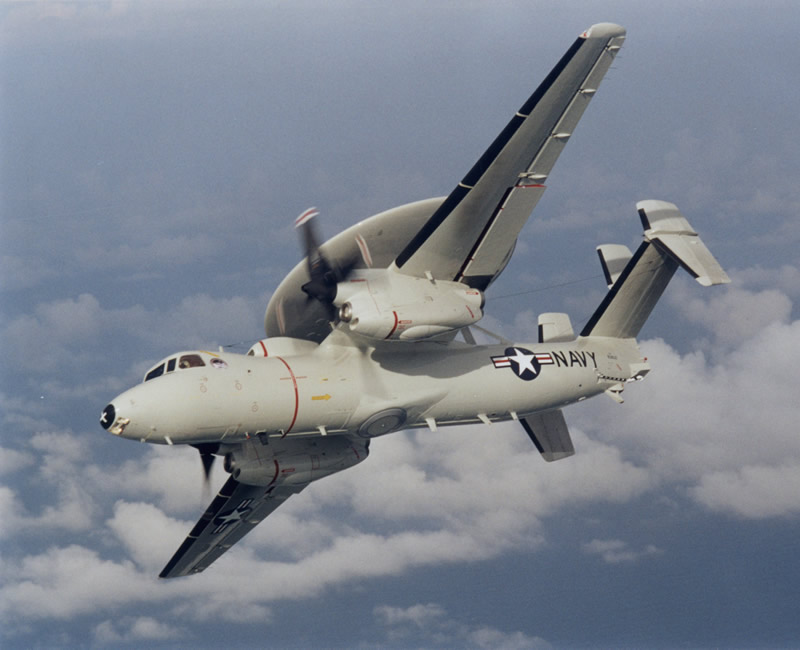
(click to view full)
Ar/Missile Defense – Hawkeye 2000 [see announcement, PDF]:
Taiwan already flies 2 E-2C+ Hawkeye 2000 and 4 E-2T Hawkeye aircraft for airborne early warning and control, and wants to upgrade the E-2Ts to the Hawkeye 2000 configuration used by the USA, France, Japan and others. The upgrade will include provisions for the Joint Tactical Information Distribution System (Link 16 for a common battlespace picture), avionics, navigation and non-navigation upgrades, and aircraft electrical, mechanical, and survivability upgrades, all necessary hardware installations, support equipment, spares and repair parts, installation and training, publications and technical documents, U.S. Government and contractor technical assistance, and other related elements of logistics and program support.
American Hawkeye 2000s also have Cooperative Engagement Capability, which allows them to provide shared battlespace pictures and targeting for properly equipped Patriot PAC-3 and PAC-2 missiles. If CEC is not included, the JTIDS/Link 16 can be used to share a battlespace picture and provide advance warning, but cannot be used for targeting.
The estimated cost is up to $250 million, and the prime contractor will be Northrop Grumman Corporation in Bethpage, NY. Implementation of this proposed sale will require the assignment of 6 contractor representatives to the recipient for a not to exceed a 5-year period.
Taiwan has requested industrial offsets with this order; they will be defined in negotiations with Northrop Grumman.
DSCA: E-2C 2000 AWACS upgrade request
Air Force – Aircraft Parts [see announcement, PDF]:
This blanket order would allow Taiwan to requisition follow-on spare parts as required to maintain its C-130H Hercules transports, F-5E/F Tiger II fighters, F-16A/B fighters, and F-CK IDF fighter aircraft. The requisitions can include communication equipment, radar, and other related elements of logistics support, as well as spares. The estimated cost is $334 million, and items will be ordered from appropriate contractors as needed.
Implementation of this proposed sale will not require the assignment of any additional U.S. Government and contractor representatives to the recipient.

(click to view full)
Army – Apache Longbow attack helicopters and weapons [see announcement, PDF]. Taiwan currently flies AH-1W Cobras in this role, and an attack helicopter deal has been in the works since 2002. The AH-64D beat Bell’s AH-1Z Viper on the grounds that it was battle proven, while the AH-1Z remains developmental.
Taiwan is requesting 30 AH-64D Apache Longbow Block III attack helicopters, the helicopter’s most modern configuration which is just beginning to enter service in the USA. The helicopters will be equipped with 30 Modernized Target Acquisition Designation Sight/Pilot Night Vision Sensor (MTADS/PNVS “Arrowhead”), 17 AN/APG-78 Fire Control Radars and AN/APR-48 Radar Frequency Interferometer (FCR/RFI), 69 T700-GE-701D Turbine Engines. Composite horizontal stabilators, crew and maintenance trainers, depot maintenance, all necessary support equipment, tools and test equipment, integration and checkout, spares and repair parts, training and training equipment, and other forms of support are included in the base purchase.
The request also includes applicable weapons for these helicopters: 173 FIM-92F Stinger Block I Air-to-Air Missiles, 35 Stinger air-air missile Captive Flight Trainers with live guidance systems but no rocket motors, 1,000 AGM-114L Longbow Hellfire anti-armor missiles that can use the APG-78 and their own radar’s millimeter-wave guidance for “fire and forget” capability, and 66 M299 Hellfire missile launchers.
The estimated cost is $2.532 billion, and Taiwan has requested industrial offsets; these will be defined in direct negotiations with the contractor(s). Implementation of this proposed sale will require the assignment of 2 U.S. Government personnel for a period of 6 years to provide intensive coordination, monitoring, and technical assistance. In addition, 6 contractor representatives will be in country serving as Contractor Field Service Representatives for a period of 5 years, with the possibility of a 5-year extension. The principal contractors will be:
* The Boeing Company in Mesa, AZ and St Louis, MO (AH-64)
* General Electric in Lynn, MA (Engines)
* Lockheed Martin Missiles and Fire Control in Orlando, FL (Longbow Hellfires, M299, Arrowheads)
* Lockheed Martin Systems Integration in Owego, NY
* Northrop Grumman Corporation in Baltimore, MD (Longbow Hellfires)
* Raytheon Company in Tucson, AZ (Stinger missiles)
* Inter-Coastal Electronics in Mesa, AZ
* BAE Systems in Rockville, MD
DSCA: AH-64D request
Army – Javelin missiles [see announcement, PDF].
Taiwan wants to buy 182 more man-portable Javelin anti-armor missile rounds and 20 command launch units, plus 40 missile simulation rounds, trainers, rechargeable and non-rechargeable batteries, support equipment, spare and repair parts, and other related elements of logistics support. The estimated cost is $47 million.
Raytheon/Lockheed-Martin’s JAVELIN Joint Venture in Orlando, FL will be the prime contractor. Implementation of this proposed sale will require a U.S. Government Quality Assurance Team consisting of 1 contractor and 2 U.S. Government representatives in country for 5 days to accomplish the initial deployment of the missiles. Taiwan won’t need more help than that, as they were one of the Javelin “fire and forget” missile’s early customers in 2002.
DSCA: Javelin missile request
(click to view full)
Navy – Harpoon missiles [see announcement, PDF].
Taiwan requests 32 UGM-84L Sub-Launched Harpoon Block II missiles for its 2 Seadragon Class submarines. Harpoon Block II includes GPS guidance that makes them easier to use near shore (for instance, against amphibious landing ships on final approach), and also gives the missiles some land attack capability out to their 150 mile range. Taiwan’s request adds 2 UTM-84L Harpoon Block II Exercise missiles, 2 Advanced Harpoon Weapons Control System (Version 2) for installation on the Seadragon Class, 36 Harpoon containers, 2 UTM-84XD Encapsulated Harpoon Certification and Training Vehicles, test equipment and services, spares and repair parts for support equipment, and other forms of support.
The estimated cost is $200 million, and the contractor is Boeing subsidiary McDonnell Douglas in St Louis, MO.
The US DSCA notes that “The recipient has previously purchased both air and surface launched HARPOON missiles and will be able to absorb and effectively utilize these submarine-launched missiles.” As such, no additional U.S. Government or contractor representatives will be required.
DSCA: Sub-launched Harpoon missiles request
Sept 29/08: Taiwan News reports that:
“The Pentagon was expected to notify the U.S. Congress of its intention to sell the arms to Taiwan by the end of its current session last Friday. Taiwan has expressed worries that if the U.S. missed the deadline, the Legislative Yuan would have to start the process of approving a budget for the arms package from the start… Congress had been extended to deal with the current financial crisis, and therefore the arms deal could still be approved.
The package includes Patriot missiles, Apache helicopters, diesel-powered submarines, anti-tank missiles, submarine-launched missiles and P-3C Orion anti-submarine aircraft, but not new F-16 fighter jets Taiwan was hoping to buy.
The U.S. State Department notified the Taiwanese media late on Friday that government departments were still reviewing the deal, and that once it was approved, Congress would be immediately notified.”
This did not sound like anything close to a sense of urgency, but events would prove otherwise. Pro-China elements in the US State Department are still blocking approval of Taiwan’s unofficial request for F-16C/D fighters.
April 23/08: Patriot SAM. Raytheon announces a $79 million Foreign Military Sales award from the U.S. Army to provide Taiwan with Patriot Configuration-3 radar upgrade kits and related engineering and technical services. This is part of a much larger order; see Nov 9/07 entry for more.
Work will be performed by Raytheon Integrated Defense Systems at the Integrated Air Defense Center in Andover, MA; the Warfighter Protection Center in Huntsville, AL; and the Mission Capability and Verification Center in White Sands, NM.
Nov 9/07: PATRIOT upgrade request. The US DSCA announces [PDF] “The Taipei Economic and Cultural Representative Office in the United States” formal request to upgrade and refurbish their 3 existing PATRIOT fire units’ ground support equipment to the latest Army Configuration 3 under a $939 million contract. Raytheon Corporation in Andover, MA will be the prime contractor. Although the purchaser generally requires offsets, at this time, there are no known offset agreements proposed in connection with this potential sale and no additional U.S. Government or contractor representatives will be required.
Obviously, this effort is less helpful than acquiring new Patriot PAC-3 missiles to add to Taiwan’s defense. Instead, they are adding Patriot PAC-3 radar and communications enhancements to Taiwan’s existing Patriot batteries, turning them into a PAC-2 GEM+ type configuration in use by a number of US allies. The PAC-2 missile is larger than the PAC-3, and uses a fragmentation warhead instead of the PAC-3 missile’s “hit to kill” approach. Patriot’s widely-touted performance during the 1991 Desert Storm operation turned out to be significantly overstated, but when coupled with PAC-3 class radars et. al., it has demonstrated useful capabilities against incoming ballistic missiles. The specific sale includes:
* 2 PATRIOT, MIM-104 (Patriot-As-A-Target)
* Radar Enhancement Phase 3 (REP-3)
* Classification, Discrimination and Identification Phase 3 (CDI-3)
* Remote Launch Communication Enhancement Upgrade (RLCEU)
* An Electric Power Plant.
* 36 AN/VRC-88E SINCGARS EXP Vehicle Short Range Radio Systems
* 32 AN/VRC-90E SINCGARS EXP Vehicle Long Range Radio Systems
* 4 AN/VRC-91E SINCGARS EXP Long Range Radio Systems
* 11 AN/VRC-92E SINCGARS EXP Dual Range Radio Systems
It also includes non-MDE (Military Designated Equipment under US Arms transfer laws) items such as
all necessary modification kits, communication support equipment, tools and test equipment, integration and checkout, spares and repair parts, installation and training, publications and technical documents, U.S. Government and contractor technical assistance, other related elements of logistics and program support, and 4 telemetry kits for its live fire training.
DSCA: PATRIOT upgrade request

note Sidewinder
(click to view full)
Sept 12/07: P-3 MPAs. The US DSCA announces [PDF] the “Taipei Economic and Cultural Representative Office in the United States” official request for 12 ‘excess’ P-3C Orion maritime patrol aircraft, with strong surveillance and anti-submarine capabilities. The estimated cost is $1.96 billion. DSCA adds that:
“This sale is consistent with United States law and policy as expressed in Public Law 96-8. The United States is committed to providing military assistance under the terms of the Taiwan Relations Act. The recipient’s current patrol aircraft are reaching the end of their fatigue and operational service life. To maintain national security it is necessary that recipient replace these fixed-wing aircraft with an airborne operational capability for land-based maritime patrol and reconnaissance, including economic exclusion zone surveillance and protection, command and control, anti-submarine warfare, and anti-surface warfare. The recipient can absorb these additional aircraft into its inventory.”
Offset agreements associated with this proposed sale are expected, but they will be defined in negotiations between the purchaser and contractors. Principal contractors include Lockheed Martin of Eagan, MN; Lockheed Martin Aircraft Center of Greenville, SC; Rockwell Collins of Cedar Rapids, IA; Raytheon Company of McKinney, TX, EDO (Condor Systems) of Morgan Hill, Ontario Canada; and L3 Wescam of Ontario, Canada. There may be up to 32 U.S. Government and contractor representatives with varying technical skills and disciplines who will be required, following the delivery of the aircraft, to provide support for 1 year after the last aircraft delivery. The exact request includes:
* 12 ‘excess’ P-3C Orion aircraft with T-56 engines. It is likely that they will begin with ‘boneyard’ stored aircraft that need refurbishing to fly, and significant modifications to be viable for any significant period. Some parties like Norway, for instance, are making their P-3s viable by completely replacing their wings as part of their general overhaul.
* Aircraft activation, aircraft life extension and avionics modification, transportation
* 3 excess TP-3A aircraft (non-operational, to be used as airframe spares) with T-56 engines
* 15 Data Link terminals
* 19 MIDS-LVT Link 16 terminals
* 2 MIDS On-Ship Terminals
Plus a mobile operation command center, Command Control Communications Computer Intelligence Surveillance, Reconnaissance, (C4ISR) network integration, training devices, medical services, support and test equipment, engineering technical services, supply support, operation and maintenance training, ground support C2 facilities, documentation, spare/repair parts, publications, documentation, personnel training, training equipment, contractor technical and logistics personnel services, and other related support elements.
DSCA: P-3C MPA request
April 16/06: President Chen Shui-bian presides over the commissioning of 2 E2C+ Hawkeye 2K planes recently purchased from the United States, and calls for an end to KMT blocking of his special military budget requests. The 2 new planes join 4 E-2Ts bought in 1995. China Post.
Additional Readings
Readers with corrections, comments, or information to contribute are encouraged to contact DID’s Founding Editor, Joe Katzman. We understand the industry – you will only be publicly recognized if you tell us that it’s OK to do so.
Background: Policy
* Republic of China, Ministry of National Defense – National Defense Report (English)
* US DSCA Defense Institute of Security Assistance Management – A Comparison: Direct Commercial Sales & Foreign Military Sales [PPT]. See also “A Comparison of Direct Commercial Sales and Foreign Military Sales for the Acquisition of US Defense Articles and Services” [PDF]. From October 2008.
Background: Equipment
* Naval Technology – Avenger Class Mine Countermeasures Vessels, United States of America.
* DID – AH-64E Apache Block III: The Once and Future Attack Helicopter.
* Lockheed Martin Code One magazine – F-16 Evolution. Explains the different Blocks & capabilities. Stops short of the subsequent F-16S/V, though the F-16E/F Block 60 has a number of similarities. From September 2008.
* Global Security – Hai Lung II [Sea Dragon] class Submarine. Details the many twists and turns in Taiwan’s attempts to buy new diesel-electric submarines.
* DID – Ships Ahoy! The Harpoon Missile Family
* Naval Technology – P-3C Orion Maritime Patrol Aircraft.
* DID – Timely Defenders: Keeping Patriots in Shape. PAC-2, PAC-3, and PAC-3 MSE.
News & Views
* Defense News (Nov 26/13) – Taiwan’s BMD Radar Gives Unique Data on China. Tags it as a modified AN/FPS-115 Pave Paws UHF long-range radar, with potential jamming capabilities given its high output.
* Asia Times (Jan 12/12) – Taiwan’s Project Diving Dragon resurfaces. Are reports of an indigenous submarine project just disinformation for KMT political advantage?
* Wall St. Journal (Aug 30/11) – Taiwan is Losing the Spying Game. “…the penetration of almost every sector of Taiwanese society by Chinese intelligence… any arms sale to Taiwan carries the risk that sensitive military technology will end up in Beijing.”
* The Diplomat (July 11/11) – Why Taiwan Needs Submarines.
* American Enterprise Institute (June 13/11) – U.S. Navy Needs Diesel Submarines. The neo-conservative think-tank cites Taiwan’s buy as one reason, and a combination of budget realities and changing US Navy missions as the other.
* Flight Global (June 13/11) – Taiwan’s AH-64 deal: a knife for a gunfight. The crux: helicopters are hard to operate without air superiority.
* Jamestown Foundation (April 13/11) – Taiwan’s Ballistic-Missile Deterrence and Defense Capabilities.
* Wall Street Journal (Dec 13/09) – Interview with Ma-ying Jeou :Taiwan’s Détente Gamble.
* StrategyPage (Nov 26/09) – Taiwan Arms Itself Despite Chinese Pressure. But it’s getting more difficult.
* StrategyPage (Oct 23/09) – The Losers Game. “In most cases, Taiwanese planners now believe that the Chinese could succeed… While many Taiwanese still see the United States as the ultimate guarantor of Taiwanese independence, they see China as increasingly capable of grabbing the island before the U.S. can intervene. So while the Taiwanese don’t have to be strong enough to defeat a Chinese invasion, they do have to be strong enough to hold the Chinese back until American reinforcements can show up.”
* World Politics Review (Oct 7/09) – Restoring the Military Balance in China-Taiwan Relations.
* Taiwan Link (Oct 3/08) – Taiwan Arms Sales: A New Phase Begins. Offers analysis concerning the overall relationship, as well as specific sales.
* Defense News (May 5/07) – Taiwan F-16 Plan Faces Opposition in Washington [dead link] “To further complicate the problem, the legislature has whittled the procurement deal down by eliminating the PAC-3s and submarines and replacing the package with a study on submarine designs, an upgrade for Taiwan’s current PAC-2s and the 12 P-3s – and still that budget has been delayed by additional political wrangling…” Also: “A very senior U.S. person is blocking the F-16 sale to Taiwan. Even if Taiwan passes the defense budget, it will not affect this decision to block the sale. A State Department rep at the meeting did not want to give any room to negotiate on this issue,” said a U.S defense contractor here.”
* DID (Oct 4/06) – F-16 Sale Nixed: KMT Opposition to Taiwan’s Defense Claims Latest Victim.
* DID (Nov 1/05) – Taiwan Orders F-16 Training in USA, But Larger Defense Buys Remain in Limbo.