

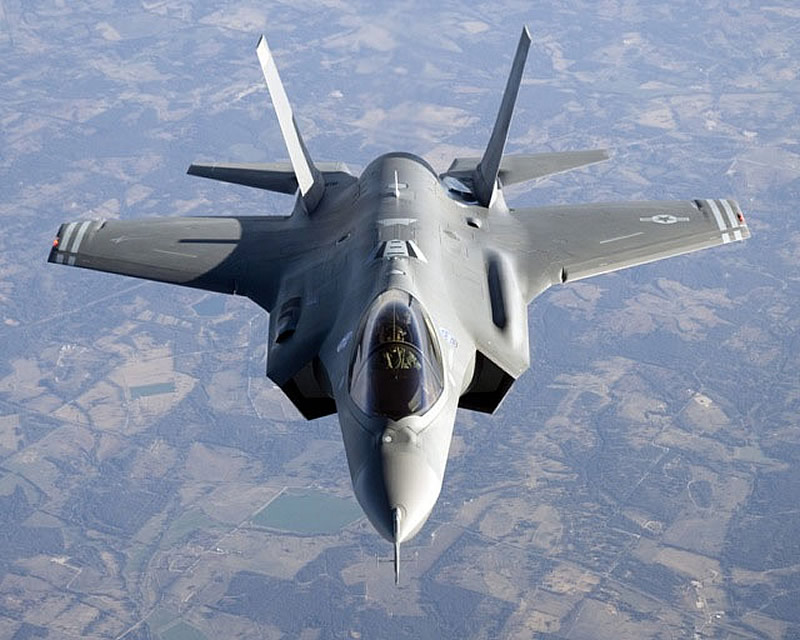
(click to view full)
The $382 billion F-35 Joint Strike fighter program may well be the largest single global defense program in history. This major multinational program is intended to produce an “affordably stealthy” multi-role fighter that will have 3 variants: the F-35A conventional version for the US Air Force et. al.; the F-35B Short Take-Off, Vertical Landing for the US Marines, British Royal Navy, et. al.; and the F-35C conventional carrier-launched version for the US Navy. The aircraft is named after Lockheed’s famous WW2 P-38 Lightning, and the Mach 2, stacked-engine English Electric (now BAE) Lightning jet. Lightning II system development partners included The USA & Britain (Tier 1), Italy and the Netherlands (Tier 2), and Australia, Canada, Denmark, Norway and Turkey (Tier 3), with Singapore and Israel as “Security Cooperation Partners.” Now the challenge is agreeing on production phase membership and arrangements, to be followed by initial purchase commitments in 2009-2010.
This updated article has expanded to feature more detail regarding the F-35 program, including contracts, sub-contracts, and notable events and reports. Recent events and major programs shifts have been added to this article, in order to ensure maximum continuity and context. 2012 developments are covered in this follow-up article.
The F-35 Family of Aircraft

(click to view full)
The F-35 is designed as an ‘affordable stealth’ counterpart to the F-22 Raptor air dominance fighter, one that can share “first day of the war” duties against defended targets but can’t perform air-air or air-ground missions to the same standard. Its air-air combat flight benchmarks are only on par with the F-16, it has a larger single engine instead of twin thrust-vectoring F119s, removing both supercruise (sustained flight above Mach 1) and super-maneuverability options. The F-22A is a much stealthier aircraft on both radar and infrared, but the F-35 is a big improvement over existing ‘teen series’ fighters and even beats Generation 4+ options like the Eurofighter, Rafale, and JAS-39 Gripen.
Radar for the F-35 JSF
click to play video
The Lightning II will be well equipped. Its advanced APG-81 AESA (Active Electronically Scanned Array) radar is smaller and less powerful than the F-22A’s APG-77v1; but still offers the strong AESA advantages of simultaneous air-air and air-ground capabilities, major maintenance & availability improvements, and secure, high-bandwidth communications benefits. The F-35 also shares a “sensor fusion” design advance with the F-22, based on sensors of various types embedded all around the airframe. This sensor set is even more extensive than the F-22’s. Both planes will be able to perform as a top-level reconnaissance aircraft, though the F-35 will have superior infrared and ground-looking sensors. Both aircraft will also have potential as electronic warfare aircraft.
These sensors are connected to a lot of computing power, in order to create single-picture view that lets the pilot see everything on one big 20″ LCD screen and just fly the plane, rather than pushing buttons to switch from one view to another and trying to figure it all out. As part of that sensor fusion, the F-35 will be the first plane is several decades to fly without a heads-up display; instead, pilots will wear Elbit/Rockwell’s JHMDS helmet and have all of that information projected wherever they look.

(click to view full)
Once targets are found, the Lightning II will be well equipped with weapons. A large order base, and a wide international client base, will provide considerable incentive for manufacturers to qualify their weapons with the aircraft. MBDA has already pledged a compatible version of its long-range Meteor air-air missile, for instance, and other manufacturers can be expected to follow.
Initial internally-stowed weapons qualified during system design and development will include 1,000-2,000 pound JDAM GPS-guided bombs, 500 pound GBU-12 Paveway II laser-guided bombs, AGM-154 JSOW precision glide bombs, and the AIM-120 AMRAAM and MBDA’s AIM-132 ASRAAM air-to-air missiles; the UK’s Paveway-IV dual laser-GPS bombs, and the USA’s GBU-39 GPS-guided Small Diameter Bombs, may also be qualified. Weapons initially qualified for external mounting will include 500 pound GBU-12 Paveway II laser-guided bombs, AIM-9X Sidewinder SRAAMs, and a 25mm centerline gun pod for the F-35B and F-35C. Kongsberg’s new Naval Strike Missile and MBDA’s ASRAAM may also receive initial qualification; and early customer Israel is certain to qualify a range of its own weapons, including the Python-5 SRAAM and various smart bombs and missiles.
Weapons will continue to be added beyond the SDD phase, with full warfighting capability currently scheduled for 2014. At present, internally stowed additions will include the 500 pound JDAM, The Brimstone and Joint Air to Ground Missile anti-armor weapons, and GPS-guided WCMD cluster bombs. All of these weapons will also be qualified for external mounting, along with the full family of Paveway laser-guided and dual-mode smart bombs up to 2,000 pounds, MBDA’s Storm Shadow and Lockheed Martin’s JASSM stealthy long range cruise missiles, a baggage pod for naval use, and other weapons as required.
Finally, the F-35 has a large number of design features that aim to simplify maintenance and keep life cycle costs down, most notably the innovation of self-diagnosing aircraft wiring, and the fleet-wide ALIS information and diagnostic system. See references in “Additional Readings & Sources,” below, for more detailed information.
For its power plant, the F-35 will offer interchangeable engine options – at least for now. Pratt & Whitney’s F135 powers the current test aircraft, and a special version with add-ons will also power the vertical-landing F-35B. GE and Rolls Royce are working on the F136, however, which can fit into any F-35 without modifications and also has a special version for the F-35B. If Congress continues to win, and the Pentagon continues to fail in its efforts to kill the F136 sub-program, customers will be able to select which company’s engine model and service package they want for their F-35 fighters. They will also have a choice of fighter models:

(click to view full)
The basic F-35A, sometimes called the CTOL (Conventional Take-Off and Landing) version, is the basic USAF version, with a 9g maneuverability limit. It is expected to be the predominant export type as well, and is considered the “baseline” version.
Its main difference from other versions is its internal 25mm cannon, rather than having to use a weapons station for a semi-stealthy gun pod option. The USAF removed guns from some of its planes back in the 1960s, and didn’t enjoy the resulting experiences. Many allies wanted the 27mm Mauser cannon installed; it was originally specified, and is widely believed to offer the world’s best combination of firing rate and hitting power. In the end, however, ammunition standardization benefits involving 25mm land and sea platforms trumped pure performance.
The F-35A has been the first variant to fly, but it may be the second type to reach Initial Operational Capacity, in 2015-16. That appears set to slip to 2017, in the wake of January 2011 announcements.

(click to view full)
The F-35B STOVL (Short Take-Off, Vertical Landing) will serve the US Marines, Royal Navy, other navies with ski-ramp equipped LHDs or small carriers, and militaries looking for an “expeditionary airplane” that can take off in short distances and land vertically. To achieve this, it has a large fan behind the cockpit and nozzles that go out to the wing undersides. In 2005, the JSF program took a 1-year delay because the design was deemed overweight by about 3,000 pounds. The program decided to reduce weight rather than run the engine hotter, because the latter choice would have sharply reduced the durability of engine components and driven life cycle costs higher. Weight cutting became a focus of various engineering teams, with especial focus on the F-35B because the weight was most critical to that design.
Those efforts pushed the F-35B’s design to greater readiness than other variants, but changed its airframe. The F-35B gives up some range, some bomb load (it cannot carry 2,000 pound weapons internally, and the shape of its bay may make some weapons qualifications a challenge), some structural strength (7g maneuvers maximum instead of 9g), and the internal gun.
The F-35B completed its Critical Design Review in October 2006, and the 2nd production F-35 was a STOVL variant. Per the new plan he signed on Sept 16/10, the USMC’s VMA-332 in Yuma, AZ must have 10 F-35Bs equipped with Block IIB software, with 6 aircraft capable of austere and/or ship-based operations, and all aircraft meeting the 7g and 50-degree angle of attack specifications, in order to declare Initial Operational Capability. Flight testing began in 2009, with Initial Operational Capability (IOC) expected by December 2012. That would have been the earliest of the 3 variants – but flight testing fell way behind thanks to a series of technical delays. The program is now on probation, with production delayed, and 2 years to show that it’s on track or be cancelled. In reality, it may have less than that due to mounting fiscal pressures. If the F-35B survives, an IOC of 2017 or later is certainly possible.
The F-35B will probably be the most expensive F-35 version, but it has a unique market niche as a more capable and safer replacement for the aging Sea Harriers and AV-8B Harrier IIs currently operated from small carriers and LHD ships by US Marines, as well as nations like Italy, Spain, and Thailand. The proliferation of fighter-capable LHDs and small carriers to nations like Australia, Korea, India and others will expand this variant’s future market options, as it currently has no viable competitors. The question is whether it will ever reach the marketplace, or find itself displaced on large-deck amphibious ships by UAVs and compound helicopters.

(click to view full)
The F-35C carrier-based fighter features 30% more wing area than other designs, with larger tails and control surfaces plus wingtip ailerons. These changes provide the precise slow-speed handling required for carrier approaches. The F-35C’s internal structure is strengthened to withstand the punishment dished out by the catapult launches and controlled crashes of carrier launch and recovery, and an arrester hook is added to the airframe. The US Navy gave up the internal gun, and the aircraft will be restricted to 7.5g maneuvers.
The F-35C is expected to be the US Navy’s high-end fighter, as well as its high-end strike aircraft. This means that any performance or survivability issues will have a disproportionate effect on the US Navy’s future ability to project power around the world. In 2010, the British Royal Navy opted to field the F-35C on their new carrier after 2020, instead of the F-35B.
The F-35C will be the last variant designed; it passed its Critical Design Review in June 2007, and the first production version was scheduled to fly in January 2009. The F-35C rollout did not take place until July 2009, however, and first flight didn’t take place until June 2010. Initial Operational Capability was scheduled for 2014, but looks set to slip to 2017 or later if January 2011 reports prove true.
F-35 Program: Production Timelines & Structure

(click to view full)
The first test aircraft, an F-35A model AA-1, had its formal rollout on July 7/06. The F-35B STOVL’s forced redesign for weight reasons has led to F-35 AA-1 being a unique airframe used to validate design, manufacturing, assembly and test processes. A total of 23 test aircraft will be built for various purposes (15 flight, 7 non-flight, 1 radar signature), but the exact order of build for the variants involved has shifted several times.
The testing phase was originally supposed to end in 2013, but is now officially scheduled to continue until 2016. Funding for the first sets of production-model aircraft is approved, parts fabrication is under way as of June 2007, and component assembly began later in 2007. The first pair of F-35A aircraft are scheduled for delivery to the U.S. Air Force beginning in 2010 – a sore point with the US Congress’ Government Accountability Office, which believes this dual-track approach over overlapping testing with production increases project risks. Production will continue to ramp up year-to-year, and BAE Systems releases expect that by 2015, when the F-35 is expected to reach Full-Rate Production, the program intends to build 240 F-35s per year.
Delays in fielding the initial set of test aircraft, fewer than expected flights, and questions about that ambitious ramp up schedule have reportedly led the Pentagon to re-examine these schedules. Development may now last into FY 2015 or later, and Full-Rate Production may also be pushed back.
The JSF program is ‘tiered,’ with 4 possible levels of participation based on admission levels and funding commitments for the System Design & Development (SDD) phase. Note that all SDD funding totals below are in US dollar equivalents:
* Tier 1 Partners: The USA (majority commitment), Britain ($2 billion)
* Tier 2 Partners: Italy ($1 billion); The Netherlands ($800 million)
* Tier 3 Partners: Australia ($150M), Canada ($150M), Denmark ($125M), Norway ($125M), Turkey ($175M)
* Security Cooperative Participants status: Israel ($35M), Singapore.
* Exports: In September 2006, Lockheed Martin vice president for the JSF program Tom Burbage said that Greece, Japan, South Korea, and Spain have expressed interest in buying F-35s. India has also been rumored as a future JSF customer, and Indian representatives have been invited to Joint Strike Fighter events.
All Tier 1-3 nations have also signed MoUs for the Production Phase. This is not a commitment to buy, just the phase in which production arrangements are hammered out – subject to revision, of course, if that country decides not to buy F-35s. Italy has expressed an interest in a Lockheed-Martin Final Assembly and Check Out (FACO) plant for European orders, and Fellow Tier 1 partner Britain is examining a FACO of its own for BAE. The Netherlands, meanwhile, wants to be a center for engine sustainment and heavy maintenance. The Dutch have signed an agreement with Italy to help each country get what it wants; Norway was added to that agreement in June 2007.
Production and Players

(click to view full)
At present, F-35 production is led by Lockheed Martin, with BAE and Northrop-Grumman playing major supporting roles, and many subcontractors below that. F-35 main production and final assembly is currently slated to take place in Lockheed Martin’s Fort Worth, TX plant. To cut F-35 production cycle time, the team produces major sections of the aircraft at different feeder plants, and “mates” the assemblies at Fort Worth. This is normal in the auto industry, but it’s a departure from the usual fighter-building process which has raw materials and individual parts or small sub-assemblies feed into production lines, and fighters roll out the other end.
The precise tolerances required for a stealthy fighter, however, are much more exacting than even high-end autos. To cope, Manufacturing Business Technology reports that the team has turned to an integrated back-end IT system. It begins with 3D engineering models (Dassault Systemes CATIA CAD), and extends into production management, where the company has rolled out a manufacturing execution system to handle electronic work instructions, workflow and process modeling, serialized parts data, quality records tracking, et. al. (Visiprise). This combination has enabled greater use of techniques like automated drilling, and product record management and collaboration around designs (Siemens PLM, TeamCenter) is also possible. On the back-end, the team uses a custom system it calls Production & Inventory Optimization System (PIOS) for manufacturing resources planning and supply chain management; it began using ERP software (SAP) in January 2008 for financials, however, and may eventually use it to handle supply-chain functions too.
This ‘digital thread’ has been very successful for the team, with part fits showing incredible precision, and successful coordination of plants around the end schedule for key events like the Dec 18/07 F-35B rollout. The system’s ultimate goal is to cut a plane’s production cycle time from the usual 27-30 months to about 12 months, and shrink the 15-20 day cycle from order creation to printed, matched manufacturing orders to 6-8 days.

(click to view full)
BAE Systems is deriving substantial benefits from Britain’s Tier 1 partner status; they will be responsible for the design, manufacture and assembly of the F-35 JSF aft fuselage and empennage (vertical and horizontal tails), and are also involved in other areas including the crew escape system, fuel system, life support system and proactive aircraft diagnostics system integration.
Northrop Grumman is responsible for the F-35’s important ‘center barrel’ section, where the wings attach to the fuselage. Denmark’s Terma and Lystrup, and Turkish Aerospace Industries, act as center fuselage subcontractors. NGC also provides the aircraft’s AN/APG-81 AESA radar, other key radar and electro-optical subsystems, the aircraft’s communication, navigation and identification avionics, mission systems and mission-planning software, and pilot and maintenance training systems.
Other subcontractors playing confirmed specialty roles in the production phase include EDO (weapons release from internal bays), SimiGon (simulation tools), Stork (wiring), and the Elbit/Rockwell partnership Vision Systems (HMDS helmet with heads-up display). A number of firms in the various partner countries will also receive production phase contracts.
To date, the aircraft is still in low-rate initial production. Orders and budgeted orders include:
* LRIP Lot 1, FY 2007: 2 F-35As for the USAF.
* LRIP Lot 2, FY 2008: 12 aircraft – 6 F-35As (USAF); 6 F-35Bs (USMC).
* LRIP Lot 3, FY 2009: 17 aircraft – 8 F-35As (7 USAF, 1 Dutch); 9 F-35Bs (7 USMC, 2 UK).
* LRIP Lot 4, FY 2010: 32 aircraft – 13 F-35As (12 USAF, 1 Dutch); 15 F-35Bs (14 USMC, 1 UK); and 4 F-35Cs (USN). Final order changed, becoming 31 planes: 10 USAF F-35As, 17 F-35Bs for USMC and Britain, and 4 USN F-35Cs.
* LRIP Lot 5, FY 2011: 32 aircraft – 22 F-35As (USAF); 13 F-35Bs (USMC, reduced to 3); 7 F-35Cs (USN). No international buys.
The US GAO describes the program this way. Cumulative American procurement dollars and aircraft bought or planned as of March 2010, over the program’s scheduled system design & development phase, were:
2007: $0.9 billion, 2 aircraft
2008: $3.6 billion, 14 aircraft
2009: $7.1 billion, 28 aircraft
2010: $14.4 billion, 58 aircraft
2011: $23.6 billion, 101 aircraft
2012: $33.2 billion, 146 aircraft
2013: $45.2 billion, 217 aircraft
2014: $58.2 billion, 307 aircraft
2015: $72.4 billion, 420 aircraft
In 2011, the Pentagon changed that plan, putting the F-35B on probation, stretching System Design & Development to 2016, and slowing production. Over the course of 2011-2016, Gates’ 2011 changes will cut 47 F-35As, 70 F-35Bs, and 7 F-35Cs, leaving American services with 415 production F-35s of all types by the end of 2016 LRIP orders. Current plans for American orders are:
2011: 32 – 22 F-35A, 3 F-35B STOVL, 7 F-35C
2012: 32 – 19 F-35A, 6 F-35B STOVL, 7 F-35C
2013: 42 – 24 F-35A, 6 F-35B STOVL, 12 F-35C
2014: 62 – 40 F-35A, 8 F-35B STOVL*, 14 F-35C
2015: 108 – 70 F-35A, 18 F-35B STOVL*, 20 F-35C
Even so, buying 415 new fighters before testing finishes still represents a large retrofit risk, if testing reveals problems in production planes.
The F-35 Family: Controversies and Competitions

(click to view full)
The program’s biggest controversies revolve around 3 issues: effectiveness, affordability, and control. A 4th issue, noise, is not significant yet, but could become so.
Effectiveness: When the F-35 Lightning II is compared with the larger and more expensive F-22A, the Raptor is a much stealthier aircraft on both radar and infrared, and its stealth is more uniform. The Lightning family is optimized for “low-observable” stealth when viewed from the front, with less stealth to radars looking at it from the sides, and less still when targeted from the rear. It also lacks the Raptor’s supercruise (sustained flight above Mach 1) and super-maneuverability thrust-vectoring options, which work with stealth to help the F-22 engage and disengage at will. Lockheed Martin claims that the F-35 design is optimized for trans-sonic acceleration, but the Raptor can cruise without afterburners at the F-35’s theoretical maximum speed, and fuel usage rates with afterburner engaged limit supersonic time for fighters like the F-35.
These relative drawbacks have led to questions about the F-35’s continued suitability against the most modern current air defense threats, and against the evolved threats it can expect to face over a service lifetime that’s expected to last at least until 2050.
On the flip side of the coin, the F-35A/C variants will offer larger capacity internal bays for weapons, allowing a wider selection of stealth-preserving internal ordnance. Slight bulges were added to the production F-35’s underside profile in order to accommodate that space, however, making them less stealthy than the original X-35 designs when confronted by radar waves aimed at their sides. All F-35s also boast more embedded sensors than the F-22, with an especial advantage in infrared and ground-looking sensors. Though this feature has yet to be tested in combat, all-aspect IRST (Infra-Red Scan & Track) sensors reportedly allow 360-degree targeting of aircraft around the F-35. If that works, the inertial guidance and datalink features of modern infrared missiles like the AIM-9X Sidewinder and AIM-132 ASRAAM can already take full advantage of it.
Which customers can live with these relative disadvantages as an acceptable trade-off, and which will be badly hurt by them? Will the F-35 be a fighter that’s unable to handle high-end scenarios, while also being far too expensive to field and operate in low-end scenarios? Even if that’s true, could countries who want one type of multi-role fighter still be best served by the F-35, as opposed to other options? That will depend, in part, on…

(click to view full)
Affordability: The F-35 family was designed to be much more affordable than the F-22, but a number of factors are narrowing that gap. One is cost growth in the program. This has been documented by the GAO, and statements and reports from the US DoD are beginning to follow the same kind of “rising spiral of admissions” pattern seen in past programs. The 2nd is loss of commonality between the 3 models, which the GAO has cited as falling below the level required to produce significant savings. A 3rd is production policy. The US GAO in particular believes that the program’s policy of beginning production several years before testing is complete, only adds to the risks of future price hikes and operating cost shocks.
The 4th factor is lateness. The program as a whole is about 5 years behind its ideal point, relative to the replacement cycle for fighters around the globe. F-35 program customers thus find themselves in the unenviable position of having to commit to a fighter that has not completed testing, and does not have truly firm purchase or operating costs, while buying early production fighters that are always much more expensive. Barring innovative procurement approaches that average unit costs for the first few hundred aircraft, customers may end up paying around $100-120 million per F-35.
Control: This has been a big issue in the past for customers like Britain and Australia, and has now become an issue for Israel as well. Without control over software source codes, integration of new weapons and algorithms can be controlled by the whims and interests of American politicians and defense contractors. On the other hand, America sees wider access to those fundamental building blocks as a security risk. Arrangements with Britain and Australia appear to have finessed that debate, without removing it. Recent statements concerning refusal to undertake hardware swap-outs for country customization, and implications that changes must be made through Lockheed Martin, could easily revive that debate.
Noise: The F135 engine’s size and power are unprecedented in a fighter, but that has a corollary. Environmental impact studies in Florida showed that the F-35A is approximately twice as noisy as the larger, twin-engine F-15 fighter, and over 3.5 times as noisy as the F-16s they’re scheduled to replace. That has led to noise complaints from local communities in the USA and abroad, and seems likely to create a broad swathe of local political issues as customers deploy them. In some countries, it may add costs, as governments are forced to compensate or even to buy out nearby homeowners affected by the noise.
Each customer must weigh the issues above against its own defense and industrial needs, and come to a decision. In-depth, updated DID articles that address some of these issues in more detail include:
* The F-35’s Air-to-Air Capability Controversy. An comprehensive look at the issue, and its consequences.
* F-35: I am Fighter, Hear Me Roar. Noise could become a serious political issue for the F-35.
* The F136 Engine: More Lives Than Disco? The Pentagon wants to cancel the GE/RR project, and rely entirely on Pratt & Whitney’s F135. GAO auditors say “don’t,” and Congress has agreed so far. The issue also has industrial implications for some countries.
DID also has in-depth, updated coverage of several competitions and semi-competitions involving the F-35:
* Israel (25-75 planes). That country has asked for F-22s in the past, and F-35 negotiations were rocky, but it became an F-35 customer in September 2010.
* Canada. Tier 3 JSF partner, facing lobbying and controversy over plans to sole-source its next fighter buy, instead of holding a competition.
* Norway (48 planes, F-35A beat JAS-39NG Gripen, Eurofighter, Rafale).
F-35 Program: Events & Developments, CY 2009-2010
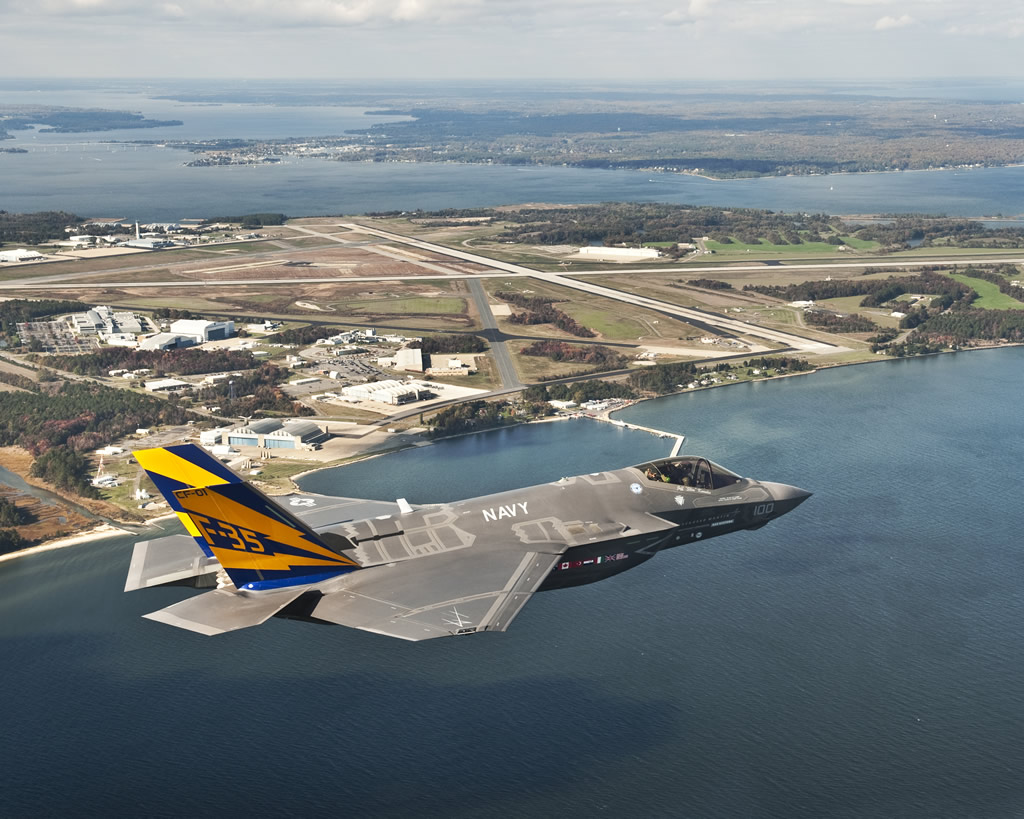
(click to view full)
During CY 2006 and the first months of 2007, the JSF program saw the formal rollout of the first test plane on July 7/06, the bestowal of its official name “F-35 Lightning II”, and a set of production phase agreements with all of the program’s participants. By the end of 2008, the first production F-35A and F-35B aircraft had been ordered, and the F-35A had beaten Saab’s JAS-39NG in a controversial Norwegian competition.
This section covers developments related to the overall program, and to international partner participation, during FY/CY 2009-2010…
Jan 7/11: Australia’s Acting Minister for Defence Jason Clare puts a positive spin on the latest program news, stating that the changes “will reduce overall program risk to Australia and should not affect Australia’s planned introduction date for the JSF.” The basis for those statements involves greater priority for the F-35A version in the new arrangements, and the existence of a project funding buffer.
That buffer may be necessary, as the hard facs involve F-35A production cuts from 2011-2016. That drives up per-plane costs in early years, even as Australia continues to insist that its first 2 planes will be delivered in 2014, and all aircraft are slated to arrive by 2017. Australian DoD.
Jan 6/11: Norway’s government reacts to the program news with reserved non-commitment, saying that it will seek more information, and adding that the program changes may change the timing of its F-35 purchase submission to the Stortinget (parliament). Norwegian Forsvarsdepartementet [in Norwegian].
Jan 6/11: As part of a plan detailing $150 billion in service cuts and cost savings over the next 5 years, Defense Secretary Robert Gates states that he is placing the Marine Corps’ F-35B on the equivalent of a 2-year probation:
“By comparison, the Marine Corps’ short take-off and vertical landing variant is experiencing significant testing problems. These issues may lead to a redesign of the aircraft’s structure and propulsion – changes that could add yet more weight and more cost to an aircraft that has little capacity to absorb more of either. As a result, I am placing the STOVL variant on the equivalent of a two-year probation. If we cannot fix this variant during this time frame and get it back on track in terms of performance, cost and schedule, then I believe it should be cancelled. We will also move the development of the Marine variant to the back of the overall JSF production sequence.”
F-35 program SDD is extended again to early 2016, versus mid-2015 as planned in the 2010 restructuring, a move that’s likely to push initial operational capability (IOC) into 2017 and cost the program $4.6 billion. Individual services are assessing their model’s specific dates.
FY 2011/ LRIP-4 will be cut from 42 to 32 planes by amending the contract, and eliminating 10 F-35Bs. FY 2012 will see production held at 32, with just 6 F-35Bs bought to maintain the supplier base for the type. F-35 production is already behind, so this may not matter as much in reality. FY 2013 will see the production process speed up. It will still fall short of the previous plan for 549 LRIP orders by FY 2016/ LRIP-9, however, with only 415 ordered by that time.
To fill the gap created from the slip in the JSF production schedule, the Department of the Navy will buy 41 more Navy Super Hornet family planes in 2012-2014, and extend another 150 F/A-18 A-D Hornets for longer service via center barrel replacements and other refurbishments. Pentagon release re: overall plan | Full Gates speech and Gates/Mullen Q&A transcript | F-35 briefing hand-out [PDF] || Atlanta Journal Constitution | The Atlantic | Aviation Week | the libertarian Cato Institute | Defense Update | Flight International | Fort Worth Star-Telegram’s Sky Talk blog | The Hill | NY Times | Politico | Stars and Stripes || Agence France Presse | BBC | Reuters | UK’s Telegraph | China’s Xinhua.nce Presse | BBC | Reuters | UK’s Telegraph | China’s Xinhua.
Dec 30/10: F-35A AF-4 flies for the first time, marking the 10th F-35 variant delivered to the program, and the final test mission of 2010 for the Joint Strike Fighter program. The Lockheed Martin release touts a fleet that “logged 410 flights for the year versus a plan of 394.”
Dec 22/10: The center-liberal Brookings Institute releases “Defense Budgets and American Power,” which recommends “Partial or even complete cancellation of the joint strike fighter or F-35… replaced with F-16 and F-18 aircraft, at an annual savings of $1 billion to $4 billion.”
Brookings’ negative review is less of a problem in the incoming Republican Congress, but it does indicate fraying political support for the program from constituencies closer to the political center, in addition to the American left and the libertarian right. See also Aviation Week Ares.
Dec 15/10: Avation Week conveys the latest Dutch spending plans for the F-35 program.
FY 2011 will include EUR 146.4 million: EUR 11.6M for general system design and development (SDD), 8.5M for Dutch-only SDD, and EUR 126.3M for the production, sustainment and follow-on development phase, which includes a 2nd F-35A. FY 2012 will include the end of the SDD phase at EUR 1.1M, 3.0M for dutch-only SDD, and EUR 82.7M for PS&FD.
Assuming the timing of the Dutch purchasses doesn’t change, spending would include allocations of EUR 161.1 million in 2013, EUR 414.2 million in 2014, and EUR 610 million in 2015. That could become very contentious, since the final decision on an F-35 purchase is supposed to be postponed until 2015.
Dec 11/10: F-35A AF-3 arrives at Edwards AFB, CA. The plane is the 1st F-35A with initial mission systems installed, and is initially slated for radar cross-section testing. Speaking of testing, which is currently quite behind schedule, Aviation Week offers a snapshot:
“Lockheed Martin, meanwhile, says it passed its 394-flight test target for 2010 on Dec. 6, taking the program total to 531 flights since the F-35 first flew on Dec. 15, 2006. Two F-35As, four F-35Bs and one F-35C logged 60 flights in November against a plan of 51. That sounds like progress, and it is, but it’s worth remembering that, in September last year, the JSF program office leadership was pojecting [sic] that 12 aircraft would be flying by now, each logging 12 test sorties a month. That goal is unlikely to be achieved until well in 2011.”
Dec 8/10: Defense News reports that Italy may be backing away from the current plan to buy 40 F-35Bs alongside 69 F-35As for the Air Force, and another 22 F-35Bs for the Navy. They will definitely be replacing their initial 4 aircraft, which were once set to be F-35Bs, with F-35As. Italian defense undersecretary Guido Crosetto:
“We are discussing it right now… The UK decision and the rumors from America do not leave us indifferent… The first thing we need to do is look closely at those we wanted for the Air Force, mainly because [the F-35B] costs 30 percent more and it is difficult to be the only one left sustaining it while other countries are making reductions and even the Americans are reconsidering it… For the navy and for the Cavour [aircraft carrier] it is essential… However, the concern is that if fewer are built, the costs will rise and we are now asking the Americans for details… The first four aircraft we will take delivery of [with deliveries beginning in 2014] will be conventional JSFs, and we will see how the STOVL program advances…”
Dec 7/10: Bloomberg reports that Defense Secretary Robert Gates will recommend giving the Marine Corps as much as 2 additional years to develop the F-35B, on top of the earlier 13-month extension to November 2015. A decision will be released in February 2011, with the proposed defense budget for FY 2012.
It also quotes Lockheed Spokesman John Kent as saying that the Marine Corps model has accomplished 197 of 232 planned F-35B test flights. See also Oct 4/10 entry.
Dec 3/10: Wikileaks documents reveal that the Norway’s F-16 replacement competition was a sham, and that the USA used its weapons export laws as a way of hindering competition from Sweden’s JAS-39N. Read “F-35 Lightning II Wins Norway’s (Fake) Competition” for full coverage.
Dec 2/10: A report to the Dutch Parliament says that the Dutch F-35 project budget has jumped another 22.5%, from EUR 6.2 billion to EUR 7.6 billion for 85 fighters. That EUR 1.4 billion rise creates a 40.7% cost increase from the 2007 estimate of EUR 5.4 billion, even as the government announces defense budget cuts of EUR 1 billion, and the shedding of 10,000 defense-related employees. F-35 maintenance costs, which may be rising under the latest Pentagon estimates, remain unchanged at EUR 10 billion over 30 years, but have not been re-examined.
By way of comparison, Saab offered the Netherlands 85 ready-to-fly JAS-39NGs for EUR 4.8 billion – q.v. Sept 7/09 entry.
At present, the Dutch VVD/CDA coalition government remains committed to the F-35, including the purchase of a 2nd IOT&E aircraft. They also say, however, that if prices continue to rise, the Dutch armed forces will simply get fewer F-35As. The Dutch Labour party remains opposed to the F-35, favoring an existing fighter with known costs. The Dutch are slated to make a full purchase decision in 2015, which means it will depend on the results of the next election. See also Dec 15/10 entry. MvD brief [in Dutch] | Radio Netherlands | Aviation Week.
Dec 1/10: No at-sea engine deliveries? Gannet’s Navy Times raises a huge potential issue for the F-35’s naval variants: the engine and its packing are too large and too heavy for carrier aerial delivery platforms, and even too heavy for ship-to-ship replenishment stations. This will make sustained operations very difficult, as on-board space for spares is limited:
“…the F-35C’s Pratt & Whitney F135 engine, contained in its Engine Shipping System, is too large for the cargo door on a standard carrier onboard delivery plane and for the V-22 tilt-rotor aircraft, the program office acknowledged in a response to a follow-on query from Navy Times. The engine can be broken down into five component parts, but just its power module and packaging alone won’t fit into the [C-2 Greyhound] COD or the V-22. The JSF Program Office says the V-22 Osprey, like the MH-53E helicopter, can externally carry the F135 engine module, the heaviest of the five components, at least 288 miles “in good weather.” One outside analyst, Jan van Tol of the Center for Strategic and Budgetary Assessments, wondered how the Osprey, in hover mode, could safely lower the module to the flight deck or pick up an out-of-service engine in higher sea states… Moreover, the Navy has no fleet V-22s and has no plans to acquire them.
The 9,400-pound engine module and transport container also cannot not be transferred from a supply ship to a carrier during underway replenishments [UNREPs] – when two ships are sailing side-by-side and connected by supply lines – because, [Capt. Chris Kennedy of the JSF Program Office] said, “It’s too heavy for the unrep station [on Nimitz class carriers].”
Dec 1/10: U.S. Defense Undersecretary Ashton Carter says he is “not happy with the situation we’re in now” with the F-35 program, adding that “This is an example of an activity where we simply cannot accept what I call … ‘will cost’… There isn’t going to be ever more money.” On the other hand, he did refer to new F-35 program manager Vice Admiral David Venlet as “a real black belt” when it came to running big weapons programs. Time will tell. Reuters.
Nov 26/10: BAE Systems announces that its test pilot Graham Tomlinson received the prestigious Guild of Air Pilots and Air Navigators (GAPAN) Derry & Richards Memorial Medal, in recognition of outstanding contributions in advancing the art and science of aviation. Graham’s contribution to the F-35 Lightning II program took the prize just days after Graham retired from flight testing, after 24 years with the company.
Nov 18/10: during a Pentagon press conference, Pentagon Press Secretary Geoff Morrell addresses the F-35. He confirms that the Defense Acquisition Board will be meeting on schedule on Nov 22/10 to discuss the F-35 program, including input from Vice Admiral Venlet’s recent 120-person “deep dive” program review. Among the conclusion Mr. Morrell would discuss was the fact that “we have more software code to be written than we had originally thought.”
The DAB won’t issue any program decisions or changes, however; that must be left for the 2012 budget request. Full Transcript
Nov 18/10: An F-35B’s 300 pound rear bulkhead, which was switched from titanium to a specially formulated Alcoa aluminum in order to save weight, has shown cracking after 1,500 hours of flight time in fatigue tests. After engineers saw unusual data from test instruments, the cracks were found in a special inspection.
Those parts are supposed to last 8,000 hours, and the goal was reportedly to test them to double that figure. They are very important parts of the plane’s structural strength, and replacements would involve cutting the plane open. The big question for the F-35B is whether the cracks are a manufacturing glitch, a part design problem, or an even more fundamental materials problem. Aviation Week | Fort Worth Star-Telegram’s Sky Talk blog | UPI.
Nov 16/10: The US Air Force Association’s airforce-magazine says that the USAF is beginning to discuss a restart of F-22A Raptor production:
“Extending F-22 production could be the dealmaker if F-35 foes carry the day and compel USAF to take mostly new-build F-16s instead. The Raptors would provide the extra stealth force required to make the non-stealthy F-16s acceptable. Also, if you’ve listened carefully, USAF has gone from saying it will retain a “portion” of F-22 production tooling to “most” and, most recently, to “all.” Gen. William Fraser, head of Air Combat Command, acknowledged last week that Lockheed Martin is filming all F-22 tooling processes as the earliest parts of production shut down, so that it can go back to production of parts… Also last week, Rep. Phil Gingrey (R-Ga.) said he might spearhead an effort to get more F-22s into the budget. But he acknowledged it could be a difficult task given pressures to rein in spending.”
Nov 15/10: The US Air Force Association’s airforce-magazine joins sources like Inside Defense, who say the US government is contemplating axing the F-35B. An excerpt explains some of the thinking, once one understands that the F-35B has a shorter range than the F-35C:
“The Pentagon is contemplating terminating production of the F-35B… Pentagon officials note that the increasing accuracy of tactical ballistic missiles in the hands of potential adversaries makes it increasingly less likely that the Marines can use the STOVL model as they’ve envisioned: either from amphibious ships right offshore or just behind the battle lines, to provide quick close air support.”
The Marines would disagree, noting that expeditionary bases offer far more targeting variety for enemies, not to mention concealment and decoy options. As for ship vulnerabilities, while the F-35B’s range is shorter, if Navy amphibs have to be so far from shore that F-35B performance is a problem, can they support the Marines at all? AFA Air Force Magazine | Aviation Week |
Nov 15/10: US Federal Judge Terry Means issues an order reversing part of his earlier decision to dismiss former F-35 programmer Sylvester Davis’ whistle-blower lawsuit against Lockheed Martin. The decision only applies to the portion of the lawsuit where Davis questions the legality of Lockheed billing the government for work on the F-35 that did not meet quality and safety requirements:
“Upon further review and given Relator’s [Davis’] specificity regarding his allegations as applied to the elements of a falseclaims allegation, which was not present in his prior briefing, this Court is convinced that dismissing Relator’s third amended complaint was erroneous and would result in injustice to Relator. The Court will issue an order this same day denying in part Defendant’s motion to dismiss Relator’s third amended complaint.”
See: Full decision [PDF] | Forth Worth Star-Telegram’s Sky Talk blog.
Nov 14-16/10: Reports surface that the USA is offering Israel a $3 billion reward of 20 F-35As, in return for diplomatic concessions that include a 3-month freeze on building in the disputed West Bank territories. Source vary, with most describing it as a 2nd order, and others describing it as Israel receiving its already-agreed order of 20 for free. US officials refuse to confirm that offer, but it is widely believed, and appears to have strong appeal in Israel. This may seem like a high price, but when one considers what America’s military and defense industries get out of the deal, the picture changes somewhat.
The F-35 is seeing delayed buys from allies, and is certain to face a major order cut from fellow Tier 1 partner Britain. It may also become a target of cuts in the next US Congress. That risks a cascade of slowing production, so prices remains high, so more buyers delay or cancel, etc. Adding more planes to the Israeli order would counteract likely near-term cuts with an uncuttable rush order that would have deep Congressional support. If it helps the F-35 partners ramp up production, that will start bringing per-plane costs down, instead of alarming both Congress and allies with higher prices. Arutz Sheva | Ha’aretz | Israel Today || Al Jazeerah | Asia Times | Asian Tribune | China’s Xinhua press agency | Iran’s Fars press agency | Irish Times | Fox News | Miami Herald | Naval Open Source Intelligence | Pakistan’s Daily Times recaps the key points | Russia’s Pravda | UPI.
Nov 16/10: While discussing the proposed Italian defense budget for 2011, Flight International reveals that Italy is looking to shift its F-35 types:
“The Italian air force shifted from an all conventional to a mixed short take-off and vertical landing/conventional version fleet including up to 40 F-35Bs and 69 F-35As, in order to offer the required flexibility for out-of-area operations,” says Gen Roberto Nordio, the head of the office responsible for procurement issues.”
This will come as very welcome news to the US Marines, though it may end up consolidating the air force buy with expected future Italian Navy buys. If so, it’s temporary good news for one variant, but means fewer aircraft for the overall F-35 program. The other assumption here is that Italy’s challenged public finances will actually be able to buy all of these aircraft. The country does field a pair of escort carriers, however, so F-35Bs are a must at some point if Italy wants to retain naval jets and replace its AV-8B Harrier IIs.
Nov 8/10: Aviation Week reports that Qatar plans to pick its new fighter in 2012, and the F-35 could become a contender to replace the current Mirage 2000v5 fleet:
“The size of the program is still under discussion, with 24-36 fighters likely to be acquired… The service is evaluating a broad spectrum of aircraft, including the Lockheed Martin F-35 Joint Strike Fighter, Boeing F/A-18E/F Super Hornet and F-15, Eurofighter Typhoon and Dassault Rafale, says Al-Khayarin. Saab officials note they also have entered the competition [with their JAS-39NG].”
Nov 8/10: Flight International reports that Lockheed Martin has entered the final 12 months of F-22A production in Marietta, GA, with the final aircraft due out of building B-1 by November 2011. Production will then shift over to F-35 inner-wing shipsets, even as the site also works to treble C-130J production to about 36 a year.
Nov 6/10: The first F-35C Lightning II carrier variant test aircraft arrives at Naval Air Station (NAS) Patuxent River, MD. It flew in from NAS Fort Worth Joint Reserve Base, and achieved successful air refuels at a maximum load of 19,800 pounds during the flight. US Navy | Lockheed Martin.
Nov 5/10: F-35B BF-4 becomes the 1st F-35 to fly with full “Block 1” software, which allows weapon release and combines information from the F-35’s radar, electronic warfare system, distributed aperture system, electro-optical targeting system and other sensors. It also forms the base for subsequent software blocks, with Block IIB required for the aircraft to become operational, and Block III the goal by the end of the design & development phase.
This isn’t the software’s first flight, of course. Block 1 has been undergoing airborne testing since May 2010 on the 737 CATBird test bed. Lockheed Martin.
Nov 1/10: One day before Defense Secretary Robert Gates is briefed on new cost and schedule assessments for the F-35 and other aircraft, anonymous officials tell American media that the F-35 program could see another overall price jump of $5 billion, the F-35A/C could be delayed another year, and the F-35B could face a 2-3 year delay due to greater than expected software, engineering and flight difficulties. That would place the F-35A’s IOC at 2016-17, the F-35B’s at 2014-15, and the F-35C’s at 2017 or so. Worst of all, the report supposedly says that the F-35s will deliver a 50% rise in operating and maintenance costs over the F-16s and F/A-18s they’ll be replacing.
The F-35 “Technical Baseline Review” is being prepared for a Nov 22/10 Defense Acquisition Board review of the $382 billion program. The report also affect the FY 2011 budget, which has not been passed by the outgoing Congress, and may become an urgent item of business for the new session. The Pentagon requested 43 aircraft, the House voted to fund 30 planes + 13 if certain conditions were met, and the Senate Appropriations Committee wanted to buy just 33. Bloomberg.
Oct 18/10: The British jump jets. Britain’s new government releases its 2010 Strategic Defense and Strategy Review [PDF]. The result is the end of the Harrier fleet, and of British fixed-wing naval aviation, after 2011. They will no longer buy the F-35B, and instead will buy rather fewer F-35Cs to field on their single operational carrier around 2020. With respect to that buy:
“We cannot now foresee circumstances in which the UK would require the scale of strike capability previously planned. We are unlikely to face adversaries in large-scale air combat. We are far more likely to engage in precision operations, which may need to overcome sophisticated air defence capabilities. The single carrier will therefore routinely have 12 fast jets embarked for operations while retaining the capacity to deploy up to the 36 previously planned, providing combat and intelligence capability much greater than the existing Harriers. It will be able to carry a wide range of helicopters, including up to 12 Chinook or Merlin transports and eight Apache attack helicopters. The precise mix of aircraft will depend on the mission…”
The effects on the F-35 program are not small. The US Marines’ F-35B, which was already attracting attention as a potential budget cut, will now become even more expensive for the USA to field on its own. Despite its unique niche as a high-end jet option for LHA/LHD ships and small escort carriers around the world, it’s going to become more attractive for the US Navy to finish pushing the F-35B into oblivion. If they do, interest in the F-35 may well decline in budget-strapped countries like Italy, and the possibility of beachhead F-35B sales to countries like Spain declines very sharply.
Oct 7/10: Israeli LoA. Israeli Ministry of Defense Director General (Maj. Gen. Ret.) Udi Shani signs the F-35A Letter of Offer and Acceptance at a ceremony in New York. Lockheed Martin.
Oct 5/10: The F-35A’s flight suspensions are lifted, and test aircraft AF-1 takes off from Edwards AFB, CA. The USMC’s F-35Bs, on the other hand, will remain grounded until later in the week, and will be barred from short takeoffs or vertical landing tests until the inlet door hinge is fixed. Aviation Week.
Oct 5/10: The U.S. Defense Department has withdrawn its Earned Value Management System certification for Lockheed Martin’s Fort Worth, TX facility, because of a lack of progress in addressing deficiencies cited in June 2010 Pentagon EVMS checks. The words “systematic corporate level problem” were reportedly used, and some reports claim that the Marietta, GA plant that builds C-130s is also affected, but Reuters reports that other company sites beyond Fort Worth were deemed to have made better progress.
The Project On Government Oversight reports that this is part of a wider Pentagon crackdown on EVMS compliance, and names one big beneficiary: Humphreys and Associates, Inc., an EVMS consulting firm in Orange, CA POGO | Reuters.
Oct 4/10: Aviation Week reports that F-35 test flights have been suspended, after lab testing revealed the possibility of incorrect sequencing in software that controls the engine’s 3 fuel boost pumps. The software modification is due Oct 5/10. The F-35B also had issues with an auxiliary inlet door hinge. The magazine adds figures for F-35 testing in 2010:
* F-35A: 2 planes at Edwards AFB, CA. 114 flights vs. 53 planned, 17 in September vs. planned 18.
* F-35B: 4 planes at Pax River, MD. 141 flights vs. 181 planned, 19 in September vs. planned 28. Will not meet 2010 test targets, initial at-sea testing delayed beyond March 2011.
* F-35C: CF-1 not finished, none of 5 planned September flights.
In a separate article, Aviation Week quotes USMC Lt. Gen. George Trautman, who says the service understands that slips in F-35B deliveries and flight testing could prompt a later in-service date than the planned 2014. Per the new plan he signed on Sept 16/10, the USMC’s VMA-332 in Yuma, AZ must have 10 F-35Bs equipped with Block IIB software, with 6 aircraft capable of austere and/or ship-based operations, and all aircraft meeting the 7g and 50-degree angle of attack specifications, in order to declare Initial Operational Capability.
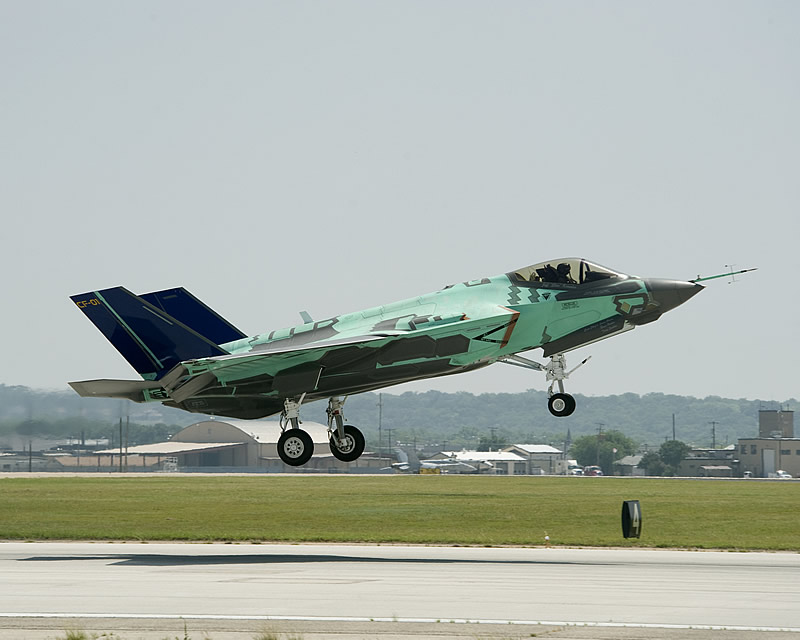
(click to view full)
Sept 30/10: Dutch downgrade? In the Dutch Concept Coalition Accord, which the parties involved will present to their members for a vote, it says that the government will remain in the F-35 program, buying a 2nd plane to joint the IOTE(Initial Operational Test & Evaluation) program, but that it will reduce its F-35 buy by an unspecified number, in order to deliver EUR 100 million in annual savings from operations and maintenance costs. It also adds that no F-35s would be bought during the period the coalition would actually be in office, from 2010-2014. Main document [PDF, in Dutch] | Appendix with financials [PDF, in Dutch].
Sept 29/10: Norway’s delay. Norwegian defence minister Grete Faremo informs the Norwegian parliament that their F-35 buy will be delayed. Instead of buying trainers in 2014, then receiving te rest of its fighters from 2016-2010, Norway will buy 4 training aircraft in 2016, and push the arrival of operational aircraft back to 2018. The delay in fielding its new fighters may force the ministry to reconsider upgrading at least some of Norway’s F-16s, in order to cover the gap.
Norway has reiterated that it will stick with the F-35, citing $350 million in contracts to date for Norwegian firms, with a potential for up to $5 billion depending on the eventual number of F-35s produced worldwide. The RNoAF’s F-35 operating base is still scheduled to be picked in 2011. Defense News | Flight International | Fort Worth Star-Telegram | Key Publications.
Sept 24/10: Dutch delay. In a statement to the Dutch parliament, the current Minister of Defence Eimert van says that Middelkoop said that since the last report in 2009, the F-35’s average cost per aircraft has risen from $69.2 million (EUR 51.4 million) to $92.4 million (EUR 68.6 million). To offset some of this cost, the Dutch Ministry of Defence plans to push back initial deliveries by 2 years, from 2014 to 2016. Key Publications.
Sept 16/10: Israel’s Ministerial Committee on Security Affairs decides to approve the deal for 20 F-35As, overcoming arguments within the Cabinet and clearing the way for a contract. Israeli Prime Minister’s Office | Israel’s Foreign Ministry.
Sept 15/10: The US Senate Committee on Appropriations’ Defense subcommittee votes to cut the FY 2011 F-35 request by 10 planes to 32 aircraft. Comments by key committee members reveal a growing skepticism bordering on hostility, noting that the USAF has’t contracted for the 30 fighters aproved last year, calling the program’s progress “disturbing,” and even going so far as to say that the committee considered cutting off funds altogether. The subcommittee does not insert funding for the F136 engine – though it criticizes the Pentagon for abandoning the dual engine strategy:
“The incongruence of the insistence on canceling the second engine program which has been a near model program and which most analysts expect would curtail long term costs of the entire JSF program with the equal insistence on the need to fully fund the JSF program is hard to rationalize.”
With the House subcommittee voting 11-5 to continue the F136 engine, it seems likely that the House bill will contain those funds. If the full Senate Appropriations Committee adds an amendment, the Senate bill could add them as well. After that there are votes and amendments on the House and Senate floor, followed by the budget bill reconciliation process between the House and Senate. Senate Appropriations Committee : release and webcast | The Hill magazine | DoD Buzz | Military & Aerospace Electronics.
Sept 15/10: The US GAO auditors release report #GAO-10-1020R: “Joint Strike Fighter: Assessment of DOD’s Funding Projection for the F136 Alternate Engine,” to Senate Armed Services Committee chair Carl Levin [D-MI]. In a significant departure from their normal conclusions, they think the Pentagon’s $2.914 billion estimate might be too high.
The Pentagon’s projection for remaining development funding in FY 2011-2016 is $1.533 billion. That breaks down as $1.188 billion for development & testing, and $345 million for engine component improvement work. It would be followed by $1.381 billion in procurement funding, which breaks down as $133 million in production tooling funding, $747 million in non-competitive engine and spares buys, and $500 million in support costs.
The Pentagon’s own belief is that their estimate has an even chance of being either too high or too low, but GAO says their 2 biggest assumptions push their estimate toward overestimating costs. The GAO believes that with F-35 schedule slippage and F136 progress, competitive buys could begin within 2 years, instead of in 4, cutting non-competitive buys. Competition could also save the Pentagon most of its “Engine Component Improvement Program” funds, as the competitors follow their behavior with the last F100/F110 engine competition, and invest in their own efforts.
August 15/10: Defense Minister Ehud Barak announces initial approval for purchasing the American F-35A. Reports indicate that Israel will buy 20 jets for about 2.75 billion, and add that the deal is a “closed package” with few to no Israeli modifications. The aircraft would be delivered from 2015-2017. If Israel chooses to buy more F-35s from later production blocks, they may have more Israeli systems.
Defense Ministry Director-General Udi Shani reportedly said that one of the considerations in approving the deal was an American offer of $4 billion in industrial offset contracts to Israeli defense industries. Their exact composition will be part of negotiations and future agreements with Lockheed Martin, who already has good relations with Israeli defense firms in a number of spheres. The entire deal will be funded by American military aid dollars, and still needs the Israeli cabinet’s approval before a contract can be signed and announced. Arutz Sheva | Ha’aretz | Jerusalem Post | Ynet News || Agence France Presse | Bloomberg | Reuters.
July 27/10: A Ha’aretz op-ed article claims that:
“And now Israel goes hat in hand pleading for a chance to be allowed to acquire the F-35 aircraft, at a price tag of $150 million each. But it’s not only the astronomical price. Israel is told that the F-35 must be taken as is – no changes or modifications to suit Israel’s specific needs, and absolutely no Israeli systems included. Take it or leave it. Just imagine Israel’s position today had the Lavi project not been canceled…”
That claim contradicts other reports. Time will tell.
July 28/10: The House Appropriations Committee’s Defense subcommittee approves its version of the FY 2011 defense budget, and votes 11-5 to spend $450 million on the F136 fighter engine. House Appropriations Committee | AFA | Aviation Week | Terre Haute, IN Tribune-Star | Australian Aviation.
July 27/10: In a letter to colleagues, the chairman (Rep. Robert Andrews, D-NJ) and and ranking member (Rep. Michael Conaway R-TX) of the House Armed Services Committee’s defense acquisition reform panel urge their fellow members of the House Appropriations Committee to fund the F136 engine. AFA | Letter [PDF].
July 23/10: During a briefing at Farnborough 2010, F-35 program EVP Tom Burbage says that a recent flight of Northrop Grumman’s old BAC-111 airliner test bed near Baltimore, MD, the DAS distributed infrared detection system captured the launch of a Falcon 9 rocket from 650 miles away. That could make F-35s with AMRAAM NCADE missiles a better option for stealthier boost-phase interdiction than a conventional “teen series” fighter with a clip-on sensor pod. Integration with the Navy’s Cooperative Engagement Capability might even allow F-35s to take on a role MDA was considering for UAVs – early targeting that would allow sea or land-based SM-3 missiles to perform earlier intercepts. Aviation Week.
With respect to future F-35B STOVL lift improvements, Burbage says that qualifying the baseline engine and LiftFan is the current focus. Beyond that, engine thrust improvements would have to be matched by shaft and lift fan improvements that balance the entire system, and allow it to make full use of engine capabilities. Aviation Week.
July 17/10: During a conference call with investors, Lockheed Martin CEO Bob Stevens discusses issues with the F-35B STOVL variant. Fort Worth Star Telegram Sky Talk:
“At the end of June, Stevens said, only 74 of 95 test flights planned for the first six months had been conducted. Lockheed spokesman John Kent updated that information after the call, saying 91 flights had been completed as of Tuesday. The goal is to have completed 125 F-35B flights by the end of July. Stevens said the component “failure rates are higher than predicted” and that Lockheed and the military test managers are working to understand why… Failing components are cooling fans that hold down fuel temperatures, lift fan doors actuators and other switches. Stevens said there have been no failures of key components of the STOVL propulsion systems, the engine or the lift fan system… By contrast, testing of the two other models is going well.”
See also Aviation Week.
July 13/10: Over at Military.com’s DoD Buzz, Former F-16 fighter pilot and test pilot Robert Newton, CEO of Newton Consulting & Engineering Inc., writes:
“There are volumes of information, metrics, reports, and books like The Air Force and the Great Engine War that describe the history, detail the lessons and highlight the value of a second jet engine source… In a short time, engine shop operating budgets and manpower to perform all the unplanned maintenance snowballed and drove our maintenance squadrons to the brink of operational bankruptcy… That initial spark of competition generated a new energy level that was unmistakable, impossible to quantify, of immeasurable benefit, and enduring… When we had problems or new technical opportunities, the creative minds of each team made it theirs and in turn set new standards of excellence for both engines.”
July 19/10: Reuters reports that Israel may be just “days away” from a $3 billion contract to deliver 19 F-35s. Outgoing DSCA head Vice Admiral Jeffrey Wieringa is quoted saying that: “The ball is in their court… I am waiting for them to make a decision any day.” Read “Israeli Plans to Buy F-35s Hitting Obstacles” for full coverage.
Lockheed Martin VP for F-35 business development, Steve O’Bryan, added that the firm is close to reaching a FY 2010 LRIP-4 production agreement with the U.S. government for another 32 planes, adding that classified briefings have been given to other countries, including Greece and Belgium, and that Finland and Spain have expressed interest.
July 16/10: Canada’s Conservative Party government declares that it will buy the F-35A, without a competitive process. The jets would begin to enter service around 2016, and the initial budget is C$ 9 billion for 65 F-35 aircraft and associated weapons, supporting infrastructure, initial spares, training simulators, contingency funds and project operating costs.
That budget has not been confirmed by an actual contract, however, something that reportedly led to unpleasant surprises when Canada recently bought C-130Js from Lockheed Martin. The loyal opposition Liberal Party of Canada has declared its disagreement with the purchase, and DND statements indicate that an F-35 contract would not be negotiated until about 2014-2015, which would be after the next election. Read “Canada Preparing to Replace its CF-18 Hornets” for full coverage.
June 30/10: The Torrance Daily Breeze reports that Lockheed Martin is using publicly-available simulators at key locations, in order to promote the F-35 with media, suppliers, etc.
June 29/10: Defense News quotes Andrew Krepinevich, president of the influential Center for Strategic and Budgetary Assessments (CSBA) think-tank in Washington, that:
“With possible American enemies, like China, developing and fielding ever-more advanced systems – such as sophisticated radar suites and surface-to-air missiles – Pentagon and administration officials must examine if the Lockheed Martin-made Lightning II will bring as much “value” to combat by the time it comes online next decade as thought decades previous when it was designed… That very question is being studied as part of two ongoing internal Pentagon studies: one on the U.S. military’s proper global posture, and another on how it should carry out long-range strike operations, said Krepinevich, who is a prominent member of the Defense Policy Board. That panel provides advice on a range of key issues directly to the defense secretary.”
This is not the first time Krepinevich has expressed such sentiments. At a May 13/14 event at Princeton University [PDF], he had said that:
“Moreover, it is far from obvious that current acquisition plans aim at buying the right systems. Secretary Gates himself has stressed that in the face of emerging anti-access/area denial capabilities, the US military needs to begin shifting from short-range strike systems to longer-range ones. Currently, however, the largest single acquisition program is, by far, the short-range F-35 Joint Strike Fighter (JSF).”
June 23/10: Lockheed Martin announces that its F-35C CG-1 ground test aircraft has completed its program of drop tests. These are exactly what they sound like, and involve dropping an airframe loaded to maximum carrier landing weight, and filled with sensors, from heights of up to 11 feet. The tests are designed to ensure that the planes can handle the controlled crash of carrier landings, involving varying angles and weight distributions. The tests were performed at Vought Aircraft Industries in Grand Prairie, TX, and Lockheed Martin reports that “no load exceedances or structural issues were found at any of the drop conditions.”
June 20/10: Gannetts Air Force Times covers preparation to train the first F-35 pilots and maintainers at Eglin AFB. The 33rd Wing’s 200 or so iInstructors will do a dry run of the course in July 2010, but the wing will hit full strength of about 2,000 people, 59 planes, and 3 squadrons (24 F-35As in USAF 58th FS “Mighty Gorillas,” 20 F-35Bs in USMC VMFAT-501 “Warlords,” 15 F-35Cs in USN VFA-101 “Grim Reapers”). The first foreign students will be British pilots scheduled to arrive in 2011, with others to follow.
The 36-38 week (9-month) training periods will begin in electronic classrooms with 42-inch flat screen monitors, which are exotic now, but will probably be standard home videogame gear by then. From there, 33rd wing already has a basic JSF simulator, and plans to install 6-8 full-motion simulators (vid. June 18/10 ancillary contract). Each pilot must fly at least 5 simulator missions before the first live flight, and if delivery dates continue to slip, simulator training may have to be extended. Even full motion simulators can’t replicate G-forces, however; while simulators can be used as 100% training for large aircraft, and are, fighters require cockpit time as well.
June 17/10: Lockheed CEO Robert Stevens says of the F-35 that they intend to achieve an F-35 price comparable to the $60-70 million cost for “similarly equipped” top of the line F-16 E/Fs and F/A-18E/F Super Hornets plus added targeting pod, electronic warfare system, jammers, and helmet-mounted display. He added that negotiations for the next “LRIP Lot 4” F-35 buy are still weeks away, but it will shift from a cost-plus deal to a fixed-price-plus-incentives deal that shifts more risk to Lockheed Martin:
“We are absolutely committed to getting this program right. We are determined to beat the government’s cost estimate, and that is not a statement of disrespect… We’ve had very candid conversations with all the leaders in the Department of Defense about our desire to improve on the cost-estimate basis that is out there today, and we intend to achieve that.”
Lockheed’s F-35 program VP Steve O’Bryan was more specific, citing an average cost of FY10$ 60 million by 2016-2017, if orders are not cut and full production ramps up on time. At the same time, USAF assistant secretary for acquisition David Van Buren is saying that recent Pentagon Cost Assessment and Program Evaluation (CAPE) estimates are not affecting USAF negotiation planning, as indeed they should not. A fixed-price plus incentives deal for the FY 2010 buy would be about 2 years before the program had planned, but would be consistent with statements over the past few months from the Pentagon. Aviation Week | BusinessWeek | Gannett’s Air Force Times | The Hill | NY Times.
June 17/10: The battle between Secretary of Defense Gates and GE becomes a direct exchange, as a result of the Secretary’s tendency to say things about the F-35 program that skirt the edge of strict truth.
In this case, Gates’ quote to a Senate hearing was that “We think that the engine does not meet, probably does not meet, the performance standards that are required…” The clear implication is that the engine is faulty, which drew the unusual step of a direct rebuttal from GE vice chairman John Rice. Rice noted that since 2005, Pentagon evaluations have rated F136 performance “exceptional” 7 times and “very good” 3 times, with positive reports from the F-35 project office as recently as May 2010. He also contested Gates’ repeated statements that the F136 would take another $2.9 billion to develop (vid. fixed price offer Sept 14/09, April 27/10), giving figures of $1 billion more for development and $800 million to jumpstart early production. GE spokesman Rick Kennedy also offered a direct rebuttal, saying that “The engine is not falling short of requirements – it’s meeting and exceeding requirements.”
Pentagon Press Secretary Geoff Morrell would later retreat from some of Gates’ statements, saying that the Pentagon believes the engine would meet Pentagon requirements at the end of development, and that all Gates meant was that the engine couldn’t meet final requirements while only part-way through its development. Readers can judge for themselves whether that was really what Gates wanted his audience to believe. The Hill | Reuters.
June 14/10: F-35B number BF-2 breaks the sound barrier, hitting Mach 1.07 (727 mph at 30,000 feet) and becoming the first vertical landing fighter to ever achieve level supersonic flight. Other supersonic JSF flights have involved F-35As. USMC Lt. Col. Matt Kelly’s historic F-35B flight took place at NAS Patuxent River’s off-shore supersonic test track, and included several Integrated Test Blocks to test roll, pitch, yaw and propulsion performance at supersonic speed.
Future F-35 testing will gradually expand the flight envelope out to the aircraft’s top speed of Mach 1.6, which it’s designed to achieve at full internal load. Lockheed Martin.
June 11/10: Rep. Barney Frank’s “Sustainable Defense Task Force” left wing/ libertarian coalition issues its report. They claim to identify $1 trillion in Pentagon budget cuts over the next decade, and the F-35 is one of the programs targeted. The basic recommendations would cut the Navy/USMC buy from 680 to 600, and the USAF buy to about 820 total (it’s not entirely clear). An optional recommendation involves complete cancellation, with F-16, F-15, and F/A-18 E/F Super Hornet variants bought instead, within the context of cuts in Air Force fighter wing and carrier air wing numbers. The F-35B would not be replaced on future LHA/LHD amphibious ships, which would operate only helicopters once the AV-8B Harrier IIs go out of service.
It should be noted that the participants do not represent a substantial faction within the American political system, but their recommendations could acquire more weight in the event of a US sovereign debt crisis. Full report [PDF].
June 10/10: Dutch elections result in important shifts, but the new balance of power isn’t positive for the F-35. Of 150 seats in the House, the new totals break down as:
In favor of JSF: 54 seats – VVD (31), CDA (21), and SGP (2)
Against JSF: 89 seats – PVDA (30), PVV (24), SP (15), GL (10) and D66 (10)
Unknown: 7 seats – CU (5) is conditional, PvdD (2) unknown
The margin is 30 seats in a best-case scenario, which requires a swing of 15 votes. That many seats would have to switch from the declared “against” parties, as the price of a governing coalition agreement, in order to avoid program delays, order cancellations from the Tier 2 partner, and a re-opened competition.
June 7-8/10: Canadian media reports indicate that the government is about to launch single-source negotiations to buy up to 65 F-35A fighters, at a cost of about C$ 9 billion. The government says that its rationale is to “lock up the cost,” but the jet’s maintenance costs would be a moving target. Canada had a similar experience with Lockheed Martin and maintenance costs when it sole-sourced its C-130J buy.
The move is politically controversial, to the point that the topic was removed from the cabinet committee on economic growth’s June 9 agenda, then reinstated. CP | The Globe and Mail | The Globe and Mail re: controversy | Winnipeg Free Press | UPI.
June 7/10: The first production-version F-35C naval variant makes its inaugural flight from Naval Air Station Fort Worth Joint Reserve Base, TX, about 18 months late. Lockheed Martin.
June 7/10: The first mission systems-equipped F-35 test jet joins the fleet at Naval Air Station Patuxent River, MD. The F-35B, designated BF-4, is fully equipped with avionics and sensors, allowing systems testing as well as aerodynamic testing. Lockheed Martin.
June 6/10: In the middle of the Dutch election campaign, Labour Party (PvdA) leader Job Cohen says that he wants the government to wait at least 4 years before deciding whether to buy the F-35 – a move that’s almost certain to take the Netherlands out of the IOT&E test program. Unless the electoral map shifts significantly on June 9/10, the PvdA will continue to hold the balance of power in Parliament concerning the F-35 decision. Radio Netherlands.
June 3/10: Good news, bad news. The Pentagon certifies the F-35 as essential to national security, allowing the program to continue even though it has breached legislated limits to program cost growth. On the other hand, the program’s total estimated cost is raised to $382 billion over its lifetime – more than $54 billion higher than its February 2010 estimate.
Lockheed Martin continues to dispute the Pentagon’s estimates. See April 30/10 entry for more background. Flight International | Reuters.
June 2/10: Defense News reports that Lockheed Martin has discovered several problems with the F-35B STOVL version during flight testing. Which is, after all, part of what flight testing is for. They reportedly affected the lift fan doors and jet engine actuator nozzle, and included a packaging problem that bent pins in the rudder pedals as they were shipped to Lockheed.
Lockheed Martin officials say these problems have not affected the flight test schedule, which is currently at 93 test flights in 2010, 3 more than planned. F-35s are far behind the original testing schedule (vid. March 1/10 entry), and will need to fly aggressively in order to catch up.
June 1/10: An article in the UK’s Defence Management magazine offers op/ed advocacy for the F-35B fighter buy, and also includes useful details regarding the plane’s:
“…20 million lines of software code. This software controls the fire control and weapon systems, as well as the radar and sensors, but most importantly, the code allows all the systems to recognise each other and work together. Block 0.1 software (about two million lines of code) created the fire control and aircraft management systems needed for the first F-35 flight from Fort Worth. The Block 0.5 software upgrade equipped the STOVL JSF with the code for electronic warfare and radar systems. This will be followed by Block 1.0, which will provide an integrated capability so that the location and nature of targets can be shown on a single display screen. Engineers will also start integrating various sensors into the aircraft in Block 1.0. Blocks 2 and 3 will add software functions that allow the aircraft to monitor itself for maintenance work and allow for the integration of more sensor and weapon capabilities. The USMC is confident that the F-35B will be ready for an initial operational capability (IOC) in 2012 with Block 2B software, which will allow the use of two AIM-120D air-to-air missiles and two 1,000lb Joint Direct Attack Munitions or two 500lb laser-guided bombs…”
May 26/10: Rust never sleeps. DoD Buzz reports a quote from the US House Armed Services Committee, in its FY 2011 budget proposal:
“The Committee notes that it has yet to receive the congressionally directed report from the Director of Corrosion Policy and Oversight assessing the corrosion control lessons learned from the F-22 Raptor fleet – which was grounded in February 2010 for corrosion on ejection seat rods due to poorly designed drainage in the cockpit – as they apply to the F-35 Joint Strike Fighter program.”
As DoD Buzz notes:
“Regardless of how lowly rust might seem at first glance, it is a huge problem for the military, costing about $20 billion each year. According to the House Armed Services Committee, roughly $7 billion of that rust is preventable…”
May 24/10: The US Chief of Naval Operations staff’s acting director of air warfare, Adm. Michael C. Manazir, gives the F-35C the US Navy’s vote of confidence, reiterating the Navy’s commitment to 680 F-35Bs and F-35Cs, with the 1st F-35C squadron scheduled to begin transition in 2014, first deployment in December 2016, and a 2nd deployment in February 2017. This is a notable reduction from the previous plan for 960 F-35B/Cs in the Navy, and Manazir implies that the previous even division between F-35B and F-35C models is being reconsidered. He says:
“I want to dispel the contention that the Navy is soft on F-35C… The Navy has had the F-35C in her horizon for more than a decade… We now need to move into the F-35C to realize our vision for TACAIR (tactical air) coming off the carriers.”
Sports fans have learned to be alarmed by team ownership “votes of confidence”; time will tell if this is anything like that. US Navy.
May 21/10: The US Marines release the latest draft of their basing options for the F-35B Joint Strike Fighter on the West Coast. The comprehensive survey on the jet’s environmental impacts outlines 6 possible plans for their West Coast basing, but the preferred plan would place 5 operational F-35B squadrons and 1 operational, test and evaluation squadron in Yuma, AZ, with another 6 operational squadrons at the Marine Corps Air Station in Miramar, CA. USMC release | Basing plans.
May 21/10: Dutch edge toward the door. By a vote of 79-71, the Dutch Parliament passes a series of 3 motions to pull out of the F-35’s test phase, terminate both initial F-35 purchases, and start a new F-16 replacement competition. The shift happened when the Dutch Labour Party (PvDA), who had initially supported the F-35 testing program and participation with reservations, have shifted to qualified opposition. It also concurred with a Green Left Party motion that asked for a new competition to replace Dutch F-16s, on the grounds that the 2002 and 2008 evaluations that chose the F-35 were based on estimates and data that have been shown to be false.
What happens now is… nothing, really. The current Dutch government is Parliament and the Queen, with a caretaker Cabinet. Under Dutch laws, that Cabinet cannot make decisions on controversial issues. That has prevented the Dutch from buying their 2nd IOT&E aircraft from the LRIP-4 production set, but the barrier works both ways. The F-35 cannot be bought or canceled, until new elections result in a new government. On the other hand, PvDA’s apparent walk-off from the pro-JSF camp makes a fighter re-compete more likely once these maters are settled. The PvDA says that their reversal is justified, because the conditions of their original motion have not been met. F-35 supporters say that the required information is expected in June 2010.
The F-35 decision was finely balanced. Major parties the Socialist Party (SP), Green Left and Geert Wilders’ PVV Party for Freedom were opposed. The Christian Democrats, VVD People’s Party for Freedom and Democracy, and Christian Union were generally in favor of the buy. The PvDA Labour Party is currently the 2nd largest party with 33 seats, and were the movers of an earlier motion to buy the first F-35 test aircraft, with the right to reverse the decision later on. A Dutch election is expected in 2010. Will the election cause the PvDA’s position to harden? Will new information and lobbying succeed in shifting the PvDA back? And what political realities after the election will play a role? Trouw re: PvDA shift (in Dutch) | nrc handelsblad | Aviation Week | Defense News | Plane Talking.
May 21/10: Australia’s Department of Defence releases its draft Australian Noise Exposure Concept 2025 map. It outlines a significant planned reduction in forecast F-35A noise footprint at Salt Ash Air Weapons Range, compared with the initial Australian Noise Exposure Forecast (ANEF) 2025 released in late 2009. Why? After public consultation, the DoD has decided to halve the new jet’s use of Salt Ash Air Weapons Range. DoD release | ANEC 2025 information & maps.
Read “F-35: I am Fighter, Hear Me Roar” for more coverage.
May 13-19/10: The U.S. House Armed Services Seapower subcommittee and Air-Land Forces subcommittees each mark up the House of Representatives’ National Defense Authorization Bill for Fiscal Year 2011 (H.R. 5136) – and both of them vote to authorize $485 million in continued funding of the GE/Rolls-Royce F136 engine. That markup has teeth, too. Until the Pentagon’s Under Secretary of Defense for Acquisition, Technology and Logistics certifies that all F136 funds have been committed, the last 25% of all F-35 program funds for FY 2011 will be withheld.
These proposals survive the full HASC committee markup, on May 19/10. Read “The F136 Engine: More Lives Than Disco?” for full coverage of this issue.
May 17/10: Another 2 F-35As fly to Edwards AFB from Fort Worth, TX, as the testing program begins to ramp up toward 8 aircraft. This is quite late; see March 1/10 entry for more details. Lockheed Martin.
May 11/10: Aviation Week suspends aviation expert and F-35 critic Bill Sweetman from covering the largest defense program in history. AvWeek issues its statement, as his colleagues note his record of being correct about the program. Our Facebook-related coverage seems timely, again.
May 6/10: In the wake of a visit from the commander of USAF Air Education and Training Command, General Stephen R. Lorenz, the USAF throws a small spotlight on Eglin AFB’s 33rd Fighter Wing. The 33rd became the world’s 1st F-35 training wing on Oct 1/09, and though the article doesn’t go into much details, it’s precisely this kind of unheralded advance work that makes a big difference to how well a military maintains and uses an important new weapons system.
May 3/10: At the JSF Advanced Technology & Innovation Conference in Melbourne, Australia’s Minister for Defence Personnel, Materiel and Science, Greg Combet, delivers a speech defending Australia’s participation in the F-35 program, and its industrial benefits. Key themes include the key role that composite materials and titanium will play in future aerospace work, and Australia’s need to vertically integrate given its 40% share of the global titanium supply.
The minister remains an optimist with respect to the F-35 program in general. In terms of concrete program-related development, Combet cites 28 Australian firms who have won A$ 200 million in contracts for early prototype and test aircraft, with further potential as full-time production begins. He estimates future upgrade-related engineering for the global F-35 program to be worth $500 million per year, with each block upgrade taking about 10 years from concept to implementation, and describes some of the programs Australia’s government is implementing to seed and secure industry positions in these efforts.
See “The Joint Strike Fighter Program and Australia: Staying Innovative To Remain Relevant” for the full transcript.
May 3/10: Lockheed Martin shuffles its decks. Former F-35 general manager Dan Crowley is promoted to to chief operating officer of the company’s aeronautics division, and is replaced by former F-22 general manager Larry Lawson. Tom Burbage, Lockheed’s general manager for F-35 program integration, will remain in his position. Lockheed Martin | Defense News.
April 30/10: A USAF article covering Pentagon Undersecretary of Defense for Acquisition, Technology and Logistics Ashton Carter’s presence at the 2010 Department of Defense Acquisition Insight Conference, included this quote:
“Despite discipline in keeping F-35 requirements stable, a combination of unforeseen engineering changes and other factors went unacknowledged and virtually unmanaged for two years, resulting in a 30-month delay and $3 billion in additional program costs, according to one estimate. “We should have better situational awareness and better early warning about the status of our programs,” Doctor Carter said… The government must stop the trend of hollowing out DOD’s in-house technical capability and then attempting to compensate by adding burdensome oversight, regulation and documentation requirements, he said.”
Reporting on these comments, aviation expert Bill Sweetman of Aviation Week explains the different points of view that persist around the F-35’s cost estimates. The problem is, Lockheed Martin and the government disagree sharply over what the cost is. The Pentagon cites an average F-35A sticker price (Unit Recurring Flyaway cost) of $63 million in 2002 dollars, or $113 million average cost paid during the program, thanks to economic inflation. Lockheed Martin says it’s more like $49.5 – 46 million in 2002 dollars, at least 20% lower, IF planned production rates are maintained. The firm says that values for its 2008-2009 contracts bear them out. Sweetman explains the difference:
“Overall, CAPE (Capabilities Assessment and Program Evaluation office) estimated that the total F-35 procurement cost would be about $23.6 billion more than the December 2007 SAR estimated. Two elements accounted for the lion’s share of that increase. $9.2 billion was attributed to increases in the cost of building the wing section [emphasis his] – which in JSF terms is the wing plus the complex and densely packed body section to which it is attached – plus other elements such as a commonality update.
$8.6 billion goes to propulsion [emphasis his], which is not reflected in Lockheed Martin contracts. Some of this is influenced by the cost of the lift system for the F-35B: the Navy is on the hook for nearly one-third of the $8.6 billion even though only 330 STOVL aircraft are planned (out of over 2,000 planned American F-35 variants)… And the LRIP contracts with Lockheed Martin are only part of the answer. They don’t include the engine… and none is fixed-price and none has been completed. (The LRIP-1 jets are due to be signed over in September… all cost-plus and fixed-price incentive contracts, one way or another, split the “execution risk” between the contractor and the government, and Lockheed Martin people are not very specific on how this has been done on LRIP 1 through 3 or how it will be done on LRIP-4…”
Lockheed Martin is worried that the rising Pentagon estimates per fighter will spook both domestic and foreign buyers, right in the crucial period between FY 20100-2015, when it is supposed to move to full-rate production, creating a vicious spiral of slower cost drop-offs, followed by more cutbacks, followed by rising costs and delays. That’s why so much is riding on who is eventually right, and on who is perceived to be right, right now.
April 27/10: GE and Rolls Royce reiterate, and extend the period for, their fixed-price offer for the F-35’s F136 engine. Unlike last year’s offer, this one includes lower fixed prices in 2013 and 2014 as well, and assumes the entire risk of cost overruns rather than sharing overages under a set formula as is common.
The offer amounts to a commercial-type contract, where the manufacturer absorbs the cost of the early production engines, and recovers it through later sales and service. The fact that this is seen as attractive by the GE/RR team speaks to the opportunity presented by the F-35 – and implicitly, to the value of a sole-source approach to Pratt & Whitney. GE Aviation President and CEO David Joyce says that accepting this competitive approach would save the government $1 billion over the next 5 years, and $20 billion over the life of the JSF program. Aviation Week | BusinessWeek | Government Executive magazine | Reliable Plant magazine | Reuters.
April 23/10: The USAF’s 513th Electronic Warfare Squadron, which will serve as the USA’s sole provider of electronic warfare support for the F-35 variants, is activated. The squadron, currently manned by 32 technicians and engineers, will grow to 130 members at full strength.
Squadron commander Col. Kevin J. McElroy, will lead the stand-up and operation of the $300 million United States Reprogramming Laboratory, which tests all aspects of the joint strike fighter’s electronic warfare capability. Half of the staff will be USAF Airmen, while the other half will consist of US Navy and Marines. USAF.
April 20/10: F-35A AF-2, the 7th flight test aircraft, flies for the first time. AF-2 is unique in that it’s the first F-35A with the internal 4-barrel 25mm GAU-22/A cannon that’s unique to this variant, and the first F-35 built for full weapons testing.
AF-2 will be used to verify the F-35A’s ability to carry both internal and external weapons throughout the required flight envelope, confirming predictions of gun vibration, acoustic and recoil loads under various scenarios. AF-2 will also be used to confirm vibro-acoustic loads with the weapons-bay doors open and closed, on it way to tests like supersonic launch of internal weapons, including maximum-speed Mach 1.6 launch of internal air-to-air missiles. In addition to its weapons bays, more than 15,000 pounds of additional ordnance can be loaded on the F-35A’s 6 external pylons. All of it needs to be tested with various weapons, singly and in combinations, to ensure that both carriage and launch are safe. Lockheed Martin.
March 24/10: In hearings joint for the US House Armed Services Committee’s Air & Land Forces and their Seapower subcommittees, ranking Republican Roscoe Bartlett [R-MD] blasts the F-35 program for evasiveness and lack of transparency:
“As I noted in my opening statement, it has been very difficult to get programmatic details from the Office of the Secretary of Defense on the JSF program, even in response to specific inquiries. That has generated not only a sense of frustration for the Committee, but has also elevated our concerns… I find it wholly unacceptable that the Department did not provide Congress immediate notification of its November 2009 analysis and cost estimates that clearly indicated the JSF program would trigger a Nunn-McCurdy breach. What’s worse, the Department has routinely failed to respond to specific requests from the Congress for information about the status and developments in the JSF program.”
Testimony: Webcast Part 1, Part 2 [Windows Media WVX] | HASC ALF chair | HASC ALF Ranking, Rep. Bartlett | HASC Sea chair | The Hon. Ashton Carter, Under Secretary of Defense for Acquisition, Technology and Logistics [PDF] | The Hon. Christine H. Fox, Office of the Secretary of Defense Director, Office of Cost Assessment and Program Evaluation [PDF] | Dr. Michael J. Gilmore, OSD Director, Operational Test and Evaluation [PDF] | Mr. Michael J. Sullivan, GAO Director of Acquisition and Sourcing [PDF] | The Hon. Sean Stackley, Assistant Secretary of the Navy for Research, Development and Acquisition [PDF] | Mr. David M. Van Buren, Acting Assistant Secretary of the Air Force for Acquisition [PDF].
March 24/10: Denmark decides to delay its fighter decision to 2014, with aircraft not being delivered until 2018.
That eliminates about 16 F-35As from FY 2011-15 production plans, but gives the F-35 a chance to stabilize costs, and win an order it appeared to be losing to Boeing’s F/A-18 E/F Super Hornet. The US Navy currently plans to acquire its last Super Hornets in FY 2013, which will shut down production barring exports to countres like India – or another multi-year Super Hornet contract in the USA, to cover the expected gap from F-35 fielding delays. Aviation Week Ares.
March 22/10: The GE/ Rolls-Royce Fighter Engine Team announces that their 3rd production-model F136 engine has successfully hit full afterburner in an advanced testing facility at GE, and reached “all major objectives” during this testing phase for thrust, temperature margins, and fuel consumption. Note that the engine nozzle is common to both the F135 and F136 engines, as part of their designed interchangeability. Another 6 F136 engines are scheduled for testing in 2010, to measure engine performance and endurance. Rolls Royce release.
March 22/10: Reports surface that the United Arab Emirates requested a classified briefing on the F-35 in 2009, but may not get it until the USA completes a review and decides on its arms export policy to the region. The UAE currently operates the world’s most advanced F-16s, and is reportedly considering France’s Rafale fighter to replace its Mirage 2000v9s. Zawya Dow Jones.
March 19/10: The US Congress’ GAO releases a report re: the F-35 program, and offers testimony. See: “Joint Strike Fighter: Additional Costs and Delays Risk Not Meeting Warfighter Requirements on Time” | “Joint Strike Fighter: Significant Challenges Remain as DOD Restructures Program” (testimony). Excerpts:
“Collectively, testing and technical challenges will likely add more costs and time to development, affecting delivery of warfighter requirements and hampering start up of pilot and maintainer training and initial operational testing… We further note that the prime aircraft contractor is spending management reserves[Footnote 9] faster than budgeted, likely creating a need for additional funding… The prime contractor now estimates it will need an additional $600 million, at a minimum, to adequately resource its reserves needed to complete development…
The F135 primary engine development effort – a separate contract from the airframe development effort–is now estimated to cost about $7.3 billion, a 50 percent increase over the original contract award. This includes an $800 million contract cost overrun in 2008. Engine development cost increases primarily resulted from higher costs for labor and materials, supplier problems, and the rework needed to correct deficiencies with an engine blade during redesign. Engine test problems have also slowed development.
The alternate engine program to develop a second engine source – the F136 – is also encountering cost and schedule challenges… The JET estimates about $1.6 billion would be needed to complete F136 development in 2016. Contractor officials told us that funding stability [DID: reduction of development funding in past years, which must be paid later], engine affordability, and testing issues are key concerns… [DID: But GAO reiterates its past findings that the alternate engine program makes financial sense overall].
click to play video
March 17/10: First vertical landing of a production configuration F-35B. F-35 Lead STOVL Pilot Graham Tomlinson performed an 80-knot (93 miles per hour) short takeoff from Naval Air Station Patuxent River, MD, at 1:09 p.m. EDT. About 13 minutes into the flight, he positioned the aircraft 150 feet above the airfield, where he commanded the F-35 to hover for approximately 1 minute, then descend to the runway. Lockheed Martin release | Rolls Royce release.
March 17/10: Aviation Week reports that the F-35 program’s new program manager has been officially nominated. As expected, the 3-star officer is Vice-Adm. David J. Venlet, head of the Navy and Marine Corps’ air systems acquisition command.
March 15/10: Danish radio station DR Forside reports that the Tier 3 JSF partner Denmark will pick Boeing’s F/A-18 E/F Super Hornet as its future fighter, instead of the F-35A JSF or Saab’s JAS-39DK Gripen NG.
According to the report, the ministry’s decision awaits an auditor’s review before being forwarded to the full government and to parliament. The formal contract and delivery date for new fighters are also expected to be delayed, with the F-16 fleet flying on and their replacements entering service in 2017-18. DDR Forside [in Danish] | Aviation Week Ares.
March 15/10: Ashton B. Carter, Pentagon undersecretary of defense for acquisition, technology, and logistics, discusses coming changes to the F-35 program. He says they will shift toward a fixed-price contract in their negotiations with Lockheed Martin for the initial production phase, which is expected. He also says that Department officials will conduct an internal analysis of what the full production cost should be, to better negotiate with Lockheed Martin. USAF.
March 12/10: Australia’s government confirms its intention to buy up to 100 F-35 Joint Strike Fighters, despite cost overrun warnings. Senator Faulkner:
“The JSF Program Office advises that no significant implications are expected for the JSF Partner countries as a result of the Nunn-McCurdy breach due to the restructuring action which has already been taken in the US… Australian Defence planning has always adopted a cautious approach to JSF cost estimates by factoring in significant amounts of contingency funds to deal with cost risks.”
March 11/10: Hearings before the Senate Armed Services Committee include the F-35 as a prominent focus. Christine Fox, director for Cost Assessment and Program Evaluation, says that average F-35 unit costs will climb from $50.2 million to as much as $95 million a copy; the Government Accountability Office testified that their assessment is about $112 million (per aircraft, no R&D), and noted that compared to the new program baseline approved in 2007, total estimated acquisition costs have increased by $46.1 billion and development extended 2.5 years. They add:
“Restructuring is not done and further cost growth and schedule extensions are likely. There is a substantial risk that the program will not deliver the expected number of aircraft and required capabilities on time.”
At least one Senate aide told DoD Buzz that he’d heard per-plane average estimates as high as $137 million – which happens to be the approximate flyaway cost of an F-22A Raptor. Formal program figures will have to wait, however, until the April 1/10 Selected Acquisition Reports. The GAO also testifies, and says:
“Although improving, manufacturing inefficiencies and parts problems persist, slowing delivery of test aircraft and, in turn, delaying development flight tests… By December 2009, only 4 of 13 test aircraft had been delivered and total labor hours to build the aircraft had increased more than 50 percent above earlier estimates… design and production processes may lack the maturity needed to efficiently produce aircraft at planned rates. Although DOD’s restructuring actions should help, there is still substantial overlap of development, test, and production activities while DOD continues to push ahead and invest in large quantities of production aircraft before variant designs are proven and system performance verified. Given the extended development time and reduced near term procurement, DOD still intends to procure up to 307 aircraft at an estimated cost of $58.2 billion before completing development flight testing by the beginning of fiscal year 2015.”
Meanwhile, Michael Gilmore, DoD director for operational test and evaluation, testifies that a recent decision to remove fuses and fire extinguishers from certain areas may increase the risk from fuel leaks and enemy fire. US Senate Armed Services Committee hearing page | GAO Report #GAO-10-520T | AOL News | AP | Aviation Week | Copenhagen Post | CDI wonders why the JET-II team wasn’t asked to testify | DoD Buzz | New York Times | Reuters | Washington Post | WIRED Danger Room.
March 11/10: As USMC AV-8B Harriers operate in Afghanistan from short runways to support the ongoing Marjah offensive, Aviation Week’s Bill Sweetman reports on the F-35B’s ability to do similar things:
“…a Navy report issued in January says that the F-35B, in fact, won’t be able to use such forward bases. Indeed, unless it ditches its short take-off, vertical landing capability and touches down like a conventional fighter, it won’t be able to use land bases at all without some major construction efforts… Vertical-landing “pads will be exposed to 1700 deg. F and high velocity (Mach 1) exhaust,” the report says. The exhaust will melt asphalt and “is likely to spall the surface of standard airfield concrete pavements on the first VL.” (The report leaves to the imagination what jagged chunks of spalled concrete will do in a supersonic blast field.)
Not only does the VL pad have to be made of heat-resistant concrete, but currently known sealants can’t stand the heat either, so the pad has to be one continuous piece of concrete, with continuous reinforcement in all directions so that cracks and joints remain closed. The reinforced pad has to be 100 feet by 100 feet, with a 50-foot paved area around it.”
March 10/10: The total cost to complete the Pratt F135 engine is now estimated to be $7.28 billion – $2.5 billion more than the $4.8 billion initially projected for the engine, and an increase of $600 million from the $1.9 billion cost overrun that was reported in 2009 by the House Armed Services Committee. Pratt & Whitney also disputes the reports, saying that its “war on costs” was working. Spokeswoman Erin Dick:
“I can unequivocally say that our costs are coming down; that there are currently no additional overruns associated with the development of the F135 engine and the government has expressed confidence in our cost reduction strategy going forward.”
An unnamed source tells Reuters that the F-35 program’s 13-month delay, and Pratt’s need for additional flight tests that add personnel costs and other overhead, are the reasons for the increases, saying that there is no “$600 million surprise.” Aviation Week | Reuters | Reuters follow-on.
March 8/10: With the American F-35 program facing a delay of a year or more before its variants enter operational service, and testing going very slowly, Israel is reportedly delaying its own contract signing. A contract was originally expected in March 2010, but media reports indicate that spring 2011 is more likely. The reports also characterize issues of Israeli technology insertion as largely resolved, but adds that delivery delays and the $130 million minimum expected cost may give a leg up to Boeing’s F-15SE “Silent Eagle” as a less-expensive stealth-enhanced alternative. Read “Israeli Plans to Buy F-35s Hitting Obstacles, Moving Forward” for full coverage.
March 6/10: The USAF lays out its envisaged 30-year aircraft investment plan. Fighter-related plans include 602 F-35As through 2020, at an estimated cost of about $70 billion. It also includes potential retirement of its F-22A Raptors in 2025, which would be around the time the comparable Russian PAK-FA fighter begins to arrive in numbers. That does seem an odd choice. The service also wants 372 MQ-9 Reapers from 2011-2018, for about $820 million, giving it long-endurance close-support aircraft with 3,000 pounds of capacity for ordnance, high-end reconnaissance sensors, electronic warfare packages, etc. Defense News | CDI advocacy piece.
March 5/10: Tucson Business: “Noise is the issue at public meetings for F-35.” The debate revolves around whether to use Tucson International Airport in Tucson, AZ as an F-35 base. The article also answers questions re: the economic benefit figures expected for the area, which actually refer to all of the current activities involving the USAF and allied air force training programs.
March 3/10: Pentagon Comptroller Robert Hale states the obvious at at the annual Precision Strike Association conference, when he says of the F-35:
“If there is cost growth, I think we will just have to reduce the buy.”
That has led to issues in other programs, however, as reduced buys raise costs in 2 ways. Program cost per plane goes up, because the R&D dollars are spread over fewer planes. That is an illusion, given the sunk cost fallacy. On the other hand, flyaway costs may also go up, as fully efficient production takes place for a smaller number of aircraft, and the military orders less than maximum production in order to spread out its outlays.
March 3/10: The US Marine Corps isn’t backing off of its “ready for deployment” Initial Operational Capability date of 2012, even as the USAF’s F-35A slips by 2 years.Full Operational Capability, however, isn’t expected until 2024. Aviation Week, who asked the question, says:
“Sticking to 2012 seems to be a high-risk goal. As it stands, there has been no vertical landing yet, and we are about two years out from the IOC goal. And, that is a critical milestone for the seafaring service. Aircraft deliveries for test jets are behind, and software testing is lagging. The big restructuring in the Fiscal 2011 budget is designed to curb the impact of these problems, but there is still a 13-month delay to the conclusion of flight testing. Testers aren’t likely to have a formal report until 2015 — three years after USMC declares its IOC.”
March 2/10: Aviation Week:
“The armaments directors of eight partner nations and the United States (Ashton Carter) are meeting this week with the CEOs of top partners building the Joint Strike Fighter… at Lockheed Martin’s final assembly facility in Fort Worth, Texas. The top CEOs will include those from Lockheed Martin, BAE and Northrop Grumman on the airframe side as well as those from Pratt & Whitney, General Electric and Rolls Royce on the engine side… Also likely to be a discussion is what happens with the F136 [engine by GE/RR]…”
March 1/10: “JSF – Mid-Year check.” Bill Sweetman charts the planned vs. actual number of test flights completed in the program.
The gap is large, and it is still widening at this point. In the first half of FY 2010, the JSF program logged 35 sorties – out of 1,243 test flights planned for FY 2010. Total sorties flown stand at 155, with almost 2/3 flown by AA-1, a first prototype that is not representative of the production version.
Feb 24/10: US undersecretary of defense for acquisition, technology and logistics issues the formal Acquisition Decision Memorandum for the F-35 program [PDF], codifying earlier informal agreements:
“…while the restructuring will be likely to mitigate the [schedule] slip from 30 months to 13 months, the contractor will be incentivized to improve on the revised JET II schedule and cost position further, The revised JET II estimate is very roughly assessed to be a “50%” estimate [even odds of being over or under actual time/cost]… Taken together, these forecasts result in the delivery of 122 fewer aircraft over the Future Year Defense Programs (FYDP) [from 2010-2015], relative to the President’s FY 2010 budget baseline (56 fewer aircraft relative to President’s FY 2009 budget baseline) with some of the production funds allocated instead to the restructured development program.”
The ADM formally extends the F-35 program’s SDD phase by 13 months, and moves completion of Initial Operational Test & Evaluation, and the Milestone C decision before Full Rate Production, to November 2015. The SDD program also gets additional planes and resources: 1 more F-35C, 3 LRIP F-35s diverted to development testing, an additional software integration line, full funding to the revised JET-II estimate, and one more Low-Rate Initial Production year (LRIP-9) before Full Rate Production begins.
Lockheed Martin also sees the promised revision to its fee structure, removing $641 million in SDD phase award fees, and directing that the contract be restructured to pay event-based fees in future only if the events meet the terms for matching or improving schedule/ cost performance.
Feb 24/10: Quentin Davies, UK Minister of Defence Equipment and Support, marks the beginning of manufacturing work on the 1st British F-35B by signing the F-35 frame before it’s loaded into the assembly jig at the BAE Systems site in Samlesbury, Lancashire. The frame will come out of the jig in Q3 3 2010.
The aft fuselage and empennage (vertical and horizontal tails) for each F-35 are designed, engineered and manufactured by BAE Systems at Samlesbury using the latest digital design and precision manufacturing technologies, while the Company’s Structural & Dynamic Test facility at Brough, Yorkshire, will take the lead on Static and Fatigue testing for the F-35 program. BAE Systems release.
Feb 20/10: The collapse of the Dutch Cabinet over the mission in Afghanistan leaves the planned buy of a 2nd test F-35A in limbo. A “demissionair kabinet” (caretaker cabinet) without parliamentary backing that has resigned may only deal with uncontroversiall current affairs, and the F-35 purchase is far too controversial for that. Secretary Jack de Vries acknowledges this in a national TV interview on Een Vandaag. Luchtvaartnieuws [in Dutch] | Aviation Week.
Feb 12/10: UPI reports that discussions between Israel and the USA concerning the F-35 are also covering the potentially contentious area of exports to Arab countries.
Feb 2/10: The USA’s proposed FY 2011 defense budget proposes to spend $11.45 billion to fund 42 F-35s: 22 F-35As, 13 F-35Bs, and 7 F-35Cs; and Gates’ transcript refers to “possibly more, depending on contractor performance.” Another $2.26 billion will be devoted to Research, Development, Test & Evaluation costs. The budget also proposes, yet again, to cancel the GE/RR F136 engine alternative program. Australia’s DoD responded by citing their moves to delay buying the F-35, which isn’t supposed to go into service until 2017-2018 now:
“As part of the Government’s JSF acquisition strategy, significant cost and schedule buffers were built into Australia’s project in anticipation of the steps announced in the US today.”
On the personnel front, USMC Major-General David Heinz, the 2-star General heading the F-35 project, will be replaced by a 3-star counterpart, reported to be NAVAIR commander Vice-Admiral David Venlet. Secretary of Defense Gates is blunt:
“Accountability is not just about holding contractors responsible. The Department of Defense also bears responsibility for the JSF’s troubling performance record… I think if I’ve set one tone here at the Department of Defense, it is that when things go wrong, people will be held accountable.”
See US DoD release, transcript, and video | Australian DoD release | Agence France Presse | Australian Broadcasting Corporation | BBC | GovExec | Reuters | Flight International | Sydney Morning Herald | UPI | Washington Post | Bloomberg re: F136.
Jan 27/10: Lead F-35B test pilot Graham Tomlinson flies F-35B aircraft BF-1 down to 120 knots, with the lift system engaged. The aircraft is undergoing a series of progressively slower flights, reducing speed from 180 knots, to 150, to 120, as it tests various speeds on the way to a full hover and vertical landing. Lockheed has reportedly said BF-1 needs a dozen STOVL flights before the first vertical landing, which would place that milestone about where Bill Sweetman had previously predicted, in February 2010.
Today’s 48-min flight was BF-1’s 32nd, while BF-12 has logged 19 so far. Aviation Week Ares.
Jan 26/10: A Royal Air Force officer becomes the first active-duty British service pilot to fly the F-35B (aircraft BF-2). Lockheed Martin release.
RAF Squadron Leader Steve Long piloted BF-2, the second short takeoff/vertical landing (STOVL) F-35B, over Naval Air Station Patuxent River, Md., logging the aircraft’s 18th mission.
Jan 19/10: Bloomberg quotes Michael Gilmore, the Pentagon’s director of weapons testing. Gilmore’s Jan 15/10 report says that the F-35 program completed just 16/168 (9.5%) planned flights in FY 2009, after racking up a 14/20 (70%) ratio in FY 2008, the first year of flight testing.
The F-35 program calls for 5,000 sorties across all 3 variants to fully test the plane’s aerodynamics, software, and sub-systems. Even if all 4,970 remaining test sorties report no problems – a nearly impossible assumption – Gilmore’s report contends that the testing program would require a “minimum schedule addition” of one year, to October 2015. This revised assessment of risks and issues is part of the rationale for the proposed program changes, as described in the Jan 7/10 entry.
At the moment, 9 test planes have been built, and 3 are currently in flight testing. Current plans reportedly involve 500 test sorties in 2010, after all 13 flight test aircraft are delivered. See also DoD Buzz.
Jan 12/10: Reports of a US Navy NAVAIR study surface in the USA. “Joint Programs TOC(Total Ownership Cost) Affordability reportedly says that:
“…the cost to operate and support the F-35 [for the USA, all variants] will be $442 billion or more depending on additional costs for integration on ships and currently unforeseen development costs. This estimate is in FY 2002 program baseline dollars; the current dollar cost will be significantly higher. The production and development costs are cited, by the JET II, to be $217 and $46 billion respectively (2002 $), thereby making total program ownership cost to be $704 billion, or more, in 2002 dollars… the cost to operate the existing (larger) fleet of F-18A-Ds and AV-8s. Cost per flight hour of the combined F-18A-??D and AV-8 fleets is estimated to be about $19,000 per hour; F-35B/?C cost per flight hour is estimated to be about $31,000…”
While F-35 operating costs will be difficult to estimate until the testing program is much farther ahead, the NAVAIR study is in line with several decades of acquisition history; newer, more advanced jets consistently cost more to operate than preceding generations. The F-35 is attempting to reverse this trend using smart wiring, embedded prognostics, fleet maintenance systems like ALIS, design for maintainability, and other innovations. Can Lockheed Martin break this very long and consistent cycle? DoD Buzz | ELP Defens(c)e, incl. chart.
Jan 12/10: Reports that the UK is considering cuts to the aircraft carrier program, and especially to its buy of carrier-capable F-35B Lightning II jets, persist. The American F-35B/C operating cost debate is also significant to Britain’s financial questions, as it ponders the future of its carrier force. The Guardian.
Jan 8/10: Aviation Week reports that Japan’s Commission on Reform of Fighter Production Technology Base says that military aerospace industrial base is losing engineers, as existing programs like the F-16 derived F-2 are wound down. It recommends against simply importing a foreign design as Japan’s next fighter, which implies that participating in development of a modified Eurofighter Typhoon, Boeing F-15 (F-15Se?), or Boeing F/A-18 E/F Super Hornet would be preferable for Japan’s next 50 fighters.
Japan’s fighter industrial base reportedly supports about 1,100 companies and engineering development involves over 1.1 million worker hours. About a third of that development work involves ATD-X stealth aircraft research, a third is devoted to maintenance, and the last third split among the closing F-2 fighter program, the new C-X tactical airlifter, and the new XP-1 maritime patrol aircraft.
Jan 7/10: Media reports surface that Defense Secretary Robert Gates has ordered a delay in the Lockheed Martin Corp. F-35 program, cutting planned purchases from 2011 – 2015 in order to fund research, development, testing & evaluation (RDT&E). The moves would be reactions to the recent Joint Estimating Team v2.0 report, and to a fighter that is late in testing but has chewed through a significant percentage of its development funds already. According a Dec 23/09 Pentagon document whose details were reported by Bloomberg News, proposed cuts and shifts include a total of 122 planes, and $2.808 billion:
FY 2011: from 52 to 42 (-10 planes), $320 million shift to RDT&E
FY 2012: from 62 to 45 (-17 planes); $544 million shift to RDT&E.
In FY 2011-12, the US Navy will reportedly compensate for the implicit F-35C delays, by buying another 24 Boeing Super Hornet family planes for $2.4 billion. The Bloomberg report confusingly mentions “F/A-18E/F planes that are capable of jamming enemy radar,” which could indicate the addition of 24 EA-18G Growler electronic warfare aircraft. The Growlers would help to fill immediate gaps in airborne jamming, which is in high demand. They would also help maintain long-term fighter numbers with aircraft that would remain operationally viable farther into the future than standard Super Hornets.
FY 2013: from 129 to 77 (-52 planes), $716 million shift to RDT&E.
FY 2014: from 110 to 90 (-20 planes), $872 million shift to RDT&E.
FY 2015: from 130 to 107 (-23 planes), $356 million shift to RDT&E.
In 2009, Gates had talked about accelerating F-35 purchases, in order to shorten the program and save fixed costs. Instead, future acceleration will now be needed just to keep the plan on track. Thomas Christie, who was in charge of the Defense Department’s weapons testing from 2001-2005, is reportedly attributing the change as a reaction to doubts about Lockheed Martin’s ability to ramp up production on schedule, as well as issues with testing schedules.
Gates’ decision is being made in parallel with a review by the Pentagon’s Ashton Carter, who is deciding whether to extend the plane’s development phase beyond October 2014 (i.e. into FY 2015, instead of the original 2013), and is reportedly preparing contract proposals that would change the current “cost-plus” contract and place more financial risk for lateness or overruns on Lockheed Martin. Bloomberg | Business Week | Fort Worth Star-Telegram.
Jan 7/10: A production F-35B fighter engages its LiftFan STOVL propulsion system in flight for the first time, running it for 14 minutes at airspeeds from 207 – 288 mph. STOVL-mode flights will continue, with the aircraft testing short takeoff mode, flying progressively slower, hovering, and ultimately landing vertically. Most STOVL-mode testing will be conducted at NAS Patuxent River, MD. Lockheed Martin release.
Jan 4/10: Reporter David Pugliese’s sources say that Canada’s Harper government, which is currently running a $55 billion deficit, is not moving to start the CF-18 replacement program, or to make a sole-source commitment to Lockheed Martin’s F-35. Boeing, which has a substantial industrial presence in Canada, continues to lobby for a competition.
According to Canadian Air Force documents, any competition needs to start no later than 2010. That allows a contract with the winning aircraft manufacturer to be signed by 2012, in order to receive initial deliveries in 2015-2016, and reach initial operating capability in 2018. That would be 38 years after the F/A-18 Hornet won Canada’s last fighter competition, and 36 years after initial Hornet deliveries. Under this timeline, full operating capability for the Hornet’s successor would be achieved by 2023.

(click to view full)
Dec 30/09: USAF officials publish a notice of intent in the Federal Register to prepare environmental impact statements at various potential F-35 bases. The environmental impact analysis will examine the issues relating to land use, airspace and safety, air and water quality, noise, socioeconomics, biological and cultural resources, and cumulative actions.
The proposed basing alternatives include Mountain Home Air Force Base, ID; Hill AFB, UT; Burlington Air Guard Station, VT; Shaw AFB/McEntire Joint National Guard Base, SC; and Jacksonville AGS, FL.
Dec 22/09: Britain’s long-term fighter plans will remain in question until the spending review that follows the next general election. Meanwhile, the British MoD has received financial approval to purchase its 3rd F-35B Lightning II operational test aircraft, to be built as part of Low Rate Initial Production Lot 4. This jet would join the international program’s lagging Operational Test and Evaluation (OT&E) effort. Lockheed Martin.
Dec 7/09: In response to reports that Tier 1 partner Britain will not be receiving F-35 source codes (q.v. Nov. 24/09 entries), Britain’s MoD offers a not-quite-answer to Reuters:
“…the UK currently has the JSF data needed at this stage of the programme, and is confident that in future we will continue to receive the data needed to ensure that our requirements for operational sovereignty will be met… This remains the basis of the agreements reached with the U.S. in 2006.”
Nov 30 – Dec 2/09: Cut and Riposte. Loren Thompson of the Lexington Institute think tank leads with: “Four Reasons for Confidence in the F-35.” That triggers a somewhat acerbic response from another respected analyst, Aviation Week’s Bill Sweetman. His Dec 2/09 piece “JSF Is Fine, Says LockMart Consultant” outlines his disagreements with Thompson’s brief.
Nov 25/09: Australia in. Australia becomes the 1st country outside the USA to commit to an operational fighter buy. Australian Minister for Defence, Sen. John Faulkner, announces government approval to buy the first 14 F-35As, plus and infrastructure and support required for initial training and testing, at a cost of A$ 3.2 billion (about $2.95 billion). Australia’s first F-35A will be delivered in the United States in 2014 to commence initial training and test activities, and the first squadron is expected to become operational at RAAFB Williamtown in 2018. Sen. Faulkner adds:
“By 2012, Defence will have much firmer cost estimates for the remaining aircraft and necessary support and enabling capabilities as part of the planned first multi-year buy that is expected to comprise over 1000 aircraft for the US, Australia and other partners. This will allow for much more effective planning of the final JSF acquisition in the context of the overall Defence Capability Plan.”
Approval of the next batch of 58 aircraft and all necessary support and enabling capabilities, sufficient to establish three operational squadrons and a training squadron of CTOL JSF, will be considered in 2012. That would provide 72 F-35s in 3 operational squadrons by 2021, fulfilling Australia’s 2009 defense white paper commitment. Another buy of 28 aircraft would be considered as part of the debate over retirement of Australia’s F/A-18F Super Hornets, which have just begun delivery. Australian DoD | Fort Worth Star-Telegram | Australian Broadcasting Corp. (N.B: uses F-35C picture) | The Age | The Australian | Radio Australia | Sydney Morning Herald | Aviation Week | Bloomberg | Malaysia Star | Reuters | The Australian op-ed expresses concern about risk.
Nov 24/09: Reuters reports that:
“The United States will keep to itself sensitive software code that controls Lockheed Martin Corp’s new radar-evading F-35 fighter jet… Jon Schreiber, who heads the program’s international affairs, told Reuters in an interview Monday [that] “That includes everybody,”…acknowledging this was not overly popular among the eight that have co-financed F-35 development – Britain, Italy, the Netherlands, Turkey, Canada, Australia, Denmark and Norway.”
Instead, the USA plans to set up a “reprogramming facility” to develop F-35-related software and distribute upgrades. The terms on which allies might use this facility, and Lockheed Martin’s ability to stall or block upgrades that might boost competing products, are not detailed. Reuters | UK’s Daily Mail | New Zealand TV | UK’s Spectator Op-Ed.
Nov 24/09: Jon Schreiber, who heads the Pentagon’s F-35 international program, tells Reuters that an Israeli version of the F-35 could include command and control systems developed in Israel, as well as the ability to carry Israeli Python 5 air-air missiles and Spice dual-mode GPS/IIR guided bombs in early model jets. Israel would also get “a relatively inexpensive path for hardware and software upgrades to add future weapons,” by which he may mean the planned reprogramming facility for the global fleet (vid. Nov 24/09, March 5/08 entries). Ha’aretz says that the boost of an Israeli endorsement has become more important to the program:
“The Americans’ willingness to soften their stance is the result of a series of meetings held by Lockheed officials and Israeli defense establishment officials three weeks ago, and also difficulties with the project, particularly concerns that orders by countries participating in the development project will be low.”
The JSF program office is still reportedly opposed to the introduction of an Israeli electronic warfare suite, but the need for fast reprogramming and tight national security regarding Israel’s knowledge of enemy signals makes that a key Israeli condition. Schreiber is quoted as saying that policy or circumstances would have to change, in order for that restriction to change. At present, the plan is for a centralized F-35 fleet signals database and electronic warfare update facility at the United States Reprogramming Laboratory in Fort Worth, TX (vid. Feb 6/08 entry in previous article).
Schreiber says that the United States plans to formally submit its offer and prices in January 2010. Israel must approve this no later than March 2010, and reach a deal with Lockheed on integrating the Israeli weapons and other systems by June or July 2010, in order to buy in FY 2012 and take delivery delivery in 2015. Reuters | Ha’aretz | Jerusalem Post | EW Reprogramming Center graphic.

Nov 23/09: Pentagon weapons acquisition czar Ashton Carter says that they’re considering ways to revise the F-35 development plan, in order to compensate for testing delays and cover expected higher costs. Options include adding more test aircraft beyond the planned 12 (which was cut from 14), in order to make up delays in the testing schedule; and/or adding more software teams to the program. While cost growth in Pratt & Whitney’s F135 engine is acknowledged as a problem, Carter maintains the Pentagon’s position that the GE/RR F136 alternative engine is disruptive to the program and should be canceled.
With respect to modifying the F-35 contract from its current cost-plus to more of a risk-sharing mode, Carter says that:
“It’s in [Lockheed Martin’s] long-term interests because of the enormity of the program… We don’t want to be in a position where the government bears the cost of schedule slips in a program all by itself. It’s reasonable that risk in a program be shared equitably.”
Some of these issues must be sorted out very soon, in order to calculate the additional funding that would be needed in the FY 2011 budget. Fort Worth Star-Telegram | Government Executive | The Hill | NY Times | Aviation Week Ares | Aviation Week.
Nov 23/09: Reuters reports that order delays and reductions by several F-35 partner countries are likely to push up prices for early buyers. With respect to Britain’s F-35B orders (vid. Oct 25/09 entry), however, F-35 international program manager Jon Schreiber says:
“The only thing that they’ve told me is that they’re currently on plan – and don’t believe what you read in newspapers…”
Nov 23/09: In the wake of a FY 2010 American defense budget that ended F-22 production, while maintaining the ban on exporting the aircraft, Japan has been forced to look at other options. Kyodo news agency reports that Japan is considering buying 40 F-35s, and that the Japanese defence ministry is seeking fiscal allocation in the 2011 budget. According to media reports, the plane beat the F/A-18 E/F Super Hornet, F-15 Eagle variants, and EADS’ Eurofighter. The acquisition plan is likely to be incorporated in new defense policy guidelines and a medium-term defense plan to be adopted in December 2010.
The F-35s are estimated to cost YEN 9 billion (about $104 million) each; that’s a rather low figure, when compared to actual expenditures by the USA and Australia. If the reports are true, the critical question would become: what model of F-35? The F-35C’s longer range might suit Japan very well, while the F-35B’s ability to make use of highways and helicopter carriers would add a very interesting wrinkle indeed. Japan Today | Agence France Presse | domain-b | Times of India.
Nov 16/09: The Fort Worth Star Telegram runs “Lockheed is upbeat about F-35 program,” in which Lockheed Martin states its own case. The firm acknowledges that they’re behind the delivery schedule, which isn’t uncommon in any civilian or military aerospace project, but points to accelerating progress.
Lockheed EVP Dan Crowley summarizes progress, saying “each jet that goes out is more complete and it takes less time,” as the firm ramps up the manufacturing knowledge curve. The first ground test aircraft (BG-1) provided a testing bright spot, showing that the structure would survive stresses well beyond the design requirements. Parts shortages are down by 50%, and the driving forces are illustrated by example:
“A key reason for delays and cost increases has been the need to redesign parts that don’t fit properly [DID: tolerances are especially tight for stealth aircraft] or need to be strengthened or made lighter. The second test airplane (BF-1), the first to incorporate massive design changes [DID: an “optimized” F-35B airframe], was missing hundreds of parts and required more than 1,000 hours of added work before its first flight, in June 2008. Airplane No. 7 (AF-2) rolled out lacking a few dozen parts and requiring about 150 hours of additional work.”
Differences still exist. The Pentagon’s and Lockheed’s program estimates reportedly differ by about $3.6 billion, and Lockheed Martin claims that improved computer simulation will allow the program to reduce the number of test flights. Of course, simulation is only as good as its assumptions, and real-world testing is all about testing those very assumptions, so there is less than universal agreement on this point.
Nov 15/09: The Fort Worth Star-Telegram runs “F-35 is far behind schedule and over budget, reports show.” An excerpt:
“Reports prepared by the Defense Contract Management Agency for Defense Department officials show that Lockheed and other contractors are months late on deliveries of test airplanes and components for future production aircraft. The program is even farther behind on testing, and the reports say Lockheed could exhaust its development budget within a year.
Problems cited in the documents, obtained by the Star-Telegram under the Freedom of Information Act, support a recent Pentagon assessment that F-35 development will require two more years and billions of additional dollars.”
This is in accord with the recent JET report (vid. Oct 22-23/09 entry), and contradicts Lockheed Martin’s claims. See also Reuters | Miami Herald.
Nov 15/09: F-35B BF-1 flies from Fort Worth, TX to Dobbins AFB, GA, then on to NAS Patuxent River, MD for flight and hover testing. F-35 program office spokesperson Cheryl Limrick said there would be about 12 flights before the plane moved into STOVL (Short Take-Off, Vertical Landing) mode. The vertical landing had been scheduled for May 2009, but is now slated to take place at the end of 2009 – about 2 years later than the original plan. Fort Worth Star Telegram | Reuters | Lockheed Martin.
Nov 14/09: F-35A test aircraft AF-1 takes off on its first flight. Another 2 F-35B test aircraft have also been fielded. F-1 is the first “optimized” aircraft built on the same moving assembly line as the 31 Low Rate Initial Production F-35s now in assembly. That moving line is intended to improve production quality and speed, and the optimized aircraft incorporates many evolutionary improvements and updates derived from program engineering efforts and the F-35A AA-1 aircraft’s test program. Fort Worth Star Telegram | Lockheed Martin.
Nov 4/09: Jane’s reports that Israel has decided not to integrate any Israeli equipment into its first F-35As, in order to curtail an expected price tag of over $130 million per plane. A follow-on Nov 11/09 article in Ha’aretz reports that Israeli defense firms are not at all pleased by this development:
“This time, the defense establishment skipped over this [consultation] stage and is willing to accept the American dictate that this aircraft is a closed package [technologically] and it is very difficult to make changes to it that are specific to each client,” the [industry] official said. “The air force urgently wants this aircraft and it looks like they are going to give in, which is going to result in the Israeli industry almost not participating in the largest procurement program in IDF history.”
The country is also debating the wisdom of the purchase as a whole, with the Ministry of Defence arguing for a 2-year delay in procurement. Israel’s air force has always believed in qualitative superiority over regional competitors, but the F-35A’s 2014 delivery/ 2016 in service dates would make it irrelevant to Iran’s expected hostilities. On the other hand, the funds required could buy a lot of Namer heavy IFVs and other equipment, which would be extremely valuable during the next war in Lebanon.
Lockheed Martin is trying to keep the pressure on, saying that by 2016, F-35 production slots will already be filled by other orders and may be unavailable. The question is whether this will spur Israel to begin F-35 payments on schedule in 2010, or spur them to find another aircraft.
Nov 2/09: The Brookings Institute’s 21st Century Defense Initiative hosts Chief of Naval Operations Admiral Gary Roughead, who discusses the U.S. Navy’s use of new technologies, and its development and integration of unmanned systems. Excerpts:
“Obviously JSF not just for the Navy but for the Marine Corps, Air Force and our foreign partners is extraordinarily important. As you know, we’ve rolled our variant out here a couple of months ago and one of the things that I’ve been doing in the past couple of months with my leadership is to work through the whole network dimension of the Joint Strike Fighter. But I will tell you right now as we are preparing to introduce and get into JSF testing the idea of making it a mode for unmanned systems is not where I am right now. I’m interested in getting that airplane to the Navy on time and on budget, but I’m also interested in other things that we have to do in the Navy, other investments that we have to make in our ships in order to take advantage of the great capability that will be coming off of that airplane in the form of networks, and so that’s where my head is right now and not coupling it in a network sense with an unmanned system at this point in time. But the networks and how we interface that airplane again with the existing capabilities that we have is something that’s important to me.”
See WIRED Danger Room | Brookings Institute and full transcript [PDF]

(click to view full)
Oct 29/09: A range of assessments offer differing views of the F-35 program. The left-wing CDI argues that the F-35 is structurally unaffordable, for reasons that go beyond JET. They cite flight testing that’s just 3% complete, and claim that by the time the USA has bought 500 via advance procurement, only 17% of flight characteristics will be validated, requiring expensive retrofit fixes for subsequent problems. CDI’s Wheeler and Spey also criticize the aircraft’s aerodynamic suitability for both close-air-support and air superiority roles.
Bloomberg reports that the Pentagon has not decided what to do with the JET estimate of cost increases and late delivery. Meanwhile, Gannett’s Navy Times quotes 2 analysts, the CSBA’s Barry Watts and Dutch analyst and F-35 opponent Johan Boeder, who see sharply lower production figures in the F-35’s future. Both forecast that the USA will buy about 50% of its planned 2,443 planes, and Boeder sees the resulting per-aircraft price increases hurting exports as well.
Lockheed Martin disagrees with these assessments, citing strong international support and improving program performance. Past company statements have also disputed unofficial outside assessments of the F-35’s aerial performance. They receive support from Greg Combet, Australia’s minister in charge of defense procurement, who expresses confidence in a radio interview. Bloomberg | Gannet’s Navy Times | Boeder analysis | CDI analysis | Flight International re: Lockheed response | Greg Combet interview.
Oct 29/09: The USAF winnows its list of potential F-35A bases from about 200 potential sites, and is currently looking at 11 locations in Vermont, Utah, Florida, Idaho and South Carolina. Locations in Idaho, Florida, New Mexico and Arizona are also being examined as potential training bases.
Next steps in the selection process include a formal environmental impact analysis of each of the 11 final candidate bases. The states involved can also be expected to provide a combination of lobbying and incentives to attract the fighter deployments, and the jobs they bring. Within that mix, however, environmental issues like noise are also likely to become a factor, as they have at Eglin AFB in Florida. The Reuters | Gannett’s Air Force Times | Arizona Daily Star | AP re: Eiselson AFB, Alaska | Fairbanks Daily in AK | Idaho Statesman | KCBI TV in ID | Mainstreet Business Journal in UT | Panama City Herald in FL | San Francisco Examiner | Vermont Public Radio | WIS TV in SC | Phoenix Business Journal re: noise levels.
Oct 29/09: Controversy erupts in Norway after it’s revealed that the F-16 noise comparisons used by Lockheed Martin involved late-model F-16s that are much noisier than Norway’s current fleet. Norway’s strict airport-related noise laws can force governments to modify houses or even move people at government expense, and estimates of F-35 noise abatement cost at the F-35’s planned base in Bodo, a town of 40,000, are about 6.45 billion Norwegian Kronor (currently, about $1.13 billion).
One option, which could hike costs to NOK 6-10 billion, would involve moving the military runway about 0.7 km, behind a set of low hills, and building the runway out into the ocean. Whether this would remove the need for additional noise reimbursement outlays is not clear, and airfields into the ocean are technically challenging with the potential for budget overruns. Read F-35: I am Fighter, Hear Me Roar for more.
Oct 28/09: President Obama signs the FY 2010 defense budget into law. That budget provides full funding for 30 F-35 aircraft (16 USMC F-35Bs, 12 USAF F-35As, and 4 Navy F-35Cs), and continues the F136 alternate engine program. White House | Cincinnati Business Courier.
Oct 28/09: Lockheed Martin appoints 2 new program managers who will serve as each services’ direct liaison to the program as the services move toward Initial Operational Capability on schedule. USAF Maj. Gen. (ret.) James “Sandy” Sandstrom moves from Deputy Director of the F-16 Greece Program to F-35 U.S. Air Force Program Manager, and USAF F-35A IOC is expected in 2013. Commander (ret.) Stephen Weatherspoon has a long history with the JAST/JSF Program since he stopped flying F-14s, leading led JSF Navy Business Development efforts from 1996 – 2003 and serving as F-35 Deputy Chief Engineer for Operational Effectiveness and Suitability, before becoming Director, F-35 Air System Integration in 2007. US Navy F-35C IOC is slated for 2014.
That Marines’ F-35B, whose IOC is the earliest at 2012, will receive its program manager later in 2009. Lockheed Martin release.
Oct 25/09: The UK’s Times reports that the Royal Navy has agreed to turn Prince of Wales into a helicopter carrier, slash its planned buy of F-35Bs to about 50, and save about GBP 8.2 billion from the long term defence budget. The Times report says that:
“The decision to have only one new aircraft carrier will cut the number of JSFs to be flown by RAF squadrons from 138 to about 50, saving [GBP] 7.6 billion. At current prices, the aircraft will cost close to [GBP] 90m each [DID: about $150 million], but this could rise to more than [GBP] 100m. Using the Prince of Wales as a commando ship will save a further [GBP] 600m, the amount that would have been needed to replace the amphibious landing ship Ocean, which is due to go out of service in 2018. The decision to cut the number of JSF aircraft has been agreed by senior navy and air force commanders in discussions preparing for the strategic defence review.
…A senior Royal Navy officer said: “We always knew that the real cost of the carrier project is the JSF fleet to go on them. It would cost us at least [GBP] 12 billion if we bought all the aircraft we originally asked for. We are waking up to the fact that all those planes are unaffordable. More than half of the [GBP] 5 billion contracts to build the two new carriers have been contracted, so it is too late to get out of building the ships. This way at least we are covered when Ocean goes out of service.”
Changing a ship’s internal plan part-way through construction is also very expensive. What’s more likely to happen is that the 2 carriers will share a single F-35B air wing, and more fighters could always be bought later if it was thought to be necessary. The biggest consequence to the F-35 program, aside from higher costs and the political fallout of a serious pullback from a Tier 1 partner, is probably the GE/Rolls Royce F136 engine. Its continued development is based partly on sound economics and operations, and partly on Britain’s importance to the F-35 program.
Oct 22-23/09: The Pentagon’s JSF Joint Estimate Team (JET), formed during the summer of 2009 by Deputy Defense Secretary William Lynn, submits an estimate that says the F-35 program will run $17.1 billion over budget, and be delayed for 2 years. These assessments are more in line with previous JET teams’ projections than they are with Lockheed Martin, who continues to disagree with the official reports and acknowledges only that “modest risks to our cost and schedule baselines exist.”
In response, some congressional aides begin to voice support for restructuring the program, and the “concurrency” strategy of building fighters while testing continues may now come in for questioning beyond the Congressional GAO’s persistent drumbeat of concern. The key will be whether these cost increases raise program costs far enough beyond original estimates to trigger a breach of the Nunn-McCurdy procurement laws, and subsequent Congressional reviews of the program. As a related concern, Pentagon leaders must decide how to deal with the JET estimates when preparing proposals for their 2011-2015 procurement plans.
At the same time, Aviation Week’s Bill Sweetman reports both good and bad news. On the one hand, the first F-35B production aircraft recently engaged its lift fan in flight for the first time during Fort Worth, TX tests, and is scheduled to go to Patuxent River for full testing in November 2009. This is late in comparison to the original schedule, but close to the aircraft’s revised schedule. Even so, the overall testing schedule remains a concern for all participants. Elsewhere, the F-35 production line is not moving as planned, because parts that should have been fitted to the airframe sub-assemblies before they were shipped to Texas, must be installed as “travel work” in Fort Worth instead. At full production of 200 aircraft per year, the F-35 production line is expected to move continuously at 4 feet per hour. Aviation Week: Bill Sweetman | Aviation Week | DoD Buzz | Reuters | Fort Worth Star Telegram. Inside Defense was the first to report the JET estimate (not public access).
Oct 22/09: Danish Defence Minister Soren Gade says that Denmark plans to purchase just 25-35 jets to replace its 48 operational F-16s, instead of the 48 aircraft originally envisioned. Gade now believes the soonest an agreement can be reached on the purchase would be the start of 2010, and the Copenhagen Post reports that the military has estimated the purchase will eventually cost “at least 100 billion kroner” (at current rates, about $20 billlion – presumably, this includes lifetime maintenance and full equipping costs).
That cost estimate is creating pause, especially in light of a February 2009 report that says the current F-16 fleet still has many hours left in their airframes. The cost imperative to stretch the current fleet runs up against the potential Danish aerospace jobs and manufacturing technology improvements that will accompany any new fighter order (vid. the F-35 related Aug 14/09 entry). A Danish Defence Command committee was set up in 2007 to evaluate the competitors, which currently include the F-35A, Boeing’s F/A-18E/F Super Hornet, EADS’ Eurofighter Typhoon, and Sweden’s JAS-39NG Gripen. Defence minister Garde is quoted as saying that at this point, there is no preference among the competitors. Copenhagen Post | defense aerospace.
Oct 4-7/09: The Japan Times reports, and Jane’s confirms, that Japan is negotiating a requested payment of about YEN 1 billion (around $11 million), in order to receive “sensitive” information about the F-35’s capabilities. Japan wanted the F-22, and is reportedly still considering it; the government is also reportedly looking at the Eurofighter Typhoon, Dassault’s Rafale, Boeing’s stealth-enhanced F-15SE, and its F/A-18E/F Super Hornet. The Japan Times adds that:
“It is rare for a country to be charged such a large sum for information on potential imports of defense equipment. The U.S. also told Japan that Washington will not provide information on the F-35’s radar-evading capabilities until Tokyo makes a decision to purchase it, the sources said.”
One wonders about the wisdom of that sales approach, if true.
Oct 6/09: House and Senate conferees rejected the approach taken by US Secretary of Defense Gates and the Obama administration, and are set to fully fund the F136 engine and the F-35 program in the reconciled FY 2010 defense budget. Military.com reports that:
“The authorization conferees agreed to fund the F-35 Joint Strike Fighter F136 alternate engine at $560 million, with no restriction or certification requirements – House and Senate related provisions (H 218 & 242; S 211) dropped. The conferees also agreed to fully fund the $6 billion requested for procurement of 30 F-35 aircraft, which includes 16 F-35Bs for the Marine Corps and 4 F-35Cs for the Navy and 10 F-35As for the Air Force. The conference report is expected to be taken up in the House [on Oct 7/09].”
Looks like Sen. Inouye [D-HI, q.v. Sept 9/09] knew what he was doing. See also Aviaiton Week’s article: “Levin Happy to Lose on Alternate JSF Engine.”
Oct 5/09: Aviation Week reports that the proposed international consortium buy to get allies their F-35s in time, but avoid the vastly higher price tags of early-production aircraft, may have collapsed. If so, the cost repercussions may affect several proposed international buys:
“A plan for a five-year, eight-nation, 368-aircraft order for Joint Strike Fighters is dead, according to a senior Australian government official. According to Australian Financial Review (subscription site) Defence Management Organization chief executive Stephen Gumley has told Australia’s parliament that a lack of interest among partners, plus US procurement rules, has killed the plan. (To “cruel” something, in Australia, means approximately the same as “kibosh” – its implication is terminal.)
Gumley also told AFR that, as a result, Australia may defer its main JSF orders by two years, to 2015 (with delivery in 2017) to avoid buying high-priced low-rate initial production aircraft.”
Other reports, such as a recent Dutch KRO-Reporter TV show, quote Lockheed Martin representatives as saying that they hope to be able to offer a firm averaged price to international partners in Q1 2010.

(click to view full)
Sept 29/09: Dutch Defence Secretary Jack deVries submits a letter to Parliament, which includes the admission that the MvD does not yet know the exact price of the proposed 2nd F-35A test aircraft from the LRIP 4 production batch. On one level, this is minor – but this is likely to add to jitters over the JSF program’s uncertain total cost (vid. Sept 7/09 entry).
The letter adds that based on noise calculations carried out by the Dutch National Aerospace Laboratory (NLR), the F-35’s noise footprint “is well within the current 35Ke noise zones.” Letter to Parliament [ in Dutch] | Defense Aerospace translation.
Sept 15/09: Pratt & Whitney responds with an offer of its own:
“Pratt & Whitney has offered to provide the F-35 Joint Program Office with a firm fixed price proposal for the F135 engine if requested… [Meanwhile,] The company’s F135 engine Low Rate Initial Production (LRIP) Lot 4 contract proposal reflects confidence in the aggressive cost reductions actions underway by providing the Joint Program Office special protections against cost growth and incentives for significant cost reduction…
Pratt & Whitney’s LRIP 4 contract proposal covers production, sustainment, spare parts and engineering support for 37 F135 engines, consisting of 20 conventional take-off and landing (CTOL)/carrier variant (CV) and 17 short-takeoff/vertical-landing (STOVL) engines for F-35 aircraft. The same methodology that Pratt & Whitney and the U.S. Government used to achieve a 30 percent cost reduction on the F119 engine is being employed on the F135 engine.”
There are 2 likely reactions to this announcement. One will say that the fixed-price offer makes sole-sourcing the F135 much less risky, and argue that sole sourcing should proceed. The other will note that the proposal was prompted by a competitive offer, and say that rather than being an argument against the dual-engine program, the F135 fixed-price offer serves as an excellent illustration of dual-sourcing’s benefits and importance.
Sept 14/09: GE and Rolls Royce put out a release, offering a fixed price F136 engine, fleshing out Rep Driehaus’ [D-OH-1] statement in the April 23/09 entry:
“In response to cost overruns and schedule delays in major weapon programs, The Weapon Systems Acquisition Reform Act of 2009 was signed into law to mandate competition through the entire life of major defense programs – including funding competing sources. To drive head-to-head engine competition and predictable costs, the GE Rolls-Royce Fighter Engine Team has submitted an unsolicited fixed-price contracting approach [emphasis DID’s] for the JSF program office – a unique approach for the early production years of the JSF F136 engines.
The approach covers initial F136 engine production, beginning with the F136 second production lot, shifting significant cost risk from taxpayers to the Fighter Engine Team until head-to-head competition begins between the F136 and the Pratt & Whitney F135 engine in 2013… The financial risk for early production engine lots would be shared between the government (which manages the engine configuration) and the GE Rolls-Royce Fighter Engine Team (which is responsible for the engine program execution). “
The release also reminds readers that Pratt & Whitney’s F135 contract is reimbursed as “cost plus” an agreed percentage, while citing House Armed Service Committee figures that place F135 development $1.9 billion over plan since 2002, with a 47% rise in per-engine costs.
Sept 13/09: Aviation Week Ares reports that an F135 engine had been damaged and shut down about 2,455 cycles into a 2,600-cycle durability ground test. The precise cause remains under investigation, and there is a possibility of loose objects in the damaged engine. Damaged components included the integrally bladed rotors of the 1st and 2nd fan stages, and the compressor. A subsequent Sept 18/09 report from Military.com questions subsequent characterizations of the problems as minor:
“The investigation found that a worn bushing is the “potential cause, which tells us this issue can be addressed with little or no impact on cost or schedule.” But a congressional aide, told of Pratt’s comments, dismissed them, saying that… a Sept. 14 Pentagon fact sheet about the incident says that the engine damage was “significant.”… [The] aide also noted that this is the third failure the F135 has experienced, adding that caution is warranted given that significant problems with the F100 engine that powers most F-15s and F-16s “didn’t really show themselves until two years after initial operational capability.” The OSD document says that “an approximately 1 inch by 1.5 inch piece separated from a blade on Rotor 1 of the fan. At the time the separation occurred, High Cycle Fatigue sweep tests were being conducted, but high loads at this location on the fan blade were not expected.”
This was a new F135 IBR design, intended to succeed the already-tested first-generation design that currently flies on the F-35 test fleet.
Sept 9/09: Military.com reports that the Senate Appropriations defense subcommittee’s markup of the FY 2010 defense spending bill contained no F136 money, which is surprising because its chair Sen. Inouye [D-HI] has always been a supporter:
“After the subcommittee’s brief markup of the bill Wednesday morning, Inouye had quite a twinkle in his eye when he told several reporters that the engine was now a matter for conference and acknowledged that he worried about a fight on the Senate floor over the engine’s funding if the money had been n the defense appropriations bill. Making it a matter for conference may well ensure that the engine funding has a smoother sail than it would have if Inouye had included it in his bill.
General Electric and Rolls Royce made it very clear that they are not worried about the engine’s fate. “There is strong and broad support for an engine competition for the Joint Strike Fighter. In fact, both Inouye and (Senate Appropriations defense subcommittee) Ranking Member Cochran, along with a number of the members of the Defense Appropriations Subcommittee, are longtime supporters of the F136 engine. In addition, the competitive engine received strong endorsement in the House on an overwhelming 400-30 vote,” said GE spokesman Rick Kennedy in an email headed “Joint GE/RR statement.”
Sept 8/09: The Jerusalem Post reports that the Israeli F-35 contract signing is likely to be delayed past the target of early 2010, and continues to face problems. That may delay the F-35A’s introduction past 2014:
“A continued Pentagon refusal to integrate Israeli systems into the stealth Joint Strike Fighter will likely cause delays in the arrival of the advanced fighter jet to Israel, senior defense officials and IDF officers told The Jerusalem Post… The negotiations are still ongoing and we do not even know yet what the price of the aircraft will be,” said a top officer involved in the negotiations… Israeli demands have focused on three issues – the integration of Israeli-made electronic warfare systems into the plane, the integration of Israeli communication systems and the ability to independently maintain the plane in the event of a technical or structural problem. The British have made similar requests and according to a recent report in the Daily Telegraph is also seeking independent maintenance capabilities as well as access to some of the more classified technologies.”
Sept 7/09: The Dutch TV show KRO reporter does an expose, which claims that the Ministerie Van Defensie (MvD) has knowingly misled Parliament regarding its F-35 procurement plans. The reports says that the Dutch Defence Materiel Organization head had told the MvD in 2005 that its plans for 85 F-35s was not sustainable at expected budget levels. But the MvD continued to use that number when describing its planned budget and plans to Parliament, and even signed off on that number in the 2006 production phase agreement.
The MvD responds that it still intends to buy 85 aircraft, and that a budget increase to EUR 6.1 billion will take care of the gap. Which is true – if the pricing for the F-35As can be relied on. In contrast, KRO reveals that Gripen International has submitted a firm fixed-price bid for 85 in-service JAS-39NLs at EUR 4.7 – 4.8 billion. KRO reporter video [Flash] | Defense Aerospace translation of KRO written portion | MvD response [in Dutch].
Aug 22/09: Canada’s Ottawa Citizen newspaper reports that the government is preparing a presentation to cabinet for approval of a sole-source, multibillion deal to to buy 65 F-35s, even though military leaders had earlier claimed that a competitive process would be followed in any replacement of Canada’s F/A-18A/B Hornets. Meanwhile, officials from Boeing (Super Hornet) and Gripen International (JAS-39NG) are interested in competing for Canada’s follow-on order. Read “Canada Preparing to Replace its CF-18 Hornets” for more.
Aug 14/09: A total of 9 companies sign a Memorandum of Understanding (MoU) that makes Denmark’s Terma A/S a Major Strategic Supplier to the F-35 Joint Strike Fighter Program. The MoU is also signed by Lockheed Martin, BAE Systems, Northrop Grumman Corporation, General Dynamics Armament and Technical Products, Marvin Engineering Company, Moog Incorporated, and Parker Hannifin Corp.
Terma’s release says that the firm has delivered DKK 135 million (about $25.75 million) so far to the F-35 project, including Gun pods for the F-35B/C variants, F-35B STOVL horizontal tails, Composite conventional edges for all horizontal tails, Advanced lightweight composite components for the center fuselage, Data acquisition pods for flight test instrumentation, Radar electronics, and “Flight control components.”
Aug 14/09: F-35B STOVL flight test fighter BF-2 successfully begins began a series of tests in which fuel is uploaded into the aircraft from a US Marine Corps KC-130J aerial tanker at 10,000, 15,000 and 20,000 feet, at speeds ranging from 200 – 250 knots.
The refueling mission marked the first time a Lockheed Martin KC-130J tanker has been used to refuel an F-35. Unlike USAF F-35As that use a dorsal refuelling boom receptacle, the F-35B and US Navy F-35C use the probe-and-drogue refueling system, which is also common on European aircraft and on helicopters. Lockheed Martin release.
Aug 3/09: Aviation Week DTI reports that the F-35’s Joint Project Office raised its estimate total program costs, because Pratt & Whitney is not achieving the projected learning curve for F135 engine production. Tolerance and yield issues with manufacturing parts have raised the estimated average cost from $ 6.7 – $8.3 million (24%).
Meanwhile, the US DoD’s independent Joint Estimating Team (JET) has been told to update its projections for the F-35 program as a whole. Lockheed Martin briefed JET officials on progress on July 29/09, but JSF program executive officer Brig. Gen. David Heinz says that “Without significant flight testing I do not expect a major revision” of previous JET estimates.
The previous JET report estimated that Joint Strike Fighter development would cost $5 billion more, and take 2 years longer, than the Joint Project Office’s 2008 estimate. They cited engineering personnel losses, manufacturing span times, software development, and flight-test delays to date.
July 28/09: A ceremony at Lockheed Martin’s Fort Worth, TX plant marks the rollout of CF-1, the first F-35C test plane. The aircraft will undergo a wide-ranging series of ground tests before its first flight, which Lockheed Martin described as scheduled for late 2009. subsequent reports placed that flight in early 2010, about a year behind original plans.
CF-1 is the 9th F-35 test aircraft to be rolled out; thus far, the existing fleet of F-35As and F-35B have logged more than 100 flights, though the F-35B remains about 6 months behind expected STOVL testing. Lockheed Martin | Composites World.
July 23/09: In 2008, a Pentagon Joint Estimating Team (JET), of experienced individuals had predicted a 2-year delay to the JSF program, which would push full-rate production back to 2016. A Congressional Quarterly piece covers the issue again, which because a live topic following the Senate vote to end the F-22 Raptor program. F-35 delays could mean lower numbers of serving US fighters, and also has implications for any industrial transition from F-22 to F35 production. Finally, Congress is reportedly complaining that no version of the JET report has been issued to them. Aviation Week’s Bill Sweetman adds that:
“As we noted in March, the FY2009 goal for the JSF program was 317 sorties. The total so far (excluding the CATBird test bed) is more like 30 flights, with a little more than two months to go.”
Pentagon JSF spokesman Geoff Morrell tells WIRED’s Danger Room that the JET study’s findings were widely published and fully available to Congress. With respect to testing, he says that the Pentagon is gathering data, in order to determine whether to add more flights and more aircraft to get the overall F-35 program back on schedule. That move may well involve an increase in testing costs, of course, and the program has already spent more of its testing budget than anticipated. Choices, choices. Congressional Quarterly | Aviation Week | WIRED Danger Room.
July 16-30/09: Political gamesmanship by the program leads the Obama administration to issue veto threats if the F136 alternate engine program isn’t canceled. The threats are weaker than the ones issued over the F-22, and are being issued as “the President’s advisers will recommend a veto” rather than a direct Presidential threat.
United Technologies, who makes the F135 and currently holds an engine monopoly for the JSF, is paying for ads advocating F136 termination. Meanwhile, a Senate voice vote led by Joe Lieberman [D-CT], who represents Pratt & Whitney’s home state, acts to strip F136 funding from the Senate’s FY 2010 defense budget (S.1390). But the House holds firm in its FY 2010 budget (H.R. 3326), leaving $560 million allocated. The F136’s fate will be determined in House-Senate committees, as they reconcile their defense bills into one document. Read “The F136 Engine: More Lives Than Disco?” for more.
July 9/09: Reports emerge that the Israeli Air Force has submitted an official Letter of Request (LOR) to the Pentagon to purchase its first squadron of 25 F-35As, and that the 2 sides are close to resolution on several key issues. Negotiations concerning price, and the ability to insert Israeli equipment, will continue. If they are successful, delivery would be expected in 2014. Read “Israeli Plans to Buy F-35s Hitting Obstacles, Moving Forward” for more.
July 6/09: Adelaide Now reports that Australia may be set to lose A$ 2 billion in F-35 related contracts.
“Prime contractor Lockheed wants local firms involved in aspects of construction. Those include composite skins, assembly of vertical tail fins, machining metal parts and electronics – creating hundreds of jobs. The potential through-life value for Australia in support contracts is up to $9 billion with more than 2000 technical and engineering jobs… “This work is sole sourced to Australia, it is not a global competition but unless there is a decision in the next few weeks it will go elsewhere,” an industry source said. Several state governments have expressed interest, but none has committed funds to support their companies.
Head of Lockheed’s JSF project, Tom Burbage, was surprised by the lack of support… “Australia is not at risk of losing it to another country. They may be at risk of not having anybody that wants to do it.” Initial potential partner Hawker pulled out in favour of civilian work and discussions with Australian Aerospace have bogged down. Lockheed now is looking at [West Ausralia] company Quick Step Technologies. Unless a solution is found this year, Lockheed will go to its sub contractors in Britain, the U.S. and Europe to get the work done.”
May 20/09: The GAO issues report #GAO-09-711T: “Joint Strike Fighter: Strong Risk Management Essential as Program Enters Most Challenging Phase.” Key excrpts:
“JSF development will cost more and take longer to complete than reported to the Congress in April 2008, primarily because of contract cost overruns and extended time needed to complete flight testing. DOD is also significantly increasing annual procurement rates and plans to buy some aircraft sooner than reported last year. Total development costs are projected to increase between $2.4 billion and $7.4 billion and the schedule for completing system development extended from 1 to 3 years… The contractor has not yet demonstrated mature manufacturing processes, or an ability to produce at currently planned rates. It has taken steps to improve manufacturing; however, given the manufacturing challenges, DOD’s plan to increase procurement in the near term adds considerable risk… DOD is procuring a substantial number of JSF aircraft using cost reimbursement contracts… DOD may procure 273 aircraft costing an estimated $42 billion before completing flight testing.”
With respect to the F136 engine, the GAO adds that:
“To date, the two contractors have spent over $8 billion on engine development – over $6 billion with the main engine contractor and over $2 billion with the second source contractor… In each of the past 2 years we have testified before this committee on the merits of a competitive engine program for the Joint Strike Fighter. As we reported last year, a competitive strategy has the potential for savings equal to or exceeding that amount across the life cycle of the engine. Prior experience indicates that it is reasonable to assume that competition on the JSF engine program could yield savings of at least that much… Results from past competitions provide evidence of potential financial and nonfinancial savings that can be derived from [dual] engine programs.”
Read “The F136 engine: More Lives Than Disco?” for in-depth background and past reports.
April 24/09: The Netherlands continues to debate their fighter purchase. Aviation Week offers a roundup of the current state of affairs and plans in “Netherlands JSF Debate – Final Update.”

(click to view full)
April 6/09: At first glance, the F-35 emerges as one of the big winners in American defense secretary Gates’ announcement of the Pentagon’s FY 2010 budget recommendations. American orders would increase to 30 planes and $11.2 billion in FY 2010, with 513 to be bought over the proposed 5-year defense plan. Gates reiterated the goal of 2,443 total aircraft, but this assumes that both budgets and overall costs will hold steady. The US GAO audit office doubts that costs will hold, and soaring American deficits place a cloud over budgeting stability beyond FY 2010.
Read “Gates Lays Out Key FY 2010 Budget Recommendations” for more.
March 19/09: The Jerusalem Post relays word from Israel’s Ministry of Defense, who said that Israeli systems “have already been installed in the F-35… We are holding further discussions to install further systems.”
US-built models of the jet would incorporate Israeli-made data links, radios and other command and control equipment, but would exclude an Israeli-made electronic warfare suite due to the high cost of integrating the system into the plane.
March 19/09: Maj. Joseph T. “O.D.” Bachmann becomes the first U.S. Marine Corps pilot to fly the F-35 Lightning II, during the flight-test program’s 90th mission in Fort Worth, TX. He is the 5th pilot to fly the fighter, and the 2nd active duty pilot. The aircraft he flew was F-35A #AA-1, however, not the F-35B STOVL that the US Marines will begin flying in summer 2009 at Pax River, MD. Lockheed Martin.
March 17/09: Reuters quotes Pentagon official Jon Schreiber, who heads the Joint Strike Fighter’s international program, concerning potential buys by Israel and Singapore:
“I think our system will meet [Israel’s] requirements with some tweaking, and I think they’re starting to come around to that realization themselves. They have pretty tight budget constraints and we’re attempting to fit their requirements into their budget… We expect to get a revised letter of request from (Israel) within the next month or so…”
He added that he expected Singapore to sign an agreement within the next month, covering security safeguards around program information as a prelude to “more serious discussions.” Schreiber said that Singapore could order as many many as 100 airplanes, adding that indications to date pointed to a “plain vanilla” aircraft request. Singapore has a history of swapping Israeli electronics and other advanced systems into its F-15s and F-16s, creating its own configurations like the F-15SG.
March 12/09: The USA’s Government Accountability Office auditors release GAO-09-303: “Joint Strike Fighter: Accelerating Procurement before Completing Development Increases the Government’s Financial Risk”:
“The total investment required now exceeds $1 trillion – more than $300 billion to acquire 2,456 aircraft and $760 billion in life cycle operating and support costs, according to program estimates. The Ronald W. Reagan National Defense Authorization Act for Fiscal Year 2005 requires GAO to review the JSF program annually for 5 years. This is the fifth and final report under the mandate in which GAO (1) determines the program’s progress in meeting cost, schedule, and performance goals; (2) assesses manufacturing results and schedule risks; and (3) evaluates development test plans, progress, and risks. GAO’s work included analyses of a wide range of program documents, cost data and interviews with defense and contractor officials.
JSF development will cost more and take longer than reported to the Congress last year, and DOD wants to accelerate procurement. Two recent estimates project additional costs ranging from $2.4 billion to $7.4 billion and 1 to 3 more years to complete development. Despite cost and schedule troubles, DOD wants to accelerate JSF procurement by 169 aircraft from fiscal years 2010 through 2015; this could require up to $33.4 billion in additional procurement funding… on cost-reimbursement contracts, magnifying the financial risk to the government… Officials expect to deliver all test aircraft and fix many problems by 2010. By then, DOD plans to have purchased 62 operational aircraft and will be ramping up procurement. Procuring large numbers of production jets while still working to deliver test jets and mature manufacturing processes does not seem prudent… DOD’s revised test plan adds a year to the schedule, better aligns resources and availability dates, and lessens the overlap between development and operational testing, but it still allows little time for error discovery and rework. DOD’s decision late in 2007 to reduce test aircraft and flight tests adds to risks while any additional delays in delivering test aircraft will further compress the schedule. The revised plan relies on state-of-the-art simulation labs, a flying test bed, and desk studies to verify nearly 83 percent of JSF capabilities. Only 17 percent is to be verified through flight testing. Despite advances, the ability to so extensively substitute for flight testing has not yet been demonstrated. Significant overlap of development, test, and procurement results in DOD making substantial investments before flight testing proves that the JSF will perform as expected. Under the accelerated procurement plan, DOD may procure 360 aircraft costing an estimated $57 billion before completing development flight testing.”
The GAO report also references the Pentagon’s Joint Estimating Team conclusions. They predict that F-35 development costs will rise $5 billion to $51.8 billion, and will be delayed from the initial 2013 date to October 2016. See: GAO page [HTML] | Full report [PDF] | Fort Worth Star-Telegram | Aviation Week’s Bill Sweetman.
March 12/09: The Netherlands commits to at least one IOT&E test aircraft, in a contract announced by the Pentagon. See the “Contracts & Key Events” section, below, for details.
March 10/09: Lockheed Martin touts program milestones from 2008 and early 2009:
“Milestones achieved in 2008 and 2009 continue to validate the F-35’s continued success: The successful first flight of F-35 BF-1 on June 11, 2008; the deployment of F-35 AA-1 to Edwards AFB, Calif., with all tests accomplished ahead of schedule; and recently, the successful first flight of F-35 BF-2 [F-35B STOVL model] on February 25, 2009. The program remains on schedule to deliver the first production-model F-35s to Eglin Air Force Base, Fla., in 2010 and to meet all services’ Initial Operational Capability dates, starting in 2012.”
March 5/09: A British House of Commons Parliamentary Committee issues a report covering a badly-awry project to modify a number of the RAF’s CH-47 Chinook Mk3 helicopters for special forces use. One of the key recommendations has strong implications for the F-35 program, given past issues and controversies:
“3. The problems with the Mk3 procurement stemmed from the Department’s failure to specify in the contract that it required access to the software source code in order to assess the safety risks and establish whether the helicopters would meet UK airworthiness standards. Given that software is key to the operation of most modern defence equipment, this is irresponsible. The Department should specify access to software as a clear requirement within any contract, especially where access to proprietary software is needed to provide airworthiness certification…”
Feb 25/09: Aviation Week quotes an Israeli Air Force general who says the F-35’s price is the biggest issue, industrial participation industries is 2nd, and the tiff about replacing U.S. electronic warfare systems with local products is 3rd.
The report adds that Elta is expected to provide its own AESA radar to replace the APG-81, without U.S. complaint, but the price tag of “more than $100 million” remains the biggest problem.
Feb 5/09: Aviation Week reports that the forthcoming Pentagon budget will try, for the 3rd year in a row, to kill funding for the GE/Rolls-Royce F136 engine. The USA’s GAO auditors have disagreed with the move, and Congress reinstated the program both times. Read “The F136 Engine: More Lives Than Disco?” for an in-depth report.
Jan 26/09: Aviation Week quotes current USMC Commandant Gen. James T. Conway, who suggests that the Marines might consider buying some F-35Cs instead of some F-35Bs:
“When that first squadron is fully capable, we’re going to put it aboard ship on a routine deployment and fly it off the carrier … and attack targets… We will then make determinations about the tail-end of the [F-35] buy. Does it make more sense to have some variant of [the Navy’s F-35C] that gives the MEF commander more flexibility?”
Jan 16/09: The Pentagon’s American Forces Press Service quotes F-35 program manager Maj. Gen. Charles R. Davis (USAF), who spoke at a at a Brookings Institution forum, “The Joint Strike Fighter and Beyond.” The Obama administration is expected to make its decision early regarding the balance between F-22 and F-35 numbers, in line with continuing Secretary of Defense Robert M. Gates’ view that the USA should “end the debate, make a decision and move on.” Davis expressed confidence in the F-35 program’s future, and said that:
“As of yet, we see no reason that that support is going to change. There is nobody on Capitol Hill who has said they want to cancel the Joint Strike Fighter… [but] We lose two airplanes in our [fiscal 2009] appropriation, and every other one of the airplanes being bought in that year goes up $3 million.”
Those consequences are out of Davis’ hands, but could be critical. A cycle of support, followed by cutbacks in numbers bought, followed by rising costs triggered by those cutbacks, followed by further cutbacks, played a large role in the F-22 program’s slide from 800 aircraft planned to under 200 built and delivered.
(click to view full)
Dec 18/08: Tier 2 Joint Strike Fighter partner The Netherlands issues a comparative study of the F-16 Block 60+, JAS-39MG Gripen, and F-35A, which has been compiled in coorperation with several organization, and audited by 2 ministries and RAND Europe. Unsurprisingly, it recommends the F-35 as the best combat aircraft. Surprisingly, it also concludes that the F-35 also has the lowest capital costs, and the lowest anticipated life-cycle costs, despite having no operational data. The issue will now go before Parliament.
Read “Dutch MvD Report Urges F-35 over Gripen NG, F-16E Fighters” for full details and updates.
Dec 14/08: Noise becomes an issue in the Netherlands. The Eglin AFB noise issue has received international notice, especially in light of Dutch laws that require demolition of houses in the “noise zone”. The F-35 is estimated to be 4 times louder than the RNLAF’s current F-16s, which creates issues if, in fact, any F-35s end up based at Leeuwarden. Read “F-35: I am Fighter, Hear Me Roar” for more background.
Dec 4/08: Dutch Economic affairs minister Maria van der Hoeven (CDA party) reports to Parliament. By the ministry’s October 2008 calculations, industry is EUR 308 million short on its promised public-private partnership commitment toward the EUR 858 million spent to become a Tier 2 development partner. She declares that she had assessed industry objections and denied them, and that negotiations are at an end. Industry must pay, and if they don’t like it, the Dutch NIFARP companies can seek arbitration per the terms of their 2002 agreement.
The Dutch government paid for the country’s Tier 2 status following an agreement with a consortium of Dutch defense firms, which included a provision that the funds would be repaid through a 3.5% tax on all F-35 related contracts. In July 2008 the government raised the tax to 10.3%, a move that could “kill the golden goose,” and make it very difficult for Dutch industry to compete for production contracts.
Read “Dutch Government to Industry: See You in Court over JSF” for more.
Nov 30/08: Aviation Week reports that the USAF (F-35A) and US Marines (F-35B STOVL) are moving toward plans that would let them convert F-35s into electronic attack aircraft that would serve the same role as the Navy’s EA-18G Growlers. Plans aren’t firm yet, but officials apparently hope that the F-35’s extremely advanced electronics and sensors, combined with parallel efforts like the Next Generation Jammer program, will allow the planes to be used as “EA-35s” without requiring dedicated and modified airframes.
In a world where small pods that can clip onto any fighter in the fleet have completely replaced dedicated “RF-” reconaissance fighters, the idea of a parallel development for “EA-” fighters does not seem ridiculous. See DID’s October 2005 “Supersonic SIGINT…” for more. Nevertheless, any program to create a full EF-35 capability will face challenging technical questions. An EW specialist interviewed by Aviation Week explained some of them:
“…if it’s in an external pod, [the extra radar reflectivity] will give away the aircraft’s location. Yet, if you put the guts of an NGJ into the weapon bays of a single-engine single-generator aircraft in order to maintain all-aspect stealth, you are rapidly going to run out of available power to run it… [And] If the aircraft has to maintain all-aspect stealth, then how can you do the necessary jamming… [Plus,] electronic attack is one area where size does matter… an EB-52 carrying large-aperture, active electronically scanned array radar with the output of an electronic techniques generator routed through it can be a very long-range electronic weapon. [Large ilitary aircraft of many types] are also possible platforms for the Next-Generation Jammer. Finally, unmanned aircraft of the Global Hawk and Reaper size could have the necessary size, power and payload.”
Nov 28/08: Eurofighter GmbH submits a blog report that Australian Defence Minister Joel Fitzgibbon is touring Europe and has visited Getafe, Spain for a briefing on the Eurofighter’s capabilities. If Australia decides not to buy the F-35A, and America decides not to offer an F-22EX for sale, Eurofighter’s air superiority strength and twin-engine configuration would make it a very strong contender to replace the RAAF’s F/A-18 Hornets.
Nov 27/08: In a new letter to Parliament, the Dutch Secretary of Defense says that the Netherlands will delay making a decision concerning the first F-35 IOT&E(Initial Operational Test and Evaluation) test aircraft by 3 months, to the end of April 2009. See “Dutch Signing on to Multinational F-35 Testing?” for additional details and updates.
JSFnieuws.nl adds [in Dutch] that this works both ways, noting that the Netherlands would also have to pay more for its own plane if the British or the USA postpone or cancel aircraft buys during LRIP Lot III; the USA, for instance, has already removed 2 aircraft from that lot. Indeed, the Dutch will already be paying quite a bit more than expected, unless some form of production cost averaging agreement is signed soon; in 2006, the plan for LRIP Lot III was 49 aircraft, which would have pushed the production curve down and lowered costs.
Nov 20/08: Norway’s Ministry of Defence releases its decision in favor of the F-35A as Norway’s F-16 replacement, though Parliament still needs to approve the deal to buy up to 48 aircraft. In response, Saab’s CEO takes the unusual step of holding a public presentation, in which he offers very specific complaints regarding the conduct of the procurement process and revisions of Saab-supplied figures.
At this point, the immediate procurement cost is expected to be NOK 18 billion (about $3.27 billion), and the total cost of the deal over a 30-year life span is expected to be about NOK 145 billion ($26.3 billion) for the fighter, weapons, maintenance, infrastructure and operations. Read “F-35 Lightning II Wins Dogfight in Norway” for more.
Nov 20/08: The Dutch daily ‘Trouw’ reports that 2 of the 3 parties in the Dutch government coalition want the decision on an IOT&E aircraft purchase to be delayed by 3 months, in order to compare it with Saab’s JAS-39NG. See “Dutch Signing on to Multinational F-35 Testing?” for additional details and updates.
Nov 13/08: F-35 AA-1 accelerates to Mach 1.05, or about 680 miles per hour at 30,000 feet, with a full internal load of 5,400 pounds/ 2,450 kg of weight to simulate weapons carriage. This is the first supersonic flight for the fighter, and comes during AA-1’s 69th test flight.
Trans-sonic data from the flight would be very interesting. One of Lockheed Martin’s claims for the F-35 is optimized transonic performance, which would allow the aircraft to accelerate into and out of the low supersonic range more easily than current fighters. JSF PEO Major General Charles Davis, who was previously the program manager for the F-15 Eagle, has been quoted as saying that the Eagle may technically be a Mach 2.0 class fighter, it has rarely exceed the threshold of Mach 1.2 to Mach 1.3 during it’s entire 30 year life span. This is normal for “supersonic” fighters, due to the excessive fuel cost of keeping the afterburners on throughout supersonic transition and flight. It remains to be seen if the F-35 can improve on previous designs in that regard, and if so by how much. Lockheed Martin release.
Nov 12/08: Finnish media outlets report that their Air Force is looking to the F-35 as a potential replacement of the country’s 63 F/A-18C/D Hornets, which are set to begin retiring in 2025 and finish by 2030. A political decision on replaceing the F/A-18s is not expected until 2015, which would be about half way through the fleet’s service life.
Russia’s invasion of Georgia has delivered something of a shock to its neighbors, however, and Russia’s invasion of Finland in the 1930s remains recent history to that country. With Russia accelerating its own rearmament, its neighbors may begin to find that military purchase timelines are influenced by external factors as well. Helsinki Times.
Nov 4/08: The Dutch government releases 2 documents. One is the ‘decisions report’ from the Defense Committee [PDF, Dutch]; Agenda item #9 mentions that Secretary of Defense De Vries has sent the second document, a letter to the chamber with further information on the F-35 IOT&E phase. In schedule terms, he says that the decision has to be made by the end of February 2009 for the first Dutch IOT&E JSF to be delivered in November 2011, and in February 2010 for the 2nd IOT&E aircraft for deliver in Q1 2012
See “Dutch Signing on to Multinational F-35 Testing?” for additional details and updates.
Nov 4/08: The Netherlands was scheduled to hold an important Parliamentary vote today re: participation in the F-35 test program. The vote was expected to be very close, but Motion 26 488 nr 116 [PDF, Dutch] is stamped AANG (Aangehouden, means ‘detained’ or postponed’), per the Secretary of Defense’s recommendation. The decision will now have to take place some time before the end of February 2009. See “Dutch Signing on to Multinational F-35 Testing?” for additional details and updates.
Oct 31/08: Jane’s Defence Forecasts publishes “Analysis: Reducing F-35 purchase could save UK up to USD5.8bn,” which speculates that Britain’s planned buy of 150 F-35Bs could drop to 100 or even 85 aircraft:
“The global financial crisis and the UK’s subsequent response in October (including the multi-billion pound buttressing of the banking system and a commitment to increase public spending to offset recession) has since added to the strain felt by the Treasury. Lingering hopes that extra funding would be made available to supplement the defence budget in the short to medium term appear to have been dashed. Despite already scaling back programmes… further cuts are expected… one programme that could see drastic cuts is the Joint Combat Aircraft (JCA) programme… Jane’s believes this total is likely to be reduced down to around 85-100 aircraft when the production contract is finalised, creating savings of at least USD4.5 billion (GBP2.7 billion) to USD5.8 billion in acquisition costs alone.
The potential for cutting the programme stems from the fact that JCA is the only high-profile, high-cost project that the MoD could scale back significantly without detrimentally affecting the capabilities of the UK’s armed forces in future… as few as 85 aircraft would allow the RAF to maintain its current fast jet combat aircraft inventory levels while at the same time increasing the capability and flexibility of the force.”
Oct 28/08: Space War relays an AFP report involving Royal Netherlands Air Force spokeswoman Sascha Louwhoff. She discusses required changes to the F-35’s cockpit, in order to accommodate taller Dutch men and let the RNLAF choose from a wider variety of candidates:
“We had a list of operational requirements, and one of these was that Dutch pilots should fit in the cockpits… It may be funny, but it’s true… Our pilots are obviously taller than Italian or Turkish pilots. Over the years, the Dutch people have grown taller, and we’ve had to keep up with that.”
See also Belgium’s Gazet van Antwerpen.
Oct 23/08: Former Australian research scientist and defense analyst Dr. Dennis Jensen, MP [Liberal – Tangney], reveals that respected senior analyst and Pacific Vision 2008 lead John Stillion has left RAND. In a speech to Parliament, he says the departure raises “deeply disturbing” questions, adding that:
“There are suggestions in some quarters that he was dismissed over the document and that his removal was ordered by the US military.”
Oct 23/08: F-35A AA-1 is at Edwards AFB for advanced testing. The plane arrived on Oct 1/08, and on this media day it performed an “air-start” test, in which the plane shuts down its engine in flight and restarts it. The test marks the beginning of the “largest flight test program in history,” said Doug Pearson, the Lockheed Martin vice president of the F-35 Integrated Force. USAF release.
Oct 20/08: Flight International covers 2 new USAF spending proposals worth a combined $8.4 billion, which may be able to restore plans to buy 110 F-35As per year from FY 2013. Barring a 25% cut in the US defense budget, of course.
“A leaked internal planning document, first reported last week by InsideDefense.com, proposes retiring about 300 conventional fighters early and diverting the $3.4 billion savings mostly towards buying more F-35As. That proposal comes less than three months after [USAF Chief of Staff Gen. Norton] Schwartz told lawmakers the Department of Defense would contribute an extra $5 billion to the USAF’s fighter recapitalisation account, with part of the proceeds flowing to the JSF account.”
Oct 10/08: The USAF released an environmental impact report that could inflame the community debate at Eglin AFB (see Sept 30/08 entry). It says that the noise over base facilities, including housing and schools, F-35 Lightning II operations will reach 83 decibels, rising up to 90 decibels in civilian neighborhoods under an Eglin flight path. The report goes on to say that military takeoff power is about 9 decibels higher than an F-15C at military takeoff power, and 19 decibels higher during landing. With respect to perceptions of loudness, every 10 decibels doubles volume, so that’s about 2x as loud on takeoff and 4x as loud on landing. Gannett’s Air Force Times | Everyday decibel loudness comparison chart | Full DID coverage.
Oct 10/08: Politicians in the Netherlands reveal that Tier 2 partner Italy has opted out of participation in the Initial Operational Test & Evaluation phase, leaving the USA, UK, and the Netherlands to shoulder that effort. Italy’s 2009 defense budget is being slashed by 6.9%, and its defense procurement budget is being slashed by over 20%.
Lockheed Martin states that this will not affect Italy’s position in the program, or the ramp-up of production. What it will do, is remove a planned aircraft from F-35 Lot III, leaving 16 aircraft (16 USA, 2 UK). It is also very likely to remove a second Italian plane from Lot IV. Italy’s original plans for 131 Joint Strike Fighters (109 F-35A, 22 F-35B) may even be in question, with reports that the total buy will be cut to about 100. If so, most of the cuts are likely to be F-35As, as the F-35Bs will replace Av-8B Harriers on Italy’s new Cavour Class carrier.
The Netherlands may add another 2 planes for the F-35’s IOT&E phase, and a recommendation on whether to acquire the aircraft or buy Saab’s rival JAS-39 Gripen NG is expected by early 2009. Dutch parliamentary reply | Defense News | Flight International | Reuters. See also the March 11/08 entry for the GAO’s assessment of the IOT&E effort, which has reportedly spend 2/3 of its budget but is only half-way through the process.
Oct 9/08: An Alenia Aeronautica release discusses a recent report by the Italian Institute for International Affairs, which analyzed the F-35’s benefits to Italy, its capabilities, and its relative advantages and disadvantages vs. other options. See: Alenia Aeronautica release | Full IAI report [Italian, PDF].
The report is generally positive for the F-35, which would fulfill naval aviation (F-35B) and attack (F-35A) roles for the Italian Air Force, with Eurofighters alongside as high-end air superiority aircraft. Technology transfer, efficient spare parts supply, and shaky European bargaining power stand out as concerns in the IAI report.
* DID’s coverage of CY/FY 2007-08 events and developments…
* DID’s coverage of CY/FY 2006 events and developments…
F-35 Program: System Development & Production Contracts, FY 2009-2010
(click to view video)
DID is keeping this set of entries current from the beginning of FY 2009 (Oct 1/08) to the end of calendar year 2010. Unless otherwise specified, contracts are managed by the US Naval Air Systems Command (NAVAIR) in Patuxent River, MD. Unless otherwise specified, the contractor is Lockheed Martin Aeronautics Co. in Fort Worth, TX.
Dec 14/10: Program office support. Wyle announces a competitive contract win for a $318 million, 5-year task order from the General Services Administration’s Federal Systems Integration and Management Center, to provide engineering and integration support services to the Joint Strike Fighter Program Office. Wyle’s assistance is designed to help the Program Office ensure that the manufacturing team meets government requirements and required timelines as the program ramps up – hopefully with more success.
Wyle’s team will be involved in strategic planning for technology programs and activities, concept development and requirements analysis, system design, engineering and integration, test and evaluation, integrated logistics support, Foreign Military Sales, and acquisition and life cycle management development (GSA Professional Engineering Services Schedule 871).
The majority of the work will be performed in Arlington, VA, with field support at the Naval Air Station Patuxent River, MD; Edwards Air Force Base, CA; Wright-Patterson Air Force Base, OH; Eglin Air Force Base, FL; and Lockheed’s operations in Ft. Worth, TX. Teaming partners are:
* Decisioneering, LLC
* First Principles, Inc.
* ITT Corporation
* PAL Services, Inc.
* Teledyne Brown Engineering, Inc.
Subcontractors will include:
* Ausley Associates, Inc.
* Dynamic Research, Inc.
* General Dynamics, Information Technology
* Jahn-Corporation
* Science Applications International Corporation
* Whitney, Bradley & Brown
Dec 10/10: A $6.9 million undefinitized contract action (UCA) cost-plus-incentive-fee contract modification for additional recurring sustainment and system engineering in support of the LRIP Lot 4 F-35 buy. Work will be performed in Fort Worth, TX (35%); El Segundo, CA (25%); Warton, United Kingdom (20%); Orlando, FL (10%); Nashua, NH (5%); and Baltimore, MD (5%), and is expected to be complete in December 2010 (N00019-09-C-0010).
Dec 9/10: A $76 million fixed-price-incentive-firm modification to a previously awarded advance acquisition contract. It provides additional funding for long lead efforts and materials associated with the production and delivery of 42 LRIP Lot 5 aircraft (22 F-35A, 13 F-35B, 7 F-35C).
Work will be performed in Fort Worth, TX (35%); El Segundo, CA (25%); Warton, United Kingdom (20%); Orlando, FL (10%); Nashua, NH (5%); and Baltimore, MD (5%), and is expected to be complete in May 2011 (N00019-10-C-0002).
Nov 19/10: A $3.49 billion congract modification converts the Low Rate Initial Production Lot IV contract from a cost-plus-incentive-fee to a fixed-price-incentive contract with a firm target. It orders 10 USAF F-35As ($1.1 billion, 36%), 16 USMC F-35B STOVLs ($1.685 billion, 48.4%), 1 British F-35B IOT&E test aircraft ($117.6 million, 3.4%), and 4 US Navy F-35Cs ($582.1 million, 16.6%). Under this contract, the JSF consortium will also provide “associated ancillary mission equipment,” flight test instrumentation, and manufacturing support equipment.
Lockheed Martin lists the LRIP-4 total as $3.9 billion, but when $885.4 million in advance buy contracts from July 19/10 and Sept 29/10 are counted, the LRIP-4 total comes to $4.34 billion – not counting “government furnished equipment” (GFE) like engines, which are bought separately. Likewise, the $117.6 million listed here for Britain’s F-35B doesn’t include previous advance buys ($3.8 million), or GFE costs. Aviaiton Week has a fuller analysis and explanation of LRIP-4 costs. It adds that:
“To put it another way: to finish LRIP-IV on time, the JSF program has to deliver an average of just under 2.5 jets a month, starting today. They delivered seven jets in the past 12 months. If the schedule is not met the cost will go up, as night follows day, for the simple reason that the contract accrues overhead costs from the day it is signed to the day it is completed.”
Lot IV was initially set at 32 fighters: 13 F-35As (12 USAF, 1 Dutch); 15 F-35Bs (14 USMC, 1 UK); and 4 F-35Cs (USN), but this contract sets it at 31 with 10 F-35As, 17 F-35Bs, and 4 F-35Cs. While the Netherlands’ new coalition government had reportedly decided to buy a 2nd F-35A for operational test and evaluation (IOT&E), their order is not reflected here. Likewise, the British IOT&E F-35B order doesn’t reflect future needs, in that Britian’s government switched its future aircraft choice to the F-35C in early November 2010.
Work will be performed in Fort Worth, Texas, and is expected to be complete in March 2013. $21.8 million will expire at the end of the current fiscal year, on Sept 30/11 (N00019-09-C-0010). See also Lockheed Martin | Bloomberg | Defense Update. See also Aviation Week’s “JSF Contract Signed” and “JSF LRIP IV Cost Targets Released.”
Nov 19/10: A $13.7 million cost-plus-incentive-fee/award-fee contract modification, exercising an option to buy 1 ruggedized repair verification radar (RVR) test set. The RVR test set will support aircraft maintenance level evaluation and verification of zonal radar cross section performance, following aircraft repair. Stealth is very much an exercise in precision, where small a gap or a an item that protrudes even 1/8″ from the surface can drastically increase the plane’s radar cross section. Training and procedures have to account for that.
Work will be performed in El Segundo, CA (96%); Fort Worth, TX (3.5%); and Orlando, FL (0.5%). Work is expected to be completed in January 2013 (N00019-08-C-0028).
Oct 6/10: Lockheed Martin Aeronautics Co. in Ft. Worth, TX receives a $13 million cost-plus-award-fee contract modification to incorporate “shipborne rolling vertical landing capability” into British F-35Bs.
That maneuver involves a 60-70kt/ 111-129km/h approach speed, at a flight path angle of 6-7 degrees, with alternations for different sea conditions. It has also been used by British Harriers, as it raises maximum weight limits and saves fuel. Once developed for the British F-35B fleet, it’s likely to be available to all F-35B customers as part of the plane’s flight software. The US Marines are reportedly interested in the technique, but it does have risks, including no standard “bolter” option that would let the pilot rev the engines and try another landing.
Work will be performed at Fort Worth, TX (54%); Warton, UK (35%, BAE Sstems); El Segundo, CA (7%, Northrop Grumman); and Orlando, FL (4%). Work is expected to be complete in October 2013 (N00019-02-C-3002). See also Flight International | Aviation Week.
Oct 1/10: A $14.4 million undefinitized contract action modification to a previously awarded cost-plus-incentive-fee contract for support and system engineering sustainment activities necessary to meet the requirements and delivery schedule of efforts associated with the F-35 Joint Strike Fighter air system LRIP Lot 4 order.
Work will be performed in Fort Worth, TX (35%); El Segundo, CA (25%); Warton, United Kingdom (20%); Orlando, FL (10%); Nashua, NH (5%); and Baltimore, MD (5%). Work is expected to be complete in November 2010 (N00019-09-C-0010).
FY 2010

Sept 29/10: Lockheed Martin Aeronautics Co. in Fort Worth, TX receives a not-to-exceed $65.8 million cost-plus-incentive-fee advance acquisition contract modification from the US Marine Corps ($52.6 million; 80%) and US Navy ($13.2 million; 20%).
In return, they’ll provide aircraft sustainment spares and consumables for the F-35B and F-35C’s active interceptor system, canopy actuator, electrical power management system, hydraulics and utility actuation, landing gear, power and thermal management system, electro-optical targeting system (EOTS), integrated core processor, communications, navigation and identification, electronic warfare / countermeasures, and electro-optical distributed aperture system sensor (EO-DAS).
These spares are necessary to meet the requirements and delivery schedule of the Low Rate Initial Production Lot IV contract, wich includes 15 USMC F-35Bs and 4 US Navy F-35Cs. Work will be performed in Fort Worth, TX (35%); El Segundo, CA (25%); Warton, United Kingdom (20%); Orlando, FL (10%); Nashua, NH (5%); and Baltimore, MD (5%); and is expected to be complete in December 2012 (N00019-09-C-0010).
Sept 16/10: Lockheed Martin Aeronautics Co. in Fort Worth, TX receives a $424.4 million cost-plus-incentive-fee advance acquisition contract modification, for sustainment activities in support of the F-35 Joint Strike Fighter’s LRIP Lot IV production. Sustainment activities will include autonomic logistics information system operations and support, block upgrade and concurrency modification planning, site activation, training systems, and support equipment.
This modification combines purchases for the U.S. Navy ($62.0M/ 15%), U.S. Air Force ($135.7M/ 31%), U.S. Marine Corps ($194.5/ 46%), and international partners ($32.2M/ 8%). The work will be performed in Fort Worth, TX (35%); El Segundo, CA (25%); Warton, United Kingdom (20%); Orlando, FL (10%); Nashua, NH (5%); and Baltimore, MD (5%), and is expected to be complete in December 2012. US Naval Air Systems Command in Patuxent River, MD manages the contract (N00019-09-C-0010).
Aug 9/10: Northrop Grumman discusses its efforts to ramp up production of F-35 center fuselages:
“As recently as two years ago, the company… was delivering a center fuselage… to Lockheed Martin’s final assembly facility in Fort Worth, Texas about once every 30 days. With this week’s delivery of the center fuselage for the F-35 designated AF-14, however, that delivery interval has now dropped to just 10 days. And by early next year, the number is expected to drop to eight days…”
July 19/10: Lockheed Martin Aeronautics Co. in Fort Worth, TX receives an $819.6 million cost-plus-incentive-fee modification to a previous advance acquisition contract (N00019-09-C-0010) for special tools and test equipment required in support of F-35 LRIP Lot 4 production.
Work will be performed in El Segundo, CA (25.2%); Fort Worth, TX (21.6%); Rochester, UK (21.5%); Rolling Meadows, IL (9.5%); Baltimore, MD (2.2%); Boulder, CO (2.1%); various locations outside contiguous U.S. (9.2%); and locations within the contiguous U.S. (8.7%). Work is expected to be complete in January 2013. This modification combines purchases for the U.S. Navy (F-35B/C, $352.5M; 43%); the USAF (F-35A, $294.5M; 36%); and international partners (F-35A/B, $172.7M; 21%).
July 7/10: United Technologies subsidiary Pratt & Whitney Military Engines in East Hartford, CT receives a $57.6 million modification to convert a previously awarded advance acquisition contract (N00019-09-C-0015) to an unfinalized contract for 32 LRIP Lot 4 engines, and engineering services. Hardware includes: 10 F135s for the USAF ($7.9M, 13.7%); 1 F135 for the Netherlands ($546,806, 0.95%); 16 F135 STOVLs with LiftFan for the US Marine Corps ($41.6M, 72.3%), 1 F135 STOVL with LiftFan for Britain ($3.8M, 6.6%); 4 navalized F135 carrier variants for the US Navy ($2.5M, 4.3%). This contract modification also includes associated and specifically identified sustainment and one-time engineering efforts for all JSF program partner countries.
Work will be performed in East Hartford, CT (70%), Bristol, United Kingdom (19%), and Indianapolis, IN (11%), and is expected to be complete in January 2013. Contract funding for engines and/or services will come from the buyers mentioned above, and JSF partner countries Australia ($28,437, 0.025%), Italy ($1.2M, 2.1%); and Turkey ($28,437, 0.025%). Canada, Denmark, and Norway are JSF partner countries listed in the announcement, but have no funding tied to them.
Note that the prices reflect the contract modification cost, not necessarily engine purchase prices. The services are a notable component – vid. Italy, who ordered no engines.
July 6/10: Lockheed Martin Aeronautics Co. in Fort Worth, TX receives an estimated $522.2 million advance acquisition contract for long-lead materials to produce 42 F-35s as part of LRIP Lot 5 (FY 2011). This contract provides materials and components that need to be on hand and assembled as construction begins for 22 USAF F-35As ($193.1M, 37%), 13 USMC F-35B STOVLs; and 7 US Navy F-35Cs ($329.1M, 63% for combined Navy/USMC). Lockheed Martin has confirmed to DID that LRIP Lot 5 never expected to include foreign purchases, due to program needs and buy schedules; q.v. also May 6/10 contract, which covers engine-related LRIP-5 long-lead materials.
Work on this contract will be performed in Fort Worth, TX (35%); El Segundo, CA (25%); Warton, United Kingdom (20%); Orlando, FL (10%); Nashua, NH (5%); and Baltimore, MD (5%). Work is expected to be complete in May 2011. This contract was not competitively procured, since there’s only 1 possible manufacturer (N00019-10-C-0002).
May 19/10: An $85.5 million modification to a previously awarded cost-plus-incentive/ award-fee contract (N00019-07-C-0097). It supports LRIP Lot 2 production with additional special tooling and special test equipment, which is required to meet production ramp-up targets.
Work will be performed in Ft. Worth, TX (35%); El Segundo, CA (24%); various continental U.S. locations (19.2%); Lancashire, United Kingdom (17%); Turin, Italy (4.5%); and other locations outside the continental USA (0.3%). Work is expected to be complete in April 2012, and $25.8 million will expire at the end of the current fiscal year, on Sept 30/10.
May 19/10: A $58 million modification to a previously awarded cost-plus-incentive-fee contract (N00019-08-C-0028) for technical services required to meet production ramp rates in support of LRIP Lot 3 aircraft.
Work will be performed in El Segundo, CA (55%); Fort Worth, TX (12.6%); and various continental U.S. locations (13.5%), Lancashire, United Kingdom (18%); and other locations outside the continental USA (0.9%). Work is expected to be complete in January 2011.
May 6/10: United Technologies Corp. subsidiary Pratt & Whitney Military Engines in East Hartford, CT receives an estimated $138.8 million advance acquisition contract LRIP Lot 5 (FY 2011) long lead components, parts and materials associated 22 F135 engines for the Air Force ($51.3 million, 37%); 13 F135 Lift-Fan STOVL propulsion systems for the Marine Corps’ F-35Bs ($65.6 million, 47%); and 7 F135 carrier variant propulsion systems for the Navy’s F-35Cs ($21.9 million, 16%).
Work will be performed in East Hartford, CT (70%); Bristol, United Kingdom (19%); and Indianapolis, IN (11%), and is expected to be complete in April 2011. This contract was not competitively procured, as there is currently only 1 operational engine choice for the F-35 (N00019-10-C-0005).
April 13/10: Lockheed Martin (manufacturer), Magestic Systems, Inc. (Ply Compensation System), and Nikon Metrology (Laser Radar technology) accept a 1st-place JEC Show Innovation Award in composites manufacturing, in recognition of the cured laminate compensation (CLC) process. This new metrology-assisted process is used in the production of composite parts for the F-35, and was developed specifically to pre-measure and correct the thickness of cured composite wing skins, resulting in significant cost savings.
The award was presented in Paris, after a jury of international experts selected the best composite innovations, based on their technical interest, market potential, partnership, financial impact and originality. Nikon Metrology believes that this unique composite parts manufacturing process is not limited to aerostructures, and has immediate relevance to products like wind turbine blades, super yachts and cars. Lockheed Martin | Magestic | Nikon Metrology.
March 18/10: A $7.9 million modification to a previously awarded cost-plus-award-fee contract (N00019-02-C-3002) to develop, manufacture, and qualify a polymer matrix composite drag brace, for use on the main landing gear on the F-35 joint strike fighter aircraft.
Work will be performed in Helmond, the Netherlands (67%), and Ft. Worth, TX (33%), and is expected to be completed in October 2014.
Feb 2/10: Whle announcing its FY 2011 budget request, the Pentagon reveals that it will not be awarding Lockheed Martin $614 million in performance-related contract bonuses. Secretary of Defense Gates:
“…the progress and performance of the F-35, over the past 2 years, has not been what it should, as a number of key goals and benchmarks were not met. As a result, I will withhold $614 million in performance fees from the lead contractor, since the taxpayers should not have to bear the entire burden of getting the JSF program back on track. This step is being taken with the agreement of the contractor, and I appreciate their responsiveness and commitment to finding the best solution.”
See US DoD release, transcript, and video | Agence France Presse | Australian Broadcasting Corporation | BBC | GovExec | Reuters | Sydney Morning Herald | UPI | Washington Post | Bloomberg re: F136.
Feb 2/10: Pratt & Whitney delivers the first F135 production engine, as opposed to earlier model F135 test & development engines. The engine has accrued more than 13,000 hours in test during the development program. Pratt & Whitney release.
Jan 28/10: United Technologies’ subsidiary Pratt & Whitney Military Engines in East Hartford, CT received a $5.9 million modification to a previously awarded cost-plus incentive fee/ award fee contract (N00019-08-C-0033), covering additional spares for the F135 conventional take off and landing jet engine.
Work will be performed in East Hartford, CT, and is expected to be complete in February 2012.
Dec 28/09: A $98 million modification to a previously awarded cost-plus-incentive-fee contract for special tooling and special test equipment required for F-35 LRIP manufacturing. Work will be performed in Fort Worth, TX, and is expected to be complete in November 2011 (N00019-08-C-0028).
Dec 4/09: A $329.4 million modification to the previously awarded F-35 LRIP Lot 3 cost-plus-incentive-fee/ award-fee production contract (N00019-08-C-0028) for special tooling and special test equipment. LRIP Lot 3 includes 17 aircraft: 8 F-35As (7 USAF, 1 Dutch), ad 9 F-35B STOVLs (7 USMC, 2 UK).
Work will be performed in Fort Worth, TX (35%); El Segundo, CA (25%); Orlando, FL (10%); Nashua, NH (5%); Baltimore, MD (5%); and Warton, United Kingdom (20%). Work is expected to be complete in November 2011.
Nov 17/09: Rolls Royce announces a $171 million contract from Pratt & Whitney to supply Rolls-Royce LiftSystems for another 9 F-35B STOVL aircraft, as part of LRIP Lot 3 production. The Rolls-Royce LiftSystem comprises a LiftFan, Roll Posts and 3 Bearing Swivel Module. Module deliveries began in July 2009 under the contract’s long lead time items provisions, and the scope of the contract also includes spare hardware, production investment, and sustainment planning.
This order is the second JSF production contract for Rolls-Royce, following a $131 million LRIP Lot 2 contract (vid. Dec 15/08 entry).
August 10/09: Lockheed Martin Aeronautics Co. in Fort Worth, TX receives a pair of contracts to upgrade 14 initial production F-35s “from the Block 0.5 to the Block 1.0 configuration”; DID believes this to be a software modification to Block 1 core software. Work will be performed Fort Worth, TX (35%); El Segundo, CA (25%); Warton, United Kingdom (20%); Orlando, FL (10%); Nashua, NH (5%); and Baltimore, MD (5 percent), and is expected to be complete in June 2011. Awards include:
A $7.05 million modification to a previously awarded cost-plus-incentive/award-fee contract (N00019-07-C-0097) to upgrade 6 USAF F-35As and 6 USMC F-35Bs from Low-Rate Initial Production Lot II (LRIP II).
A $6.2 million modification to a previously awarded cost-plus-incentive/award-fee contract (N00019-06-C-0291) fto upgrade of 2 USAF F-35As from Low Rate Initial Production Lot I (LRIP I).
July 15/08: United Technologies subsidiary Pratt & Whitney Military Engines in East Hartford, CT received a $571.1 million modification, finalizing the F-135 LRIP Lot 3 advance acquisition contract (N00019-08-C-0033) into a fully funded cost-plus-incentive-fee/ award-fee production contract for 10 conventional F135 engines, and 10 STOVL F-135 engines with the lift fan system.
This modification combines purchases for the U.S. Navy ($260.7 million, 46%: 7 USMC STOVL engines; initial spare modules and parts); the U.S. Air Force ($160.3 million, 28%: 7 engines, 1 spare engine, initial spare modules and parts); and the Governments of the Netherlands and the United Kingdom ($150.2 million, 26%: 1 RNLAF engine, 1 spare engine, and spare parts; 2 Royal Navy STOVL engines, one spare STOVL engine, initial spare modules and parts). This modification also provides for associated special tooling, special test equipment, one-time production-related projects, autonomic logistics planning and management, maintenance and sustainment, program management, and financial and technical data.
Work will be performed in East Hartford, CT (73%) and Indianapolis, IN (10%), and in Bristol, UK (17%); and is expected to be complete in February 2012.
Previous LRIP Lot 3 engine contracts have included Nov 24/08 ($93.9 million, 1 STOVL engine etc.), Sept 23/08 ($332.1 million, USA, 7 CTOL and 7 STOVL engines), and Sept 2/08 ($78.1 million, long-lead items for 11 STOVL engines and 12 CTOL engines).
July 2/09: Lockheed Martin Aeronautics Co. in Fort Worth, TX receives a $441.9 million modification, finalizing the previously awarded Joint Strike Fighter LRIP Lot 3 advance acquisition contract (N00019-08-C-0028, see also March 25/09 and June 2/09) to a cost-plus-incentive-fee/award-fee contract.
This modification adds performance based logistics support and hardware to support the ordered aircraft: 7 USAF F-35As, 1 Dutch F-35As, 7 U.S. Marine Corps F-35B STOVL, and 2 United Kingdom (UK) F-35Bs. It also includes material necessary to support activation of JSF bases; 2 Aircraft Systems Maintenance Trainers; 1 Weapons Loader Trainer; 2 Full Mission Simulators; 1 USMC and 1 UK Deployable Mission Rehearsal Trainer; 16 LM-STAR avionics test stations; hardware and software for the Integrated Training Center; Autonomic Logistics Information System (ALIS) shipboard certification and deployment for American aircraft carriers; ALIS depot trade study; and associated technical and financial data.
Work will be performed in Orlando, FL (42%); Fort Worth, TX (37%); El Segundo, CA (9%); Nashua, NH (2%); Baltimore, MD (1.5%); Cleveland, OH (1.2%); Rolling Meadows, IL (1.1%), San Diego, CA (1%), Warton, United Kingdom, (4%); and Cheltenham, United Kingdom (1.2%); and is expected to be complete in December 2011. The Naval Air Systems Command, Patuxent River, MD, is the contracting activity.
June 2/09: A $2.11 billion modification, finalizing the March 25/09 Lot 3 advance acquisition contract to a cost-plus-incentive-fee/ award-fee production contract. This modification provides for 7 USAF F-35As ($857.1 million, 40.7%), 7 US Marine Corps F-35Bs ($877.8 million, 41.7%); 1 F-35A for the Netherlands ($119.7 million, 5.7%), and 2 F-35Bs for the United Kingdom ($251.9 million, 11.9%). In addition, this modification provides for the associated ancillary mission equipment and technical/ financial data.
The award comes on top of the $320 million March 25/09 long-lead materials contract, and also connects to just over $500 million in related Lot 3 contracts for the planes’ F-135 engines and their long lead parts (Nov 24/08, Sept 23/08, Sept 2/08). When those contracts are added, each of the 17 F-35s averages out to about $172.7 million per plane. That figure is slightly msleading, as part of the associated engine contracts were for industrial equipment to scale up production, and the F-35A is expected to cost less than the F-35Bs. Within this finalization, however, the average spread between the 2 versions ranges small: about $2-5 million.
Work will be performed in Fort Worth, TX (35%); El Segundo, CA (25%); Warton, United Kingdom (20%); Orlando, FL (10%); Nashua, NH (5%); and Baltimore, MD (5%), and is expected to finish in December 2011 (N00019-08-C-0028).
April 9/09: A $41.2 million modification to contract N00019-09-C-0010 will buy advance materials, assemblies, and work associated with the F-35’s Low Rate Initial Production (LRIP) Lot 4 buy of 3 additional F-35Cs, and and 1 United Kingdom F-35B STOVL aircraft.
This will bring the USA’s long lad-time equipment buys to 30 for the FY 2010, orders, per the Pentagon’s budget recommendations: 12 USAF F-35As, 14 USMC F-35Bs, and 4 Navy F-35Cs. FY 2010 advance prodction orders also include an F-35A for the Netherlands, and an F-35B for Britain.
Work will be performed in Fort Worth, TX (35%); El Segundo, CA (25%); Warton, United Kingdom (20%); Orlando, FL (10%); Nashua, NH (5%); and Baltimore, MD (5%), and is expected to be complete in January 2010.
March 25/09: A not-to-exceed $320 million modification to advance acquisition contract N00019-08-C-0028) will buy more long lead materials and efforts associated with the Low Rate Initial Production Lot 3, including the required Special Tooling, Special Test Equipment and Technical Assistance.
Work will be performed in Fort Worth, TX (35%); El Segundo, CA (25%); Warton, United Kingdom (20%); Orlando, FL (10%); Nashua, NH (5%); and Baltimore, MD, (5%), and is expected to be complete in November 2011. The Naval Air Systems Command in Patuxent River, MD manages this contract.
March 18/09: British Defence Secretary John Hutton announces that the Tier 1 program partner will buy 3 F-35Bs for the program’s IOT&E (Initial Operational Test and Evaluation) phase. The first 2 will be purchased in FY 2009, while the 3rd will be purchased in FY 2010. UK MoD | Lockheed Martin | Reuters.
March 13/09: Israeli newspaper Ha’aretz reports that the Israeli Defense Ministry is urging Lockheed Martin to subcontract some F-35 parts and electronics work to frms like Israel Aerospace Industries (IAI), Israel Military Industries (IMI) and RAFAEL, in addition to Elbit Systems’ joint venture interest in the plane’s HMDS helmet-mounted sight.
DID’s take: Lockheed Martin wants to close the Israeli deal, in order to build momentum for key purchase decisions in the USA and Europe. At the same time, it also has to think about exportability to Muslim countries, whose refusal to recognize a Jewish state involves continuing economic boycotts. When combined with the program’s inflexible policy re: country-specific electronics additions, the amount of wiggle room available is limited.
March 12/09: Lockheed Martin Aeronautics Co. in Fort Worth, TX receives an estimated $265 million advance acquisition contract for long lead materials and effort associated with the Lot 4 JSF Low Rate Initial Production (LRIP) buy. This contract also provides associated ancillary mission equipment, sustainment support, special tooling/special test equipment and technical/ financial data. Parts will be purchased for
* 12 US Air Force F-35As
* 1 F-35A for Tier 2 partner the Netherlands.
* 14 US Marine Corps F-35B STOVL(Short Take-off and Vertical Landing)
* 1 US Navy F-35C
Work will be performed in Fort Worth, TX (35%); El Segundo, CA (25%); Warton, UK (20%); Orlando, FL (10%); Nashua, NH (5%); and Baltimore, MD (5%), and is expected to be complete in January 2010. This contract was not competitively procured (N00019-09-C-0010).
March 12/09: Bloomberg News covers Lockheed Martin’s upcoming switch to a continuously moving F-35 production line in Fort Worth, TX, in order to speed up production. The technique is a departure from the “pulsed line” approach used for the F-22A Raptor and F/A-18E/F Super Hornet, which moved the aircraft into specific stations, then keeps them there until that task set is done before moving them on to the next one. At full rate, the F-35 moving line is expected to move about 60 feet a day based on a 13.5 hour production day. If it succeeds, each plane could take ust 5 months to build.
Lockheed Martin director of final F-35 assembly Dave Abbett, whose previous career in the auto industry left him well acquainted with continuously moving production lines, will be leading this effort. The goal is to reach 20 planes per month from this factor, up from the current rate of 1 per month. Abbet also believes that the switch could save an estimated $324 million in reduced tooling and labor requirements, while forcing a more rapid response to any production problems that arise. As is the case in advanced auto plants, lights flash and e-mails are sent to managers if the line has delays or problems.
Testing of the new aproach started in 2008, and will continue through 2012, when the company must make the full transition. Lockheed program general manager Dan Crowley was blunt: “Our ability to execute to plan affects how solid is our funding support… Performance is the name of the game.”
March 11/09: Aviation Week reports that the Joint Strike Fighter program’s deputy executive officer, Maj. Gen. David Heinz, has asked for studies of ways to improve the aircraft’s thermal signature. The plane is designed to transfer heat to its fuel, in order to keep the aircraft cool and make it harder to see in infrared.
Heinz says he is currently meeting the specification, but wants to increase the margin. AW notes that this implies performance that’s very close to the specification, and could be pushed over the limit by future changes to the design. Situations like operating at the end of a mission, with little fuel left, at low altitude, in tropical conditions would also make the task more challenging. Reducing the amount of heat produced, speeding up fuel circulation, or other changes would all have associated costs; Heinz’s requested study would assess those costs, along with the range of options.
The report also quotes Lockheed Martin’s EVP for F-35 program integration Tom Burbage, who says that testing by Lockheed Martin and the Royal Australian Air Force placed the F-35’s noise level about equivalent to an F-16 fitted with a Pratt & Whitney F100-PW-200 engine, and lower than Boeing’s F/A-18E/F Super Hornet. The conditions and parameters of the tests were not discussed or revealed.

(click to view full)
Dec 15/08: Rolls-Royce announces a $131 million contract with Pratt & Whitney to supply LiftSystems for the first 6 F-35B Lightning II STOVL aircraft. Parts deliveries are expected to begin in January 2009, and the scope of the contract also includes spare hardware, production investment and sustainment planning. This order represents the first F-35 production phase contract for Rolls-Royce.
The Rolls-Royce LiftSystem comprises a LiftFan, Roll Posts and a 3 Bearing Swivel Module, which can be added to the aircraft’s Preatt & Whitney F135 or GE/RR F136 engines. The system will allow F-35B fighters to land vertically on board ships, or on short runways.
Nov 24/08: United Technologies subsidiary Pratt & Whitney Military Engines in East Hartford, CT received a $98.9 million modification to a previously awarded cost plus incentive fee contract (N00019-07-C-0098). It exercises an option for one F135 Short Take-Off and Vertical Landing (STOVL) propulsion system, one F135 STOVL initial spare module, initial spare parts, and associated sustainment efforts for the U.S. Navy. In addition, this modification provides for special tooling and test equipment, and a low rate initial production proposal and planning effort for the U.S. Air Force and the U.S. Navy.
Work will be performed in East Hartford, CT (70%); Bristol, United Kingdom (19%); and Indianapolis, IN (11%) and is expected to be complete in February 2011. The Naval Air Systems Command in Patuxent River, MD issued the contract.
Oct 15/08: Lockheed Martin Aeronautics Co. in Ft. Worth, TX received a $39.1 million not-to-exceed modification to a previously awarded cost plus award fee contract (N00019-02-C-3002). This modification requires Lockheed Martin Aeronautics Co., to incorporate operating system changes into the F-35 Joint Strike Fighter.
Work will be performed in El Segundo, CA (80%); Baltimore, MD (7%); Nashua, NH (7%); Eagan, MN (3%); and Ft Worth, TX (3%), and is expected to be complete in October 2013. Contract funds in the amount of $16.25 million will expire at the end of the current fiscal year. The Naval Air Systems Command in Patuxent River, MD manages this contract.
* DID’s coverage of CY/FY 2007-08 contracts…
* DID’s coverage of CY/FY 2006 contracts…
F-35 Program: Ancillary and Sub-contracts, FY 2009 – 2010
click to play video
These contracts are issued by the program’s prime contractors to other companies for work on the program.
Jan 7/11: Kongsberg Group announces a NOK 120 million (about $20.1 million) subcontract for 28 sets of F-35 rudders and Vertical Leading Edges, per its industrial cooperation agreement framework signed in July 2008. Hegnar [in Norwegian].
Sept 13/10: Lockheed Martin touts a “groundbreaking” cryogenic titanium machining process for the F-35 that will make its public debut this week at the International Manufacturing Technology Show (IMTS) 2010 in Chicago. The low-flow cryogenic machining process was developed over the past several years under a US Navy Small Business Innovation Research (SBIR) program award, by a team that included Creare Incorporated in Hanover, NH (tech development and testing), H.M. Dunn Company in Euless, TX (F-35 Tier 1 supplier, performance demonstration site), and MAG IAS in Hebron, KY (commercializing the technology).
The liquid-nitrogen cooling system can also be combined with MQL (minimum quantity lubrication) to reduce tool friction and adhesion, and is expected to have particular applications for titanium, nickel-based alloys, and nodular or compacted-graphite iron (CGI). The key to the new system’s efficiency is said to be its ability to concentrate the cooling effect in the body of the cutting insert via through-tool cooling, with liquid nitrogen passed through the spindle and into the insert. The new process is said to improve both cutting-tool life and material-removal rates. These are both issues when working with titanium and other hard metals, and reducing them will reduce costs. Lockheed Martin | MAG IAS.
Sept 2/10: Lockheed Martin Aeronautics Co. in Fort Worth, TX receives a $6.1 million cost-plus-award-fee contract modification “to integrate F-35 manned simulation capabilities into a U.S. government facility.” Work will be performed at Fort Worth, TX (75%), and St. Louis, MO (25%), and is expected to be complete in May 2012. US Naval Air Systems Command in Patuxent River, MD manages the contract (N00019-02-C-3002).
Aug 16/10: Lockheed Martin announces a successful conducted the first flight of the F-35 Electro-Optical Targeting System (EOTS) on the program’s 737 CATBird test bed. EOTS maturation on the CATBird is the final step prior to integration on F-35B BF-4, the first mission systems-equipped F-35 test aircraft. During the current Block 1.0 software system test, EOTS operated in an integrated mode and collected aircraft navigation data for sensor alignment. Rich Hinkle, EOTS program director at Lockheed Martin Missiles and Fire Control:
“The CATBird’s dynamic flight environment provides the first opportunity to test and evaluate how EOTS integrates into the F-35’s fused sensor architecture… After three years of rigorous testing on the Sabreliner aircraft, EOTS is more than ready for CATBird integration…”
The F-35 EOTS is not the same as its EO DAS system, though displays will correlate data from both sources. It’s for long-range surveillance and targeting, and is based on Lockheed Martin’s Sniper Advanced Targeting Pod to provide high-resolution imagery, automatic target tracking, infrared-search-and-track (IRST), laser designation and range finding, as well as laser spot tracking.
Aug 10/10: Turkish Aeospace Industries delivers a prototype of its first major structural element for the jet’s center fuselage, a “destructive test article” of the all-composite air inlet duct, following 2 years of training TAI employees at Northrop Grumman’s Advanced Composites Center in El Segundo, CA. TAI produced the air inlet duct at its composites manufacturing facility in Ankara, Turkey as part of a 5-year, $28.4 million sub-contract awarded in September 2009.
Destructive test article are just what their name implies; they’re used to validate the quality of a manufacturing process. TAI delivered its first F-35 components to Northrop Grumman in late 2008, and its first structural assemblies for the jet in March 2009. Deliveries of production quality inlet ducts are expected by the end of 2010, and TAI plans to open a new F-35 JSF Center Fuselage Assembly and Coating Facility in 2011. Deliveries of TAI-produced center fuselages are scheduled to begin in 2013, as part the F-35 program’s LRIP Lot 6 batch. Northrop Grumman.
Aug 5/10: Harris Corporation announces a 3-year, $55 million follow-on Low Rate Initial Production contract from Northrop Grumman. Harris will provide next-generation avionics infrastructure, fiber-optic network solutions, and power supplies for up to 32 additional aircraft, which is the same total as this year’s LRIP Lot-4 production. They are already under contract for 30 sets (LRIP Lots 1-3), and this award bring Harris’ F-35 related wins to $401 million since 2001.
June 18/10: Lockheed Martin Aeronautics Co. in Fort Worth, TX receives a maximum $43.8 million modification to a cost-plus-award-fee contract (N00019-02-C-3002) to develop, integrate, and validate a program to ensure F-35 simulator fidelity. Simulators are critical to modern pilot training, and they must mirror the performance of the plane itself. When that performance is not 100% known, changes may have to be made in light of flight test results.
Work will be performed in Fort Worth, TX, and is expected to be complete in October 2014. US Naval Air Systems Command in Patuxent River, MD manages this contract (N00019-02-C-3002).
June 14/10: Lockheed Martin Aeronautics Co. in Ft. Worth, TX receives a $6.9 million modification to a previously awarded cost-plus-incentive-fee, cost-plus-award-fee contract (N00019-07-C-0097) for “diminishing manufacturing sources parts and common components,” in support of F-35 LRIP Lot 5-8 aircraft.
This sort of thing is an especial problem with electronics components, which can become obsolete or go out of production in less time than it takes to field a fighter from design to full production. It can also happen if other niche suppliers go out of business. The fix usually involves some combination of buying up large stocks of components as they’re going out of prodction, finding new suppliers for the same part, or doing some redesign and testing a newer alternative part that is still in production.
Work will be performed in Ft. Worth, TX (34%); Melbourne, FL (33%); and El Segundo, CA (33%); and is expected to be complete in June 2011; $2.95 million will expire at the end of the current fiscal year, on Sept 30/10. US Naval Air Systems Command (NAVAIR) in Patuxent River, MD manages this contract.
June 8/10: MAG Industrial Automation Systems announces a $7 million order from Lockheed Martin for a pair of 6-axis, CNC-controlled AutoDrill systems.
Beginning in Q1 2011, the precision automated drilling and trimming systems will use a surface-detecting pressure foot to drill and countersink thousands of fastener holes for the F-35’s center wing assembly, through complex contoured surfaces comprised of stacked composite materials, aluminum and titanium. The Marietta, GA plant’s new drilling systems include an upgraded 24,000 rpm spindle and new MAG head, with integral vacuum ducting and all hoses or wires run through the head. The AutoDrill systems are designed for continuous operation at 100% duty cycle, for 3 shifts per day.
MAG AutoDrill has now sold 5 of these systems sold to Lockheed Martin; the other 3 are located in the Fort Worth, TX plant. MAG-IAS | Manufacturer Tech.
May 14/10: Lockheed Martin begins to publicly discuss new classified “fiber mat” radar absorbing materials, which are baked into the F-35’s composite skin.
That solution offers exceptional durability, and should reduce the expensive and intensive maintenance assiated with previous generations of stealth paints and tape coatings. On the other hand, unless these fiber mat technologies can be exported, non-US buyers will be left with an aircraft that is likely to be less stealthy, and more expensive to maintain, compared to American F-35s. DTI story
April 26/10: ATK announces a sub-contract “in excess of $240 million” from Lockheed Martin, to produce additional composite components for LRIP lots 4-8 (FY 2010 – 2014) of the F-35 Lightning II. Under the terms of the contract, ATK will use advanced fiber-placement technology to provide upper wing-box skins, lower wing-box skins, and engine nacelle skins for the F-35A and F-35B variants. Production will take place at ATK’s Clearfield, UT facility beginning in 2010, and continuing through 2015.
Separately, ATK also received a new $10 million contract from Northrop Grumman to manufacture composite inlet ducts, as a second source supplier beyond Northrop Grumman. ATK will begin manufacturing inlet ducts during tLRIP Lot 4, with deliveries occurring through mid-2011. The follow-on, full-scale production phase of the contract is potentially worth an additional $40 million. Production of the inlet ducts will take place at ATK’s facility in Rocket Center, WVA.
These contracts are the byproduct of manufacturing vision. ATK pioneered the automated fiber placement process in the early 1980s, and remains an industry leader for fiber-placed aerospace structures, with 11 fiber-placement machines and proprietary production processes. Mark DeYoung, ATK’s President and CEO said that:
“The F-35 is a cornerstone of ATK’s growth strategy for our aerospace structures business. Combined with existing work on commercial aircraft such as the Airbus A350, and the potential of new composite contracts for both military and commercial aircraft, our Aerospace Structures business is well positioned to become one of ATK’s growth engines.”
March 23/10: Australia’s government announces that the small business firm Ferra Engineering Pty Ltd in Brisbane has signed a 2nd MoU with Marvin Engineering Co. Inc. and Lockheed Martin, selecting them as the primary source to manufacture and assemble weapon adaptor assembly components. JSF weapon adaptor assemblies do what their name suggests – they allow the aircraft to carry different ordnance for different missions.
Ferra has been doing this work for 4 years now, producing adaptors for the System Development & Demonstration and initial Low Rate Initial Production phases. Marvin Engineering is one of the USA’s largest precision machining firms,
and with Australian DoD support, Ferra is also working with their partners to develop new manufacturing techniques to reduce the costs of machining titanium. That’s an ongoing issue for many aerospace programs, not just the F-35. Australian DoD | US SME re: machining titanium.
March 22/10: Vision Systems International, LLC announces the successful 1st flight of its F-35 Gen II Helmet Mounted Display System (HMDS) on the F-35B STOVL jet. VSI is currently performing under a Low Rate Initial Production (LRIP) contract to Lockheed Martin Aeronautics Co., and has also received contracts for production tooling and initial funding for the Pilot Fit Facility Standup at Eglin Air Force Base for the HMDS program.
March 19/10: An $11.8 million modification to a previously awarded cost-plus-incentive-fee contract (N00019-07-C-0097), finalizing the requirement to provide and install P5 Combat Training System Group A provisions into all F-35 Joint Strike Fighter Low Rate Initial Production Lot 2 Aircraft. LRIP Lot 2 cosists of 12 aircraft: 6 F-35As (USAF) and 6 F-35Bs (USMC). See also March 15/10 entry.
Work will be performed in El Segundo, CA (89%) and Fort Worth, TX (11%), and is expected to be complete in February 2011. Contract funds in the amount of $5.5 million will expire at the end of the current fiscal year, on Sept 30/10.
March 15/10: Rockwell Collins, Inc. in Cedar Rapids, IA received an $11.1 million contract modification which will fund the systems development, integration, and verification phase of the P5 range instrumentation waveform. This waveform is in support of the F-22 and F-35 aircraft. At this time, $5 million has been committed by the 689th ARSS at Eglin Air Force Base, FlL (FA8678-05-C-0141). As a May 2009 solicitation noted:
“P5 CTS/TCTS [Combat Training System/ Tactical Combat Training System] provides realistic Air Combat Training to the warfighter and employs instrumentation on… participant aircraft and ground subsystem… system contains an air-to-air data link for sharing participant GPS based time-space-position information, and is capable of both rangeless and ground-based live monitor operations… The most significant projected modification, called P5 Advanced Data Link (P5 ADL), will require the integration of a Joint Tactical Radio System (JTRS) encryption radio and an advanced networking waveform. The JTRS radio planned for this upgrade is the Small Form Fit-K (SFF-K) variant. This radio and the Range Instrumentation Waveform (RIW) are currently in development through two separate government contracts, and will be produced as an integrated data link called the Advanced Data Link (ADL). Interested parties will be expected to establish the necessary contractual relationship with the radio and waveform contractors to ensure the total system, with the integrated ADL, will meet performance requirements. Availability of the ADL is not expected prior to April 2011; however, Initial Operational Capability (IOC) of the upgraded system by FY13 is critical to meeting the user’s requirement.”
March 9/10: Northrop Grumman discusses the training it’s giving to engineers from Turkey’s TAI, at its Advanced Composites Center in El Segundo. More than 12 engineers and manufacturing specialists worked from Jan 18/10 – Feb 12/10, in the 3rd of a planned series of classes designed to teach TAI employees how to build a complete F-35 center fuselage.
March 4/10: Sypris Electronics LLC announces follow-on orders from Northrop Grumman Information Systems to provide electronic assemblies for the communications, navigation and identification (CNI) avionics system on Lockheed Martin’s F-35 program. Sypris Electronics is providing assemblies for the CNI Avionics Interface Controller (2 per aircraft) and CNI Processor (5 per aircraft), each of which serve as critical communications modules in the avionics suite. The Northrop Grumman avionics system is built on software-defined radio technology that provides F-35 pilots with the consolidated capabilities of more than 40 avionics subsystems.
These additional orders bring the program total to approximately $10 million since the Company’s initial award in 2005. Sypris release [PDF].
Feb 25/10: Joint Strike Fighter pilot instructors are fitted for their new gear during a press conference. With respect to the HMDS helmet’s cost, VSI’s CTO Bob Foote said: “It costs more than your house,” but that’s expected top decline as production moves from small batches to full-scale manufacturing. Rumors place the cost around $250,000 each. The most advanced step in the fitting process is the personalized helmet fitting. A laser scanner maps the head of each pilot and creates padding tailored to the individual in a matter of hours.
The suits, designed by RFD Beaufort, are somewhat tailorable, so that Navy pilots will have options like integrating life preservers. Improvements included tailoring the sleeves for safer ejections during an emergency, g-force protection suits that reduce pilot fatigue, socks sewn into thermal suits that can act as water barriers, garments that whisk away summer heat and have coolants pumping in them, and flame-retardant undergarments. Fighter Country.

(click to view full)
Nov 30/09: Lockheed Martin announces that the first F-35 Electro-Optical Targeting System (EOTS) production units have been delivered to Lockheed Martin Aeronautics in Fort Worth, TX, for integration onto the aircraft.
Unlike other American aircraft, which depend on attached pods for these capabilities, the EOTS will be embedded into the F-35’s fuselage using a low-drag, stealth-maintaining faceted sapphire window under the nose. EOTS is designed to provide high-resolution imagery, automatic target tracking, laser designation and range finding, and infrared sensors that include both ground targeting and air-air IRST (infrared search and track). Lockheed Martin’s EOTS production group is ramping up to produce up to 200 units a year.
Nov 16/09: US FedBizOpps issues an interesting Broad Agency Anouncement solicitation, on behalf of DARPA (DARPA-BAA-10-10). They’re looking for new flight deck materials, because they think the F-35B will require it:
“DARPA is soliciting innovative research proposals in the area of Thermal Management Systems (TMS) for aircraft landing decks. The deployment of the MV-22 Osprey has resulted in ship flight deck buckling that has been attributed to the excessive heat impact from engine exhaust plumes. Navy studies have indicated that repeated deck buckling will likely cause deck failure before planned ship life. With the upcoming deployment of the F-35B Short Take Off and Vertical Landing (STOVL) Joint Strike Fighter (JSF), it is anticipated that the engine exhaust plumes may have a more severe thermo-mechanical impact on the non-skid surface and flight deck structure of ships. Currently, there are no available strategies to mitigate deck buckling and thermal-mechanical deck failure other than heavy structural modifications. The goal of this effort is to exploit thermal management technologies that incorporate a thermally and functionally stable non-skid surface which meets Navy requirements for application, safety, and performance…”
Nov 10/09: KUKA systems North America in Clinton Township, MI announces a $100+ million contract from Northrop Grumman Corp for installation of a complete integrated center fuselage assembly line for the F-35 Lightning II jet fighter program. The line, designed in close collaboration with Northrup Grumman’s engineering staff, will be installed between 2010 – 2014, and is designed to enable Northrop Grumman to achieve its production goal of one F-35 center fuselage per business day.
KUKA Systems; contract covers the supply, installation and commissioning of all assembly tooling and equipment to manufacture the F-35 center fuselage – over 500 tools required for 78 tool positions, occupying 200,000 ft2 of floor space. KUKA Systems is supplying some of its own KUKA Aerospace automation tools and solutions, employing their widely-used manufacturing robots, and sourcing equipment from other firms. Those firms will include “some of Northrop Grumman’s regular suppliers on the US West Coast and regular KUKA Systems vendors, particularly in Michigan.”
KUKA believes that this the first time a major aerospace manufacturer has contracted with a vendor to supply and install a complete assembly line, which underscores how major aerospace companies are embracing large-scale automation. KUKA releases: contract | aerospace automation trend.
Oct 6/09: Stork Fokker announces that Lockheed Martin has selected them to produce the F-35’s ‘flaperons,’ 3-metre long flaps on the wing trailing edges that also work as ailerons to enable rolling and banking. Stork Fokker has already manufactured more than 2000 sets of flaperons for the Lockheed Martin F-16 since 1978. The firm has also won F-35 related orders for doors and hatches, the electrical wiring harnesses, wiring and structural components for P&W’s F135 engines, components for the GE/RR F136 engines, and arresting gear.
Stork says the F-35 flaperon contract’s turnover value is $200 million from 2009-2014, plus 100 extra jobs. That total could exceed US $1.0 billion and 200 jobs if they’re picked to supply flaperons beyond the System Design & Development period. Obviously, that future order will depend on The Netherlands buying the F-35A. Production will take place in the existing Stork Fokker factory in Hoogeveen, and will later be transferred to a new F-35 factory when that is built. Stork’s release says that it has 40 Dutch suppliers to date working on JSF orders, “and this number is expected to increase further when the serial production phase starts.”
Oct 6/09: Northrop Grumman Corporation awards a 5-year, $28.4 million 2nd source supplier contract to Turkish Aerospace Industries, Inc. (TAI) in Ankara, Turkey, to produce composite air inlet ducts for the F-35. Production is currently taking place at Northrop Grumman’s Composites Manufacturing Center in El Segundo, CA, and initial deliveries from TAI are scheduled for June 2010, in order to support F-35 LRIP-4 through LRIP-8 production lots.
The contract is part of Northrop Grumman’s efforts to ramp up F-35 center fuselage production in Paldale, CA from its current rate of about 1 per month to an eventual rate of 1 per per day. Northrop Grumman | TAI.
June 8/09: Northrop Grumman announces delivery of the initial flight-ready integrated communications, navigation and identification (CNI) system to Lockheed Martin. The system has successfully completed safety-of-flight tests on the on the 737 CATBird test aircraft, and obtained approval for flying in summer 2009 on board the first F-35 test plane equipped with full mission systems.
This initial CNI system has nearly 500,000 lines of software code. When fully developed, Northrop Grumman’s integrated CNI system will provide the capability equivalent of more than 40 avionics subsystem functions that include Identification Friend or Foe (IFF), automatic acquisition of fly-to points, and various voice and data communications such as UHF/VHF receive and transmit, the new JTRS radio architecture, radar altimeter, tactical air navigation (TACAN) system hardware and software diagnostics, and the Multifunction Advanced Data Link (MADL) approved for use on all low-observable platforms. Using software-defined radio technology allows this level of multi-tasking, while greatly reducing size and weight.
March 18/09: Northrop Grumman announces that Turkish Aerospace Industries, Inc. (TAI) has delivered its first full structural assemblies from manufacturing facility in Ankara, Turkey. The metallic assemblies contain more than 100 parts each. TAI is scheduled to produce this metallic structural assembly for all F-35A center fuselages, as it evolves toward the status of full 2nd source supplier of up to 400 complete F-35 center fuselages.
March 5/09: Northrop Grumman announces that its sub-contractor Turkish Aerospace Industries, Inc. (TAI) in Ankara, Turkey, has produced and delivered its first composite parts. The structural composite panels are used to form the F-35’s outer surface, and Northrop Grumman will integrate these 6 parts into the center fuselages of the first 2 production F-35s.
TAI will will produce similar composite panels for every jet made during the production phase of the program, and will eventually produce complete center barrels. Mark Tucker, Northrop Grumman’s VP of tactical systems and F-35 program manager touts the deliveries as a positive step, adding that they are the first F-35 parts produced in a new composites manufacturing facility opened in November 2008, with training assistance from Northrop Grumman in the new techniques.
* DID’s coverage of CY/FY 2007-08 ancillaries…
* DID’s coverage of CY/FY 2006 ancillaries…
Additional Readings & Sources
Aircraft Background
* DID FOCUS Article – F-35 Lightning: The Joint Strike Fighter Program, 2012. There is a gap in coverage for 2011.
* DID FOCUS Article – F-35 Joint Strike Fighter: Events & Contracts 2007-08 (updated)
* DID FOCUS Article – F-35 Joint Strike Fighter: SDD Contracts & Events FY 2006.
* Air Force Technology – JSF (F35) Joint Strike Fighter, International
* Aerospaceweb – F-35 JSF Weapon Carriage Capacity. Good discussion of the 3 versions and their specific limiting factors.
* F-35 Joint Strike Fighter Program site. For other news that includes testing results and other areas not covered by contracts, see the news section.
* JSF Program Office – JSF Production, Sustainment and Follow-on Development MoU [PDF], update 4.
* Lockheed Martin – F-35 Lightning II. Includes sections covering topics such as Earned Value Management, testing, partnerships, manufacturing, et. al.
* Team JSF site. Includes job postings, news, even an “extended family” list of smaller suppliers.
* JSF UK Industry Team site
* UK Parliamentary Defence Committee. An important source of information re: Tier 1 partner Britain’s future participation in the F-35 program.
* Pratt & Whitney – F135. The F-35’s current engne.
* GE Aviation – Model F136. A collaboration with Rolls Royce.
* DID – The F136 Engine: More Lives Than Disco? The Pentagon keeps trying to kill the F-35’s engine choice program. They keep failing, in part because government accountants disagree with them. DID covers the controversy.
Aircraft Ancillaries
* DID – You Can Track Your F-35s, At ALIS’ Maintenance Hub. Possibly the F-35’s most important ancillary system.
* Martin Baker – US16E – JSF. The plane’s ejection seat. See the “F-35 Program: Ancillary and Sub-contracts” section’s Nov 12/07 entry for further details that explain why this was such a challenging design.
* Lockheed Martin Code One magazine (Q2 2006) – The New Front Office: A Whole New View For Joint Strike Fighter Pilots. Describes the new cockpit and its related technologies.
* Vision Systems International – F-35 HMDS – Joint Strike Fighter Helmet Mounted Display System
* Fighter Country – Hundreds of F-35 aircraft suppliers coordinate with Teamcenter
Official Reports
* US Government Accountability Office (March 19/10, #GAO-10-382) Joint Strike Fighter: Additional Costs and Delays Risk Not Meeting Warfighter Requirements on Time.”
* US Government Accountability Office (March 11/10, #GAO-10-520T) – “Joint Strike Fighter: Significant Challenges Remain as DOD Restructures Program.”
* US DoD Undersecretary for Acquisition, Technology & Logistics (Feb 24/10) – F-35 Lightning II Joint Strike Fighter Program Restructure Acquisition Decision Memorandum [PDF]
* Commander, US NAVFAC (Jan 12/10) – Interim Technical Guidance (ITG 2010-01) – Maintenance Hanger Design and Planning Guidance for F35 B or C [PDF]. Deals with the F-35B’s challenging short-field requirements for runways etc.
* US Government Accountability Office (May 20/09, #GAO-09-711T) – “Joint Strike Fighter: Strong Risk Management Essential as Program Enters Most Challenging Phase.”
* US Government Accountability Office (March 12/09, #GAO-09-303) – “Joint Strike Fighter: Accelerating Procurement before Completing Development Increases the Government’s Financial Risk.”
* US Government Accountability Office (March 11/08, #GAO-08-388) – “Joint Strike Fighter: Recent Decisions by DOD Add to Program Risks.”
* US Government Accountability Office (April 2/07, #GAO-07-415) – “Tactical Aircraft: DOD Needs a Joint and Integrated Investment Strategy.” They are not optimistic re: current Pentagon plans for its future TacAir mix of F-22s, F-35s and F/A-18 Super Hornets.
* US Government Accountability Office (March 22/07 #GAO-07-656T) – “Analysis of Costs for the Joint Strike Fighter Engine Program.” GAO concludes that keeping both engine programs going is likely to offer real financial benefits, even when the extra cost of development is considered.
* US HASC Air and Land Forces subcommittee (March 22/07) – CAIG(Pentagon Cost Analysis Improvement Group) Analysis of Joint Strike Fighter Engine Alternatives [PDF]. Via Testimony of David G. Ahern, Director of the Portfolio Systems Acquisition Office of the Undersecretary of Defense (acquisition, technology & logistics).
* US Government Accountability Office (March 15/07, #GAO-07-360) – Joint Strike Fighter: Progress Made and Challenges Remain. The strategy of buying aircraft before testing is complete was flagged as especially risky; AFA’s magazine has the USAF’s opposing view on that score.
* The Dutch Rekenkamer/ Court of Audit (Oct 11/06) – Monitoring the Procurement of the Joint Strike Fighter [Web page with links | Full report in English, PDF format]. Covers subjects ranging from the auditing challenges on international programs to program cost and risks, to Dutch industrial participation. Its overall tone can be fairly described as cautionary, and it presents the F-35 as a risky investment. See also DID, “Dutch Rekenkamer Issues F-35 JSF Program Report.”
Other Readings
* Anthony G Williams – Will The Fighter Gun Survive? Looks at the case for having guns on aircraft, then looks at the performance of various systems around the world. Both Boeing & Lockheed Martin originally specified the Mauser 27mm cannon for the F-35. The program later changed to the American GAU-12 rotary that equips the AV-8B Harrier, and is now being phased out of use on the AC-130 Specter fleet.
* Brookings Institute (Dec 22/10, Policy Paper #24) – Defense Budgets and American Power. Recommends “Partial or even complete cancellation of the joint strike fighter or F-35… replaced with F-16 and F-18 aircraft, at an annual savings of $1 billion to $4 billion.”
* C4ISR Journal (Nov 1/10) – F-35 as ISR collector: Air Combat Command isn’t so sure. The problem isn’t the aircraft. It’s the plane’s limited bandwidth for transmissions, need to maintain stealth; and the Air Force’s requirements and mission definition process.
* Australian Defence (Sept 10/10) – Australia and JSF: wins thus far. Lists Australian firms associated with F-35 production so far, and which systems they’re building.
* Defence Management (June 1/10) – Why the UK needs the Joint Strike Fighter. Op=-ed by Andrew Brookes, Director of the UK’s Air League. Includes useful information re: the F-35’s software coding.
* Aviation Week (May 3/10) – JSF – Talking Real Money. Bill Sweetman offers an excellent explanation of the differing cost estimates surrounding the F-35 program. Which estimate is widely believed, and which estimate turns out to be true, are not the exact same thing – and both will have substantial consequences for the program.
* Aviation Week (March 1/10) – JSF – Mid-Year check. Bill Sweetman chronicles the planned vs. actual number of test flights completed in the program. The gap is large, and it is still widening at this point.
* Air Power Australia (Nov 8/09) – Mr Secretary – Why Does the Pentagon Say the JSF is a 5th Generation Fighter . . Really? Uses the Zero-One Comparative Tabulation (ZOCT) technique across a variety of clear capabilities, to arrive at a composite score for several aircraft against that benchmark: F-22A, F-35, Russia’s SU-35S, Indo-Russian PAK-FA, and Chinese J-12. APA is arguably too ready to assign positive scores to Russian and Chinese aircraft that are still in development, and whose characteristics are not known with certainty; nevertheless, the comparison is of some value.
* Australian Radio National Interview transcript (Oct 30/09) – Interview with Greg Combet, Minister for Defence Personnel, Material, and Science. Re: Australia’s F-35 buy. IOC now planned for 2017-2018.
* CDI (Oct 29/09) – Combat Aviation’s Gloomy Future. The left-wing think tank argues that the F-35’s costs are headed sharply up, buys are headed sharply down, and aerodynamic performance will be closer to the F-105 than the F-16.
* US Air Force Association Magazine (July 2009) – Fighter of the Future
* Northrop Grumman (July 3/09) – F-35 Radar’s Electronic Protection Capabilities Validated During Northern Edge 2009 Exercise
* Australian Airpower (May 17/08) – Assessing Progress on the Joint Strike Fighter Program.
* US Air Force Association Magazine (September 2006) – Struggling for Altitude. Offers insights into several aspects of the F-35 program, including their disagreement with the US GAO’s “fly before you buy” recommendation and its effects if adopted, explanations re: plans to keep the plane’s electronics current despite the rapid evolution of computer technology, self-diagnostics, features like seeing “through” the plane for vertical landings, and potential buyers. The article is on less solid ground when it quotes sources claiming that the F-35 will be the second best air-air fighter in the world – without the slightest amount of performance-based evidence to make that claim credible.
* Flight International (June 28/06) – First Strike: Flight International JSF Special. A very informative tour of F-35 production and key decisions to be made. Articles include “The Mating Game,” describing key wing-fuselage changes to save weight, and “Who Will Be Building JSF” which discusses the international production arrangements and issues.
* DID (May 11/06) – Norway Remains in F-35’s SDD Program But Evaluates Other Aircraft. DID lists the official competitors. See also Norwegian reader Endre Lunde’s in-depth guest article “Norway’s Future Fighter Competition: A Norwegian View.”
* DID (March 10/06) – F-35 Joint Strike Fighter Program: UK Update. Britain has its Plan B if the JSF doesn’t work out… France’s Rafale.
* DID (March 3/06) – Norway to Back out of F-35 JSF Over Industrial Share? In the end, agreements were reached over the F-35, and a broader agreement was signed between the US and Britain in June 2007 to improve defense technology-sharing regulations.
* DID (Aug 24/05) – $3.43B for F-35 JSF Engine Development. DID notes major contracts for development of the JSF’s F135 and F136 engines, and talks about their respective competitive strategies and progress.