

(click to view full)
In October 2010, talks that Saudi Arabia was negotiating a $30-60 billion arms package with the USA were made official with a full multi-billion request that included 84 F-15 Strike Eagles to replace the Kingdom’s Tornado strike aircraft and/or F-15A-D fighters, upgrades for another 70 planes, about 132 UH-60 Black Hawk utility and AH-64 attack helicopters, and armaments to equip them.
This article looks at those requests, their tie-ins, the issues that are part of these potential deals, and related follow-on requests. As is often the case with DSCA announcements, years can pass between the requests and the signed contracts, but these contracts have started to roll in, alongside other significant buys.
Quick Sales Summary

US Foreign Military Sale requests are required to be fairly public, beginning with US Department of State DSCA announcements. Even so, some contract disclosures and clarification can require the permission of the customer, and Saudi Arabia’s preference is not to give that. As such, items whose orders have not been publicly announced may be farther along in the process than the above chart indicates.
The Saudis are upgrading their air and missile defenses using American equipment, but that effort is covered in-depth in a separate article that looks at the entire Gulf Co-operation Council’s air and ballistic missile defense improvements.
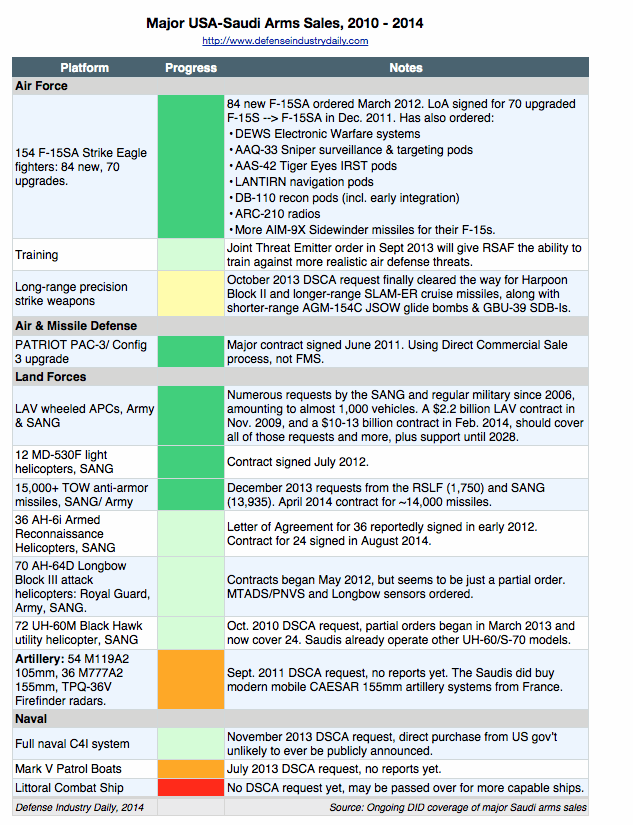
Note that this dashboard does not cover American contracts that began before 2010, such as Saudi Arabia’s drive to upgrade its M1 tanks, or various Saudi Arabia National Guard sales initiated before the big October 2010 request. It also omits sales to Saudi Arabia from outside the USA, such as S-2000 AWACS aircraft from Sweden, advanced Eurofighter Typhoon fighters from Britain, etc.
Contracts & Key Events
2015 – Today
[youtube:v=6x9fI-DjNGE]
April 21/21: ESTS The Advanced Electronics won a contract modification for the F-15 Royal Saudi Air Force (RSAF) Electronic System Test Set (ESTS). Services acquired under this effort are to provide the RSAF with an upgraded ESTS. The RSAF currently uses an A31U18240-2 ESTS configuration, and this shall provide the scope to upgrade and install the A31U18240-3 and A31U18240-4 configuration (frequently referred to as -3 and -4, respectively), as well as familiarization training, regression testing, and travel. Work will be performed at the RSAF Central Maintenance Facilities within the Kingdom of Saudi Arabia; the Science and Engineering facility in Huntsville, Alabama; and Robins Air Force Base, Georgia, and is expected to be completed April 16, 2021.
January 6/21: F-15SA Conversion Boeing won a $21.7 million contract for F-15S to F-15SA conversion support. This contract provides support for the conversion of the Royal Saudi Air Force F-15S into an F-15SA aircraft, which includes program management, reach-back support for the 48 continental United States and Washington, DC; temporary on-site for outside the continental US assistance; and round robin repairs. An advanced version of the F-15S, the F-15SA is equipped with several capabilities to enable the Royal Saudi Air Force to deter regional threats. The aircraft features a digital electronic warfare suite, fly-by-wire flight control system, Active Electronically Scanned Array radar, an infrared search-and-track system, advanced cockpit displays and Joint Helmet Mounted Cueing Systems. In early December, it was reported that the Royal Saudi Air Force has received the F-15SA advanced fighter aircraft, marking the final delivery of the Boeing-produced aircraft as part of a $29 billion foreign military sales agreement signed in 2010. Work will take place in Missouri and estimated completion date is December 30, 2022.
November 12/20: Modernization And Sustainment Boeing won a $9.8 billion deal for F-15 support for Saudi Arabia. This contract provides for modernization and sustainment of the F-15 Saudi fleet to include such efforts as hardware, software, and interface design, development, integration, test, subsystem and structural component production and installation of future modifications and enhancements to the F-15 Saudi weapon system as well as product support. Per the contract, the ordering period for this contract is five years from the date of contract award plus an option for an additional five year ordering period. Saudi Arabia’s most modern F-15s are 88 new-build F-15SAs, with an average age of just 5.1 years. In addition to fly-by wire controls, the F-15SA has a digital electronic warfare suite, an infrared search and track system and a Raytheon APG-63(V)3 active electronically scanned array radar. The aircraft’s forward and aft cockpits feature advanced displays and joint helmet-mounted cueing systems. The new F-15 variant also has two additional wing weapons stations to boost its payload. Work will take place in St. Louis. Estimated completion will be by November 2025.
June 25/20: End-User Training Advanced Electronics won a $12.4 million modification, which provides for implementation and delivery of end-user training for the CPS for two years. The scope of this contract effort will include custom contractor-developed training and original equipment manufacturer training. This is a Foreign Military Sales (FMS) acquisition between the US government and the Kingdom of Saudi Arabia. This FMS is for the total package of acquisition and fielding of 84 F-15A aircraft; the upgrade of 70 F-15SA aircraft to the F-154SA configuration; the procurement of associated equipment, weapons and spares; and the construction, refurbishment and infrastructure improvements of support facilities for the F-15SA in the Kingdom of Saudi Arabia. The F-15 Eagle is an all-weather, extremely maneuverable, tactical fighter aircraft designed to outperform and outfight enemy aircraft obtaining air supremacy for the US Air Force. The Royal Saudi Air Force (RSAF) F-15SA is an advanced fighter jet aircraft version of the F-15E Strike Eagle featuring state-of-the-art sensors and a wide range of guided and smart munitions.
August 2/19: F-15SA Advanced Electronics won a $57.8 million modification for the Royal Saudi Air Force F-15SA Cyber Protection System and Related Facilities program. The F-15SA multi-role fighter is a Saudi Advanced variant of the Boeing F-15 Strike Eagle. It has a modern fly-by-wire flight control system in place of the hybrid electronic/mechanical system used by previous F-15s. The variant includes the APG-63(v)3 active electronically scanned array (AESA) radar, digital electronic warfare systems (DEWS), infrared search and track (IRST) systems, and other advanced systems. It also includes a redesigned cockpit originally intended for the F-15SE. The fly-by-wire system will allow the carriage of weapons on the previously unused outer wing weapon stations. Work is expected to be completed by July 31, 2022.
July 26/18: F-15 FMS Alsalam Aerospace Industries is being tapped to convert six mission capable Saudi F-15S aircraft to a F-15SA configuration. The contract has a total value of $59.6 million, of which $17.8 million will come from the US foreign military sales fund. Services include program management, conversion labor and storage. The F-15SA can be considered to be the most advanced production F-15 Eagle that is being built today. In 2015 Saudi Arabia ordered 84 new build F-15SAs and close to 70 kits to upgrade their existing F-15S fleet to the SA configuration. This configuration includes a full fly-by-wire control system, a new AESA radar, a digital electronic warfare and radar warning suite, missile launch detection system, updated flat-panel display cockpits with helmet mounted displays and an infrared search and track system. Work will be performed in Riyadh, Saudi Arabia, and is expected to be completed by August 2020.
December 28/17: FMS-Repair Boeing is to carry out repair and support services for the Royal Saudi Air Force (RSAF) following the award of a US Air Force contract last Thursday. The $480.4 million fixed-price-incentive-firm contract comes as a 100 percent foreign military sale (FMS) to the Gulf kingdom, and includes a 24-month base period, with five 12-month option periods and one six-month option period to continue repair services and support between Boeing and the Royal Saudi Air Force. The deal includes the logistical in-Kingdom repair and return of parts for F-15C/D/S/SA fleets and repair of aerospace ground equipment, hush house/open air test cell equipment for the RSAF F-15 program. Work will take place up until June 25, 2025 at various locations across the US and in Saudi Arabia.
September 27/17: S&K Aerospace will provide supply, maintenance and facility services for the Royal Saudi Air Force’s (RSAF) F-15 fighter fleet, after winning a $559 million US Air Force contract on Friday. The agreement, which falls under foreign military sales to the Gulf kingdom, covers the provision of consumables, parts and maintenance of print on demand parts facilities for the Kingdom of Saudi Arabia’s F-15 program, including all F-15 C/D/S/SA fleets. Work will be carried out in Saudi Arabia and is expected to run through March 31, 2023. The F-15 Eagle is one of the main fighter aircraft operated by the RSAF, and is currently receiving delivery of its most advanced version, the F-15SA, which features upgraded avionics, electronics warfare systems and a greater payload.
March 7/17: Boeing received a contract-modification of $46 million to perform interim contractor support for Saudi Arabia’s recently purchased F-15s. The above support refers to an agreement wherein a service will defer an investment due to a lack of technological capabilities, such as equipment spares or technical data. Boeing is expected to complete this service for Saudi Arabia by the end of March. The contract is comprised entirely of foreign military sales to Saudi Arabia and supports the recent commissioning of F-15SA fighters by the kingdom.
February 9/17: Boeing has been awarded $18 million to provide AN/APG-63(V) radars for Saudi Arabia’s F-15SA aircraft. The USAF contract covers three of the radars, and work completion is expected for March 2017. Riyadh recently commissioned the new F-15SA fighter jets in January, which feature updated avionics and active electronically scanned array (AESA) radars.
December 9/16: Lockheed Martin will provide spare parts for the Royal Saudi Air Force’s F-15 Strike Eagle fighters. The $67 million USAF contract covers parts for Infrared Search and Track systems, Sniper Advanced Targeting Pods, and LANTIRN Extended Range navigation pods. Lockheed Martin has been providing sensor systems for the kingdom’s Boeing-made fleet since 1996.
October 4/16: Saudi Arabia is set to buy a further eight UH-60M Black Hawks in a $91 million US Army contract. The foreign military sale will see Sikorsky provide the medium-lift utility helicopters by December 2017. Back in February, Sikorsky and Saudi Arabian firm Taqnia Aeronautics began investigating the possibilities of producing Black Hawks in the kingdom as part of efforts to diversify their economy amid dropping oil prices.
September 22/16: Saudi Arabia’s Al Raha Group has successfully been awarded a USAF contract to provide support to the Saudi Arabian F-15 fleet. Valued at $355.9 million, Al Raha will provide comprehensive material management of unclassified spares, support equipment, and support services required to support base stand-ups and continued F-15 and F-15SA Royal Saudi Air Force flying operations. Work will be carried out both in Georgia, USA and in Saudi Arabia.
September 06/16: PKL Services have been awarded a $495 million USAF contract for work on the Royal Saudi Air Force’s F-15 fleet. The indefinite-delivery/indefinite-quantity contract covers maintenance, upgrade, and training of the Saudi Strike Eagle S- and SA-type fighters. Saudi Arabia has been flying the F-15SA since 2013, and features include improved performance and increased survivability at a lower life-cycle cost as well as two additional wing stations for increased payload and capability.
July 13/16: Boeing is to commence deliveries of the AH-6i Little Bird light attack/reconnaissance helicopter to the Saudi Arabia National Guard (SANG) at the end of the month. The Gulf Kingdom ordered 24 Ah-6is at a cost of $243 million in 2014 as part of a wider $25.3 billion helicopter deal which includes a number of AH-64E Apaches, Sikorsky UH-60M Blackhawks, and 12 MD Helicopters MD-530F. Derived from the AH-6 Little Bird, the latest version includes advanced technology from the AH-64E Apache.
November 17/15: The US State Department has cleared the sale of $1.29 billion worth of smart bombs to Saudi Arabia. The purchase will replenish supplies used in recent air strikes against both Iranian backed Houthi insurgents in Yeman and Islamic State forces in Syria. Details of the sale were posted by the Defence Security Cooperation Agency (DSCA) last Friday and follow last months shopping spree by the Saudis which totalled $11.25 billion. Last months sale included four multi-mission Littoral combat ships as well as various equipment and munitions which came in the wake of the US-Iranian nuclear agreement. Several Gulf nations made requests to the US to help modernize their military before they acquiesced to the deal.
October 21/15: The US State Department has approved the sale of up to four Littoral Combat Ship-based Multi Mission Surface Combatant Ships to Saudi Arabia, with these based on the Lockheed Martin Freedom-class LCS, as opposed to the Austal Independence-class. If lawmakers agree to the sale, a Foreign Military Sales contract can be drafted, with this likely to be signed early next year. The deal – potentially worth $11.25 billion – forms part of the Kingdom’s Eastern Fleet Modernization program.
The Gulf state also requested a significant quantity of US-manufactured weaponry to complement the new MMSC ships. This includes over five hundred RIM-162 Evolved Sea Sparrow Missiles, 128 RIM-116C Block II Rolling Airframe Missiles to equip five new MK-15 Mod 3 SeaRAM air defense systems and 48 Block II GM-85 Harpoon missiles, along with eight launchers and five control systems. The request also covers eight MK-41 Vertical Launch Systems (capable of launching Raytheon’s family of Standard Missile munitions), .50 cal machine guns and five Oto Melara MK-75 Gun Systems, as well as sonar and communications systems.
October 16/15: Saudi Arabia has signed a deal with the US for 320 PAC-3 interceptor missiles, with this following a DSCA request in July for 600. The new missiles will modernize the Saudis’ Patriot air and missile defense systems, with the request valued at $5.4 billion. The Saudi government is also reported to be pushing ahead with plans to acquire the Terminal High Altitude Area Defense (THAAD) system, along with the remaining 280 PAC-3 missiles. This news comes on the heels of reports earlier this week that the Kingdom is mulling a possible acquisition of Israeli short-range air and missile defense systems; these would complement the medium and long-range capabilities of the Patriot and THAAD systems.
The country has also requested nine UH-60M Blackhawk helicopters, along with auxiliary equipment, spares, and logistical support in a potential deal valued at $495 million. The Kingdom has already ordered a number of UH-60Ms, previously requesting 72 helicopters along with other US equipment. Other regional states have also ordered the Sikorsky helicopter, including Bahrain, Egypt and the United Arab Emirates.
October 13/15: The Saudi Arabian National Guard will receive the first of twenty-four Boeing AH-6i armed reconnaissance helicopters in late June 2016, according to a report by Janes. The helicopters are being manufactured under a $234.7 million long-lead production contract awarded to Boeing in late 2013 and announced in August 2014, with Saudi Arabia the first customer for the type. Construction of the helicopters will begin in December. Saudi Arabia has been a loyal market for US helicopter manufacturers, with acquisitions including the UH-60L Black Hawk and AH-64D Apache.
2014
Sept 15/14: Hellfires. Hellfire Systems LLC, Orlando, FL, was awarded a $68.7 million to firm-fixed-price, foreign military sales contract modification to acquire 1,361 Hellfire II tactical missiles in containers and air-to ground missiles: model AGM-114R, AGM-114R-3, AGM-114P-4A, TGM M36E7, and ATM-114Q-6.
The countries involved in this foreign military sales contract are Iraq, Jordan, Indonesia, Saudi Arabia and Qatar. All of these countries are AH-64 Apache attack helicopter customers or prospective customers, except Iraq (AC-208B aircraft), and Jordan (AC-235 aircraft). DID looked into these designations.
* The AGM-114P is generally used on UAVs like the Predator, where its 360 degree firing capability and tolerance of high altitude temperatures are welcome. These traits also make it suitable for fixed-wing aircraft.
* There is no AGM-114R-3 – but there is an AGM-114R2 with a Height Of Burst sensor, which helps improve the base AGM-114R’s tri-mode anti-armor/ timed anti-structure/ fragmentation warhead.
* The AGM-114Q model is a training round, with an inert mass that’s the same weight as the warhead. It’s used for live-fire training, where it creates less mess.
* The TGM M36E7 corresponds to what the USAF would call a “CATM” – a training missile with the seeker head, but no rocket or warhead.
Estimated completion date is Nov 30/16. Work will be performed in Orlando, FL. US Army Contracting Command in Redstone Arsenal, AL manages the contract on behalf of its FMS clients (W31P4Q-11-C-0242, PO 0104).
Oct 1/14: Saudi Arabia. The US DSCA announces a Saudi Arabian export request for more PATRIOT PAC-3 missiles, with Lockheed Martin in Dallas, TX and Raytheon in Tewksbury, MA as the designated contractors to negotiate with. the contract could be worth up to $1.75 billion, on top of previous request and sales involving a $1.7 billion upgrade of PATRIOT systems to Config-3 status for PAC-3 missile use (q.v. Nov 30/11), high-end maintenance and re-certification contracts (q.v. Dec 23/11, Nov 28/12), and a national C4I system (q.v. Nov 26/12).
This time, they want to buy up to 202 PATRIOT PAC-3 Missiles with containers, and 1 Patriot as a Target (PAC-2 Guidance Enhanced Missile GEM Flight Test Target). They also want up to 36 Launcher Station Modification Kits, 6 Fire Solution Computers, 6 Patriot Automated Logistics Systems Kits, 2 PAC-3 Telemetry Kits, 2 Missile Round Trainers, 2 PAC-3 Slings, 6 Shorting Plugs, spare and repair parts, lot validation and range support, ground support equipment, repair and return, publications and technical documentation, personnel training and training equipment, a Quality Assurance Team, and other US Government and contractor support.
“The proposed sale will help replenish Saudi’s current [PAC-2] Patriot missiles which are becoming obsolete and difficult to sustain due to age and the limited availability of repair parts. The purchase of PAC-3 missiles will support current and future defense missions…. Although [industrial] offsets are requested, they are unknown at this time and will be determined during negotiations between the KSA and contractor.”
Implementation of this proposed program will require 1 additional US contractor to travel to the Kingdom of Saudi Arabia for a period of 3 years for equipment fielding and system checkout. Sources: US DSCA #14-43, “Kingdom of Saudi Arabia (KSA) – Patriot Air Defense System with PAC-3 Enhancement”.
DSCA: Saudis request PAC-3 missiles (202)
Sept 10/14: F-15S EW. BAE Systems, Nashua, New Hampshire, has been awarded a $7.7 million firm-fixed-price contract modification for a DEWS ECM engineering change proposal, on behalf of Saudi Arabia’s F-15SAs. DEWS links various sensors that track threats to its fighter, and coordinates defensive flares, chaff, etc. The main DEWS contract was announced on April 2/12, at $366.5 million for 70 systems, as part of the RSAF’s F-15S conversions.
Work will be performed at Nashua, NH, and is expected to be complete by Nov 30/18. This award is the result of a sole-source acquisition, managed by the USAF Life Cycle Management Center at Robins AFB, GA on behalf of their Saudi client (FA8540-12-C-0013 PO 0008).
Sept 8/14: Support. Booz Allen Hamilton in McLean, VA receives a $43.3 million cost-plus-fixed-fee contract for services to support the Royal Saudi Land Forces: consulting, intensive management, logistics support, and contracting support within the United States. In addition, an office will be established in Saudi Arabia for local purchasing and local hires to sustain the fleet of M1A2S Abrams tanks purchased and sustained through the foreign military sales program.
Work will be performed in Saudi Arabia with an estimated completion date of Sept 8/17. Bids were solicited via the Internet, with 1 received by US Army Contracting Command at Aberdeen Proving Ground, MD (W91CRB-14-C-0048).
April 29/14: SANG AH-6i. Boeing in Mesa, AZ receives a $234.7 million unfinalized contract covering 24 AH-6i armed scout helicopters, the initial spares package, and ground support equipment for Saudi Arabia. $115 million is committed immediately.
IHS Jane’s confirms that this is the AH-6i’s 1st sale, as Jordan has yet to make good on its Letter of Intent. The AH-6i Letter of Agreement for 36 machines was reportedly signed on Feb 13/12, but phases, numbers, and prices remained to be negotiated. This purchase appears to clarify comments from Lynn Tilton of MD Helicopters that the type’s initial order would be for 24, with more to follow. Beyond Saudi Arabia, Boeing is reportedly targeting AH-1 Cobra operators. Many of whom received daylight-capable surplus American aircraft at a discount, and they may not be able to afford a full replacement like the AH-1Z or AH-64E.
Work will be performed in Mesa, AZ with an estimated completion date of Dec 31/16. US Army Contracting Command in Redstone Arsenal, AL manages the contract on behalf of their Saudi FMS client (W58RGZ-14-C-0082). See also IHS Jane’s Defence Weekly, “Boeing awarded AH-6i contract for Saudi Arabia” | Aviation Week Farnborough, “Boeing Readies Saudi AH-6i, Eyes More Customers”.
24 AH-6i armed scout helicopters
Aug 19/14: SANG UH-60Ms. Sikorsky in Stratford, CT receives a $30.3 million contract modification for 12 UH-60M Black Hawk helicopters, on behalf of the Saudi Arabian National Guard. All funds are committed immediately. This appears to be an initial award, with a follow-on to come that will modify the helicopters for Saudi use (q.v. March 25/13, Dec 20/13), and bring total SANG UH-60M sales to 24 of 72 requested machines.
The estimated completion date is Aug 31/17. Work will be performed in Jupiter, FL and Stratford, CT. US Army Contracting Command in Redstone Arsenal, AL manages the order on behalf of its Saudi client (W58RGZ-12-C-0008, PO 0072).
April 23/14: TOW me. Raytheon announces:
“An international customer signed an agreement with the U.S. Government for a foreign military sale (FMS) of tube-launched, optically tracked, wireless-guided (TOW) missiles to be supplied by Raytheon Company (NYSE: RTN) in a deal valued at approximately $750 million.
Raytheon plans to deliver nearly 14,000 TOW missiles to the customer over a three-year period beginning in 2015. A resulting order is expected to be executed by the U.S. government with Raytheon in the coming weeks.”
Do they mention the customer? No, they don’t. Are there any other customers with pending orders for “nearly 14,000 TOW missiles” (q.v. Dec 5/13)? No, there aren’t. The only question is whether this includes only the SANG, whose DSCA request involved 13,935 TOW missiles, or stands as a joint buy that also includes the Royal Saudi Land Forces. Sources: Raytheon, “International customer signs agreement with USG valued at $750 million for Raytheon’s TOW missiles”.
~14,000 TOW missiles
April 11/14: F-15SA. Boeing in St. Louis. MO receives a $9.9 million unfinalized contract modification for Royal Saudi Air Force F-15SA Training. The contract had an initial face value of $75.6 million, which brings the total to 84.5 million. The increase covers new activities within the contract’s original scope, including training in the USA, and maintenance and aircrew and academic training outside the USA.
Work will be performed until Aug 5/19 in St. Louis, MO; and at King Khalid Air Base near Khamis Mushayt, Saudi Arabia. The USAF 338th Security Assistance Training Squadron at Joint Base San Antonio in Randolph AFB, TX manages the contract on behalf of their Saudi client (FA3002-13-D-0012, PO 0005).
March 13/14: AH-64. Longbow LLC in Orlando, FL receives a $25.5 million FMS contract modification via the Royal Saudi Land Forces Aviation Command for initial spares, peculiar ground support equipment, integrated logistics support, management, and production line spares. Longbow, LLC makes the fire control radar used with the AH-64 Apache attack helicopter.
All funds were committed immediately. Work will be performed in Orlando, FL until June 30/16. The US Army Contracting Command in Redstone Arsenal, AL manages the contract (W58RGZ-06-C-0134, PO 0045).
Feb 10/14: Hellfires. Hellfire Systems, LLC in Orlando, FL receives a $157.4 million firm-fixed-price contract modification, exercising an option for FY 2014 Hellfire II missile production requirements that include foreign military sales to Saudi Arabia, Jordan and Indonesia. The Saudis are buying Hellfire missiles for their AH-64 and AH-6i helicopters.
All funds are committed immediately, using FY 2012 – 2014 budgets. Work will be performed in Orlando, FL, with an estimated completion date of Nov 30/16. US Army Contracting Command – Redstone Arsenal (Missile) at Redstone, AL manages the contract, and acts an an FMS agent for other countries (W31P4Q-11-C-2042, PO 0068).
Hellfire missiles

(click to view full)
Feb 14/14: LAVs. The Canadian government announces a huge contract, and lets slip that it’s from Saudi Arabia in the footnotes. Mr. Fast led trade missions to the Saudi kingdom in 2012 and 2013, so he has cause to be pleased, but he may have missed the nuance that Saudi Arabia is generally reticent about its military buys. Even if it is a tremendously timely order for GDLS Canada, which will keep the plant and its supply chain open as US Stryker (LAV-III) purchases wind to a close:
“The Honourable Ed Fast, Minister of International Trade, and Danny Deep, Vice President, General Dynamics Land Systems-Canada, announced today a historic multi-billion dollar contract win for vehicles and associated equipment, training and support services. The announcement was made in London, Ontario, where the light armoured vehicles will be designed and manufactured and which will become the epicentre of a cross-Canada supply chain directly benefiting more than 500 local Canadian firms. This 14-year contract will create and sustain more than 3,000 jobs each year in Canada, with southern Ontario accounting for approximately 40 percent of the supply base.”
To clear up any confusion about jurisdictions: The contractor is General Dynamics Land Systems, which is an American firm subject to US government export laws and approval requirements. At the same time, the state-run Canadian Commercial Corp. handles all exports from Canadian firms, even if they’re subsidiaries like GDLS-Canada.
There’s no official corporate release yet, but General Dynamics has described the deal to reporters as $10 billion, which could rise to $13 billion if all options are exercised. That’s far bigger than Oct 4/07 and June 13/11 DSCA requests for new vehicles (total: about $1 billion) can account for. Nor do purchases for the Saudi Arabian National Guard make up much of the difference. GDLS-Canada announced a $2.2 billion deal on Nov 24/09 for 724 LAV-II 8×8 wheeled armored personnel carriers, in 10 different variants, which exactly matched a July 20/06 Saudi DSCA request.
The Saudis already had a substantial fleet of LAV vehicles in their military branches. It seems very likely that a support contract covering all Saudi LAV fleets going forward is a big part of this deal, along with all LAVs requested to date and perhaps more. It is possible for the Saudis to order vehicles as a Direct Commercial Sale, which still requires approvals but doesn’t require the same announcements, and would make the Saudis fully responsible for managing the buy. Sources: Foreign Affairs, Trade and Development Canada, “Largest Advanced Manufacturing Export Win in Canada’s History” | Reuters, “General Dynamics Canada wins Saudi deal worth up to $13 billion”.
Huge LAV order, plus over a decade of support
Feb 5/14: LAV-AT SWORD. Raytheon in McKinney, TX receives a $16.3 million firm-fixed-price, foreign military sales contract for 22 modified improved target acquisition systems for the Royal Saudi Land Forces SWORD program, and 3 for the Saudi Arabian National Guard. A seemingly-related FBO.gov solicitation describes SWORD as:
” WITHIN THE FMS CASE, ON LINE ITEM 012 NOTE 36, SWORD DIRECTED THE PURCHASE OF LIGHT ARMORED VEHICLE-ANTI TANK (MOD) (LAV-AT(M)) WITH THE MITAS.”
LAV-ATs use under-armor TOW missiles, and improving them with ITAS modified for those vehicles delivers a lot of bang for the buck. Bids were solicited via the Web, with 1 received. Work will be performed in McKinney, TX, and the estimated completion date is June 30/15. Work will be managed by US Army Contracting Command in Warren, MI as the Saudis’ agent (W56HZV-14-C-0066).
2013
1st F-15SA flight and official rollout; Significant contracts for WCMD cluster bombs & JTE trainers; Slew of AH-64E helicopter contracts; Export requests for a new array of precision strike weapons, Full naval C4I systems, Mk.V Patrol Boats, thousands of TOW missiles; Boeing & Sikorsky team of up for long-term Saudi support.

(click to view full)
Dec 20/13: SANG UH-60Ms. Sikorsky in Stratford, CT receives a $105.3 million contract modification to contract “to modify 8 UH-60M Black Hawk Helicopters to a General Service Configuration in Support of the Saudi Arabian National Guard.” The contract number indicates that these machines are purchases under the MYP-8 multi-year deal, which explicitly allows other countries to take advantage of American volume pricing. Essentially, they’re buying 8 UH-60Ms as an initial order under the Oct 20/10 DSCA request to export up to 72 machines.
One bid was solicited with one received. Work will be performed in West Palm Beach, FL and in Saudi Arabia. US Army Contracting Command in Redstone Arsenal, AL acts as the Saudis’ agent (W58RGZ-12-C-0008, PO 0089).
8 UH-60Ms: initial order
Dec 19/13: F-15SA. Lockheed Martin Missiles and Fire Control in Orlando, FL receives a maximum $8.8 million firm-fixed-price modification on an existing RSAF contract for AN/AAQ-33 Sniper surveillance & targeting pods (q.v. April 2/12). They’ll provide configuration support for compact multiband data link software and firmware on the RSAF’s F-15SAs, and handle various other support tasks involving the Sniper ATP.
Work will be performed at Orlando, FL, and is expected to be complete by November 2016. The USAF Life Cycle Management Center/WNKCB at Robins AFB, GA acts as the Saudis’ agent (FA8540-12-C-0012, PO 0004).
Dec 17/13: F-15 Sensors. Goodrich Corp. (now United Technologies’ Aerospace Systems) in Westford, MA has been awarded an $183 million firm-fixed-price unfinalized action within the Royal Saudi Air Force DB110 Reconnaissance System program. This modification changes the requirements to include in-country setup and installation, ground stations, and a pod survey study being produced under the basic contract, issued on April 13/12 for $183 million (see also May 31/12).
Work will be performed at Westford, MA, and is expected to be complete by July 23/21, which is a year ahead of the April 2012 announcement. It appears as if they’ve kept the price stable, but adjusted some terms. DID is investigating. A July 10/12 Goodrich release cited the Saudi order as 10 dual-band reconnaissance pods per the Oct 20/10 DSCA request, 5 ground stations, and “extensive training and logistics support.” The USAF Life Cycle Management Center/WINK at Wright-Patterson AFB, OH acts as the Saudis’ agent (FA8620-12-C-4020, PO 0013).
Dec 5/13: TOW missiles. The US DSCA announces Saudi Arabia’s official request for export clearance to buy 1,750 portable TOW anti-armor missiles for the Royal Saudi Land Forces. The request includes up to 1,000 BGM-71E TOW-2A missiles with a nose spike to help defeat advanced armor and fortifications, 7 TOW-2A test missiles, 750 BGM-71F TOW-2B Aero missiles with longer range (>4 km) and a top attack mode, and 7 TOW-2B test missiles. they’re also requesting containers, spare and repair parts, support equipment, tools and test equipment, publications and technical documentation, personnel training and training equipment,and other US government and contractor support.
The estimated cost is up to $170 million, but the Saudis will need to negotiate a contract with prime contractor Raytheon Missile Systems in Tucson, AZ. Saudi Arabia already operates TOW missiles, and they won’t need any additional personnel in country. The Saudi National Guard also submitted a request for TOW missiles today, but it was far larger at over 13,000 missiles and up to $900 million. Sources: US DSCA, 13-52.
DSCA request: TOW missiles
Nov 27/13: F-15SA. Boeing in St. Louis, MO receives a $15.5 million firm-fixed-price contract modification for “disorientation recovery function capability on the F-15SA aircraft”. In English, if the plane is behaving in a way that suggests the pilot has lost control via G-force blackout or other causes, and isn’t receiving ongoing input from the pilot, an autopilot is engaged to right the aircraft. As they say, the ground always has a PK of 1.0.
$2.4 million is committed immediately. Work will be performed in St. Louis, MO and will be complete by Feb 2/15. The USAF Life Cycle Management Center at Wright-Patterson AFB, OH acts as Saudi Arabia’s managing agent (FA8634-12-C-2651, PO 0021).
Nov 20/13: Navy. The Royal Saudi Navy’s core currently consists of French Al-Riyadh (Lafayette) and Al-Madinah Class frigates at the high end, and older US-built Badr Class corvettes and Al-Sadiq Class patrol boats at the low end. The Saudi Naval Expansion Program II will shape the Kingdom’s next set of buys, and discussions have ranged from American LCS frigates, to full-size DDG-51 Aegis destroyers capable of ballistic missile defense. They could turn to options like Spain’s Navantia (F100 family), if they wish to buy Aegis ships from a source other than the USA. The Saudis are also evaluating France’s new FREMM frigates, which could offer missile defense capabilities of their own, and share some commonalities with their existing Al-Riyadh Class.
October statements by Saudi intelligence chief Prince Bandar bin Sultan may have said that the kingdom was hoping to make a major shift away from the United States, but at this point, they can’t really do that for their C4I systems. The Saudis’ installed and committed C4I base is one reason. In addition, the US Navy is still the pre-eminent force they need to cooperate with in the Gulf, so they need C4I interoperability. Ships are another matter. Sources: Reuters, “Lockheed sees more clarity on Saudi naval buy in next months” | UAE’s The National, “Challenges in the Middle East for US defence companies“.
[youtube:v=VJNIDyWOYVc]
click for video
Nov 19/13: Navy C4I. The US DSCA announces an official Foreign Military Sale export request from Saudi Arabia for C4I system upgrades and maintenance, aimed specifically at Saudi Arabia’s naval forces, at a cost of up to $1.1 billion. “The RSNF will use the upgraded C4I system to provide situational awareness of naval activity in the Persian Gulf and the Red Sea…. and keep pace with the rapid advances in C4I technology to remain a viable U.S. coalition partner in the region.” The request includes:
* Global Command and Control Systems – Joint (GCCS-J). A November 2012 announcement from Raytheon referred to a $600 million Direct Commercial Sale contract for a “national, strategic C4I system, providing capabilities for joint service coordination.” GCCS-J is what the US military uses for that purpose, and the US military has service-specific variants of it. Saudi Arabia has effectively financed other countries’ upgrades before, and a big contract could help DISA implement some of the GCCS-J changes it wants. Starting with moving GCCS-J off of SPARC-chip computers and onto Intel chip computers. DISA also wants to migrate the software from Windows into plug-ins for the Agile Client framework (Java NetBeans, NASA’s WorldWind, plus VMWare’s Gemfire), while migrating web client capabilities into the Joint Command and Control Common User Interface (JC2CUI, uses the Ozone Widget Framework). If the Saudis help to develop a system with 1 or more of these migrations, the impact will be felt by the US military.
* Air Defense System Interrogator (Ultra Electronics’ ADSI), which provides tactical data link forwarding, and interfaces between a very large set of tactical data links, radar interfaces, and electronic intelligence interfaces.
* Combined Enterprise Regional Information Exchange System (CENTRIXS) and follow-on systems. Looks like there will be a CENTRIXS-SA soon, enabling text and web communication with the US Navy and other CENTRIXS-equipped nations like Britain.
* 109 Link–16 Multifunction Information Distribution System Low Volume Terminals (MIDS-LVT)
* Identification Friend or Foe (IFF) hardware.
* Commercial Satellite Communications (SATCOM).
* Commercial High Frequency (HF) and Ultra High Frequency/ Very High Frequency (UHF/VHF) Radios, including HF Voice and Data, HF Sub-Net Relay (SNR), Commercial HF Internet Protocol (IP)/SNR.
* Global Positioning System (GPS) gear.
* Plus communications support equipment, information technology upgrades, spare and repair parts, publications and technical documentation, personnel training and training equipment, and US Government and contractor support.
There will be no principal contractors involved with this proposed sale. Acquisition and integration of all systems will be managed by the U.S. Navy’s Space and Naval Warfare Weapons Command (SPAWAR), and implementation will require the assignment of 14 U.S. Government and contractor representatives to Saudi Arabia for 10 years to support network design, acquisition, implementation, installation, and integration efforts. Sources: DSCA 13-44.
DSCA: Full naval C4I backbone
Oct 15/13: Weapons. The US DSCA announces Saudi Arabia’s formal export request for a variety of weapons that will equip its F-15SA fighters. Note that this list is in addition to the weapons mentioned in the main October 2010 request, and could be worth up to $6.8 billion in total:
* 400 AGM-84L Harpoon Block II missiles, which add GPS to the missile’s radar targeting. They can be used against land targets as well as ships.
* 40 Harpoon CATM.
* 20 ATM-84L Harpoon Exercise Missiles.
* 650 AGM-84H SLAM-ER cruise missiles. This Harpoon variant adds IIR terminal guidance to GPS navigation, and extended-range wings that let it hit land and sea targets 250 km away. South Korea’s F-15Ks already deploy it. The US Navy uses its AGM-88K successor, which they consider to be their most accurate strike weapon. The Saudis already deploy MBDA’s stealthy, long-range Storm Shadow cruise missile from their Tornados, so they may be less impressed, but SLAM-ER will definitely add punch to the F-15 fleet.
* 40 CATM-84H Captive Air Training Missiles (CATM), with seekers but no motor.
* 20 ATM-84H SLAM-ER Telemetry Missiles for test shots.
* 4 Dummy Air Training Missiles. Sometimes you just need similar weight & form factor.
* 60 AWW-13 Data Link pods. Pilots can receive text, data, and photos from various sources, and can also use it to communicate with the SLAM-ER in mid-flight.
* 973 AGM-154C Joint Stand Off Weapons (JSOW). This stealthy 2,000 pound glide bomb uses GPS for navigation and IIR guidance for terminal guidance.
* 10 JSOW CATM.
* 1,000 GBU-39/B Small Diameter Bombs (SDB). These 250 pound JDAM variants can be carried 4 to a rack. GPS guidance and pop-out wings give them decent range and accuracy, and their design makes them more effective against hard targets than their weight would suggest.
* 36 SDB Captive Flight and Load Build trainers.
* Containers, mission planning, integration support and testing, munitions storage security and training, weapon operational flight program software development, transportation, tools and test equipment, spare and repair parts, publications and technical documentation, personnel training and training equipment, and other forms of U.S. Government and contractor support.
The principal contractors will be Boeing in St. Louis, MO (Harpoon, SLAM-ER, SDB); Raytheon in Indianapolis, IN; and Raytheon in Tucson, AZ (JSOW). If contracts are negotiated, they’ll need to negotiate the addition of approximately 2-4 additional U.S. Government or contractor representatives to Saudi Arabia. Sources: US DSCA 13-49, Oct 15/13.
DSCA: Precision strike weapons request
Oct 15/13: Support. The US DSCA announces Saudi Arabia’s export request for 3 years of support services to its Ministry of Defense from the US Military Training Mission (USMTM) in Riyadh, Saudi Arabia. They’re responsible for identifying, planning, and executing US security cooperation training and advisory support. The estimated cost is up to $90 million, no contractors are involved, and no additional personnel will be needed. Sources: US DSCA 13-53, Oct 15/13.
Oct 3/13: A maximum $181 million not-to-exceed contract modification lets Saudi Arabia buy 2 KC-130J transport and tanker aircraft under the US umbrella deal, along with associated non-recurring engineering support. It’s just a small part of the 25-plane, $6.7 billion request (q.v. Nov 9/12).
Work will be performed at Marietta, GA, and is expected to be completed by April 2016. This contract is 100 percent foreign military sales for Saudi Arabia. Air Force Life Cycle Management Center/WLNNC, Wright-Patterson Air Force Base, Ohio, is the contracting activity (FA8625-11-C-6597, PO 0177).
2 KC-130Js
Sept 26/13: Industrial. Boeing’s Al Salam Aircraft Corp. joint venture in Riyadh, Saudi Arabia receives a $33.1 million firm-fixed-price contract related to the F-15S to F-15SA upgrade program. The contract is all about getting the company ready to carry out the demanding Phase II program, and includes setting up the facility, developing manufacturing plans and schedules, and readying automated performance reporting tools.
During Phase I of this upgrade, 2 F-15S fighters will be converted to F-15SA status at the Boeing facility in St. Louis, MO. Following successful completion of the initial phase, production will resume under Phase II at Alsalam, to complete the remaining 68 aircraft.
The firm has experience with F-15s, and has been providing Programmed Depot Maintenance to the Saudi F-15C/D/S fleet since 2002. The initial phase is expected to be complete by Dec. 31/15, with overall contract completion on Dec 31/19. The USAF Life Cycle Management Center/WWKA at Robins AFB, GA, acts as the Saudi FMS agent (FA8505-13-C-0014). See also: Alsalam Aircraft Corp History | Video.
(click to view full)
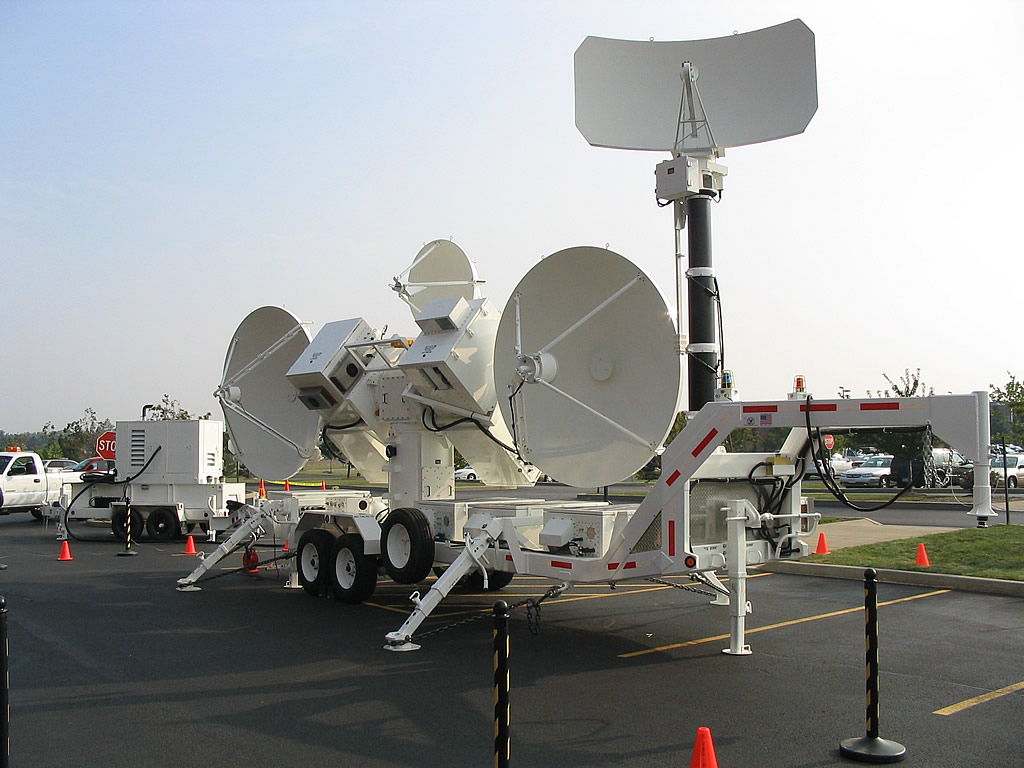
Sept 9/13: JTE. Northrop Grumman Amherst Systems in Buffalo, NY received a $219.1 million firm-fixed and cost-type contract from Saudi Arabia for its Joint Threat Emitter (JTE). They’ll supply 1st article and production units, associated drawings, retrofit kits, provisioning, and software. $44 million is committed immediately.
This contract was a competitive acquisition, with 2 offers received by the Saudis’ agent: the USAF Life Cycle Management Center/PZZK at Hill Air Force Base, UT.
The JTE is a mobile multi-radar system that radiates at realistic power levels, reacting to attempted jamming, employing IFF technologies, and tracking pilots’ reactions to its own efforts. It can simulate Anti-Aircraft Artillery radar systems, and Surface-to-Air missiles up to modern high-end threats. The goal is to train combat aircrews to defeat or avoid integrated air defense systems (FA8210-13-C-0001). Sources: Pentagon | NGC, Joint Threat Emitter (JTE) | USAF, “Joint Threat Emitter transmits signals for attack training”.
Aug 23/13: Support. The US DSCA announces an official Saudi request to continue support and services for Royal Saudi Air Force (RSAF) aircraft, engines and weapons, to include contractor technical services, logistics support, maintenance support, spares, equipment repair, expendables, support and test equipment, communication support, precision measuring equipment, personnel training and training equipment, technical support, exercises, deployments and other forms of Government and contractor support.
The estimated cost is $1.2 billion, but the time period isn’t clear. There is no prime contractor, and no new deployment of support personnel required.
DSCA request: Aircraft support
Aug 20/13: WCMD. Textron Defense Systems in Wilmington, MA receives a $640.8 million modification to a firm-fixed-price contract for 1,300 “cluster bomb units.” The Oct 20/10 DSCA request was much more specific – these are GPS-guided “CBU-105 Sensor Fuzed Weapons.” They spew out BLU-108 rods, whose attached tuna-can shaped smart sub-munitions can target tanks and vehicles before blowing a formed projectile through their roofs. The Saudis haven’t agreed to the Convention on Cluster Munitions; indeed, its only Mideast parties are Lebanon and Iraq, and it has very few adherents in Asia.
The 2010 request was buried within the larger $30 billion F-15SA purchase, but the Saudis also placed a June 13/11 request for another 404 of them. If that contract is signed, it could add another $355 million to Textron’s balance sheet.
Work will be performed at Wilmington, MA, and is expected to be completed by Dec. 31, 2015. This contract involves foreign military sales (FMS) for Saudi Arabia. FMS funds in the amount of $410,218,248 are being obligated at time of award. Air Force Life Cycle Management Center/OO-ALC/EBHKA, Hill Air Force Base, Utah, is the contracting activity (FA8213-12-C-0064, PZ 00001).
July 18/13: Rockets. General Dynamics Armament and Technical Products Inc. in Williston, VT receives a $67.5 million firm-fixed-price, option-filled, foreign-military-sales contract order from Saudi Arabia for 70mm Hydra rockets, warheads and related parts. The rockets are most frequently used on helicopters, and can also be used on qualified fixed-wing aircraft, if the right launcher is added. The addition of guidance sections like APKWS, DAGR, etc. can even turn them into laser-guided precision weapons.
Work will be performed in Camden, AR, and the US Army Contracting Command in Redstone Arsenal, AL acts as the Saudis’ agent (W31P4Q-10-C-0190, PO 0136). The cumulative total face value of this contract is $1.025 billion, but previous orders have been on behalf of the US military.
July 17/13: F-15SA. Boeing subsidiary McDonnell Douglas Corp. in St. Louis, MO receives a maximum $75.6 million firm-fixed-price and cost-reimbursable contract, in order to update Saudi training and reflect the F-15SA’s new features. Elements like fly-by-wire are significant changes, to give just one of several examples. That means updated courseware, revised initial training for new pilots, and differences training for RSAF pilots moving over from other F-15 models.
Work will be performed until July 19/19 in St. Louis, MO, and King Khalid Air Base in Khamis Mushayt, Kingdom of Saudi Arabia. This is a sole-source acquisition, using FY 2011 international funding. Under Foreign Military Sale rules, the customer is the USAF’s Security Assistance Training Squadron. More specifically, Saudi Arabia’s agent is the Air Education and Training Command Contracting Squadron/LGCI (International Contracting Flight) at Randolph AFB, TX (FA3002-13-D-0012).
(click to view full)
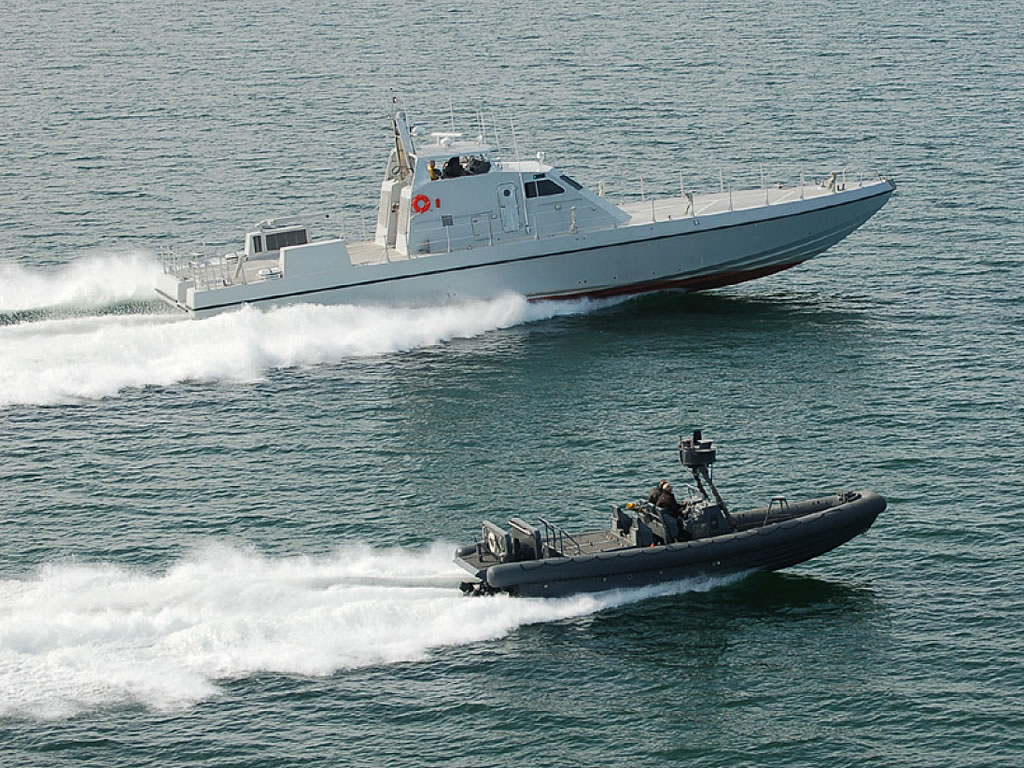
July 10/13: Patrol Boats. The US DSCA announces [PDF] Saudi Arabia’s formal export request for 30 Mark V patrol boats, 32 foredeck-mounted 27mm guns, spare and repair parts, support equipment, personnel training and training equipment, publications and technical documentation, and US government and contractor support. The estimated cost is up to $1.2 billion, but exact prices for the boats and support will depend on contract negotiations with the principal contractor, who hasn’t been picked yet, though USMI is a potential builder. Implementation of this proposed sale will require an additional 3-4 U.S. Government and contractor representatives to Saudi Arabia over a period of 7 years, to provide support and warranty work during delivery of the boats.
The Mark Vs are best known for their use by SEAL teams in the USA (Mk.V SOC), and have been used to launch and recover small UAVs. They are also used independently of the SEAL teams by the US Navy. Buying them creates a fast-moving armed force that can protect critical infrastructure in the Arabian/ Persian Gulf, and has the on-board guns to destroy Iranian “Boghammer” fast boats in a clash. They can also be used in efforts like Saudi operations around Yemen, which made significant but under-reported use of naval interdiction.
The DSCA says that this purchase represents an upgrade and modernization over the RSNF’s existing small patrol boat fleet. Note that the RSN’s 9 Al Sadiq Class boats, built in the early 1980s by Peterson, offer about 10x the Mk.V’s displacement, and include weapons like anti-ship missiles. They don’t sound like the boats the Mk.Vs will replace.
DSCA request: Mk.V Patrol Boats
July 2/13: AH-64E. Boeing in Mesa, AZ receives a $15.4 million firm-fixed-price contract modification as part of its AH-64E purchases. The customer is confirmed as Saudi Arabia, with a cumulative total face value of $50.6 million for this one contract. US Army Contracting Command at Redstone Arsenal, AL acts as the Saudi agent (W58RGZ-12-C-0113, PO 0004).
July 2/13: AH-64 support. Boeing in Mesa, AZ received a $109.5 million firm-fixed-price contract modification “for services in support of the Royal Saudi Land Force Aviation Command.” The exact uses for these funds are unclear, as the RSLF operates 12 older AH-64D Apache helicopters, while also buying new AH-64Es. The contract itself, however, seems to be associated with new AH-64Es.
The Pentagon gives a cumulative total face value of $394.9 million for this one contract. US Army Contracting Command at Redstone Arsenal, AL acts as the Saudi agent (W58RGZ-12-C-0089, PO 0006).
June 20/13: Boeing-Sikorsky. With the Saudi government tipping sharply toward a very American helicopter fleet, Boeing (AH-6i, AH-64D/E) and Sikorsky (UH-60) have formed the Boeing Sikorsky International Services (BSIS) 50/50 joint venture to compete for Saudi support, maintenance & repair services. For Saudi helicopters bought under the huge Oct 20/10 announcements, those contracts will be passed through the US government as part of its Foreign Military Sales process.
Both firms have strong roots in the kingdom, and both are already performing maintenance service for the Saudis’ small AH-64 and UH-60 fleets. Boeing also supports research and community projects, and is involved in partnerships that address Saudi educational goals as well as industrial development. Sikorsky began later, in the early 1990s, and has been involved in a pair of Saudi upgrade programs as well as standard support work.
The Saudis have been willing to outsource their extensive maintenance and support contracts to 3rd parties, but firms like BAE have also demonstrated that original manufacturer’s with compelling offerings can capture a very profitable aftermarket business. BSIS makes it that much harder for outsiders to win, and strengthens the firms’ negotiating positions. Boeing | Sikorsky.
June 7/13: AH-64E. Longbow LLC in Orlando, FL receives a $39 million firm-fixed-price, foreign-military-sales (FMS) contract modification from Saudi Arabia, buying AH-64 mast mounted assemblies; the fire control radars that go inside them; and related support equipment.
The Pentagon says that the cumulative total face value of this contract is $333.3 million, but it’s a FY 2006 contract that far predates Saudi AH-64E buys, and involves just part of the helicopter.
Based on DID’s tracking of announced contracts, the Saudis have committed $339 million to their AH-64E buy so far, using several contracts. US Army Contracting Command in Redstone Arsenal, AL manages the contract on behalf of its Saudi client (W58RGZ-06-C-0134, PO 0042).
May 22/13: AH-64E. Boeing in Mesa, AZ receives a $69.2 million firm-fixed-price, foreign-military-sales contract modification for Saudi Arabia’s Apache Block III aircraft and associated parts and services. The US Army reports the total cumulative value of this contract so far as $259.4 million; when other known Saudi contracts are added, contract value to date is somewhere between $296-300 million. Given Saudi AH-64E export requests for up to 60 helicopters, and known helicopter prices, this is just a drop in the bucket.
US Army Contracting Command in Redstone Arsenal, AL manages the contract on behalf of its Saudi client (W58RGZ-12-C-0089, PO 0008).
May 22/13: AH-64E. Boeing in Mesa, AZ receives a $14.3 million firm-fixed-price, foreign-military-sales contract modification for Saudi Arabia’s Apache Block III aircraft and associated parts and services. The US Army reports the total cumulative value of this contract so far as $35.2 million. US Army Contracting Command in Redstone Arsenal, AL manages the contract on behalf of its Saudi client (W58RGZ-12-C-0113, PO 0003).
May 8/13: AH-64E. Boeing in Mesa, AZ receives a $26.1 million firm-fixed-price, foreign military sales (FMS) contract modification covering AH-64E training and support in Saudi Arabia.
The Pentagon says that the cumulative total face value of this contract is now $216.2 million, which almost exactly matches the announced $216.5 million total of all contracts with this designation – many of which were unattributed. The Army seems to be using specific contracts for specific export customers (W58RGZ-12-C-0089, PO 0007).
April 30/12: F-15SA Rollout. Boeing formally rolls out the 1st F-15SA fighter, in a St. Louis ceremony. Boeing.
March 25/13: Saudi. Sikorsky in Stratford, CT receives a $49 million firm-fixed-price contract. This modification will provide engineering and configuration services to 4 utility helicopters for Saudi Arabia. The contract number indicates a MYP-8 purchase, and the amount indicates that there’s an accompanying base helicopter order still to come. There are ways that could be done outside the purview of standard contract announcements.
Work will be performed in Stratford, CT with an estimated completion date of Dec 31/16. One bid was solicited, with 1 bid received by US Army Contracting Command in Redstone Arsenal, AL (W58RGZ-12-C-0008).
Saudi Arabia: 4 UH-60Ms?
March 14/13: F-15SA, subtraction edition. The Pentagon announces the removal of $456.2 million from the $4 billion contract to develop and test F-15S to F-15SA conversion kits, install 4 initial kits, and produce 68. The revised not-to-exceed amount is now $3.544 billion.
Schedules and other elements are unaffected – see Nov 2/12 entry for the full listing (FA8505-12-C-0001, PO 0004).
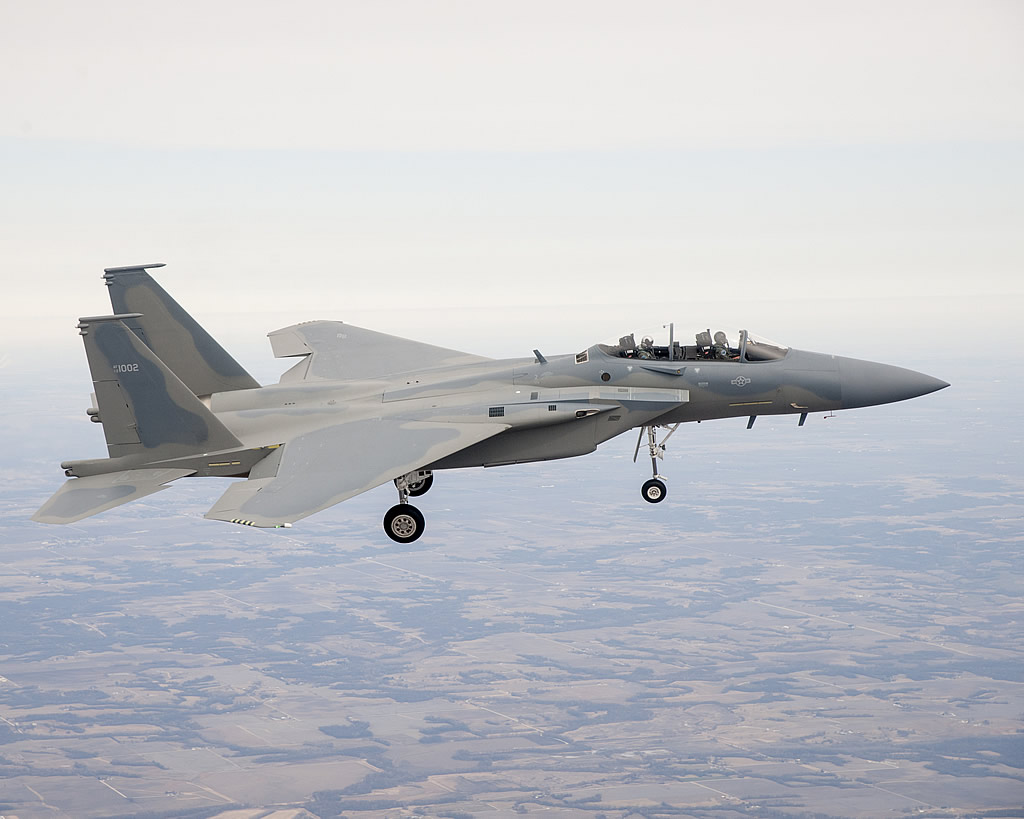
(click to view full)
Feb 20/13: 1st flight. The F-15SA’s maiden flight takes place at Boeing’s St. Louis, MO facilities, and goes as planned. The F-15SA flight test program will include 3instrumented F-15SAs operating from Boeing facilities in St. Louis, MO and Palmdale, CA.
The Saudi F-15SA is the first F-15 model with full fly-by-wire controls, something that was standard on F-16s decades ago. That change makes flight testing more important than it might be for another F-15E variant like Korea’s F-15K, or Singapore’s F-15SG. Which may also explain why 1st delivery will take place about 2 years after 1st flight, in 2015. Deliveries are expected to finish in 2019. USAF.
F-15SA first flight
Jan 3/13: Saudi? Boeing in Mesa, AZ receives an $18.4 million firm-fixed-price contract modification “to procure Apache Block III Aircraft in support of Foreign Military Sales.” We asked for further details to clarify which customer, but neither Boeing nor the US military will provide those any longer, except through Freedom of Information Act requests. AH-64 Foreign Military Sales seem to have different contracts for each country, however, and a subsequent announcement that pegs Saudi Arabia as the customer also offers totals that match the totals for this contract number.
Work will be performed in Mesa, AZ with an estimated completion date of April 30/13. The bid was solicited through the Internet, with 1 bid received (W58RGZ-12-C-0089).
2012
F-15SA fighter contract; F-15S upgrade kits and sensors bought; AIM-9X sidewinder missiles bought; AH-64E attack helicopter buys begin; MD-530F light utility helicopters bought; AH-6i armed scout helicopters bought.
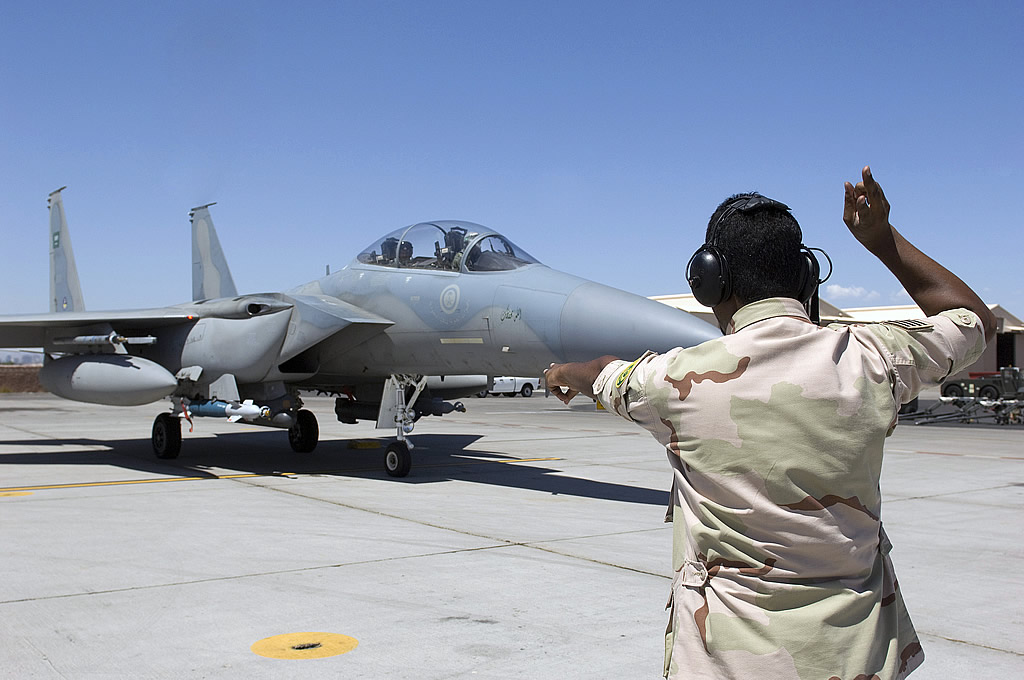
(click to view full)
Dec 31/12: F-15 Upgrades. Lockheed Martin in Akron, OH receives a $253.4 million firm-fixed-price contract for the F-15SA modernization program.
Work will be performed in Akron, OH, and is expected to be complete by June 2020. The AFLCMC/WNSK at Wright-Patterson Air Force Base, OH manages the contract on behalf of their Saudi Foreign Military Sale client (FA8621-12-R-6256).
Dec 28/12: F-15 support. PKL Services Inc. in Poway, CA receives a $95 million firm-fixed-price, indefinite-delivery/ indefinite-quantity contract for F-15C/D/S maintenance & upgrade training at King Khalid Air Base in Khamis Mushayt and King Abdul Aziz Air Base in Dhahran.
Work is expected to be complete by Jan 1/15. The AETC CONS/LGCI at Randolph AFB, TX manages the contract on behalf of their Saudi Foreign Military Sale client (FA3002-13-D-0003).

(click to view full)
Nov 9/12: Saudi Arabia The US DSCA announces [PDF] Saudi Arabia’s DSCA request for up to 25 C-130J family aircraft, in a deal that could be worth up to $6.7 billion once a contract is negotiated.
The RSAF currently operates 30 C-130H medium transport aircraft, and another 7 KC-130H aerial refueling tankers with secondary transport capabilities. External engine fleet and depth maintenance contracts take care of them, but as the hours pile up, replacement looms. The Saudis would replace their fleet with just 20 stretched C-130J-30s, and another 5 KC-130Js. On the other hand, the stretched planes offer more room, and the C-130J’s extra power makes a big difference to real cargo capacity in Saudi Arabia’s lift-stealing heat. The request includes:
* 20 C-130J-30 stretched transports
* 5 KC-130J aerial tankers, which could be armed in future
* 120 Rolls Royce AE2100D3 Engines (100 installed and 20 spares)
* 25 MIDS-LVT Link-16 systems
* Plus support equipment, spare and repair parts, personnel training and training equipment, publications and technical data, and U.S. Government and contractor support.
The prime contractors will be Lockheed-Martin in Bethesda, MD (C-130Js); General Electric Aviation Systems in Sterling, VA; and Rolls Royce Corporation in Indianapolis, IN (engines). Implementation of this sale will require the assignment of U.S. Government and contractor representatives to the Kingdom of Saudi Arabia for delivery, system checkout, and logistics support for an undetermined period of time.
Request: 20 C-130J-30s & 5 KC-130Js
Nov 2/12: F-15 upgrades. Boeing in St. Louis, MO receives a $4 billion firm-fixed-price, cost-plus-fixed-fee, cost-reimbursable-no-fee contract for 68 F-15S to F-15SA conversion kits, Country Standard Time Compliance Technical Order (CSTCTO) development, CSTCTO integration and testing, fabrication of trial kits to support validation and verification activities, and the procurement and installation of 4 base stand-up kits.
This is the same listing as the June 26/12 entry, and the current announcement appeared to be the finalized version – until a March 14/13 announcement cut the total to $3.544 billion for the same work.
Note that this amount doesn’t reflect the full cost of the 72 upgrades. As one can see below, the conversion kits are accompanied by a wide variety of modern sensors, and other equipment from vendors beyond Boeing. That equipment is included in the fighter upgrade program, and installed / integrated under this contract, but it isn’t bought under this contract.
Work is expected to be completed by Dec 31/19. The AFLCMC/WWKA at Robins Air Force Base, GA manages this Foreign Military Sale on behalf of its Saudi Arabian client (FA8505-12-C-0001, PO 0002). See also Arabian Aerospace.
68 F-15S to F-15SA conversions
Aug 6/12: RSAF support.The US DSCA announces Saudi Arabia’s request to buy continued support and services for the Royal Saudi Air Force’s aircraft, engines and weapons; publications and technical documentation; airlift and aerial refueling; support equipment; spare and repair parts; repair and return; personnel training and training equipment; and other forms of US government and contractor support. To sum up: “Saudi Arabia needs this follow on support… in order to sustain the combat and operational readiness of its existing aircraft fleet.”
The estimated cost is $850 million. This appears to be a government-to-government agreement, so that limit is probably reasonably accurate. There is no prime contractor, and all the U.S. Government personnel or contractors required are already in Saudi Arabia.
RSAF Support request
July 13/12: MD-530Fs. MD Helicopter in Mesa, AZ receives a $40.7 million firm-fixed-price contract, to buy MD 530F helicopters and related equipment for Saudi Arabia’s National Guard. This is the type’s 2nd military order, after Afghanistan ordered it as a training & utility platform, so the buy is significant to the company.
Saudi Arabia’s Oct 20/10 DSCA request had mentioned 12 MD-530Fs, which are designed to operate in the thinner air created by hot and/or high-altitude conditions. These helicopters are often used in policing and light utility roles, but they can be armed with light weapons. The SANG’s forthcoming AH-6is (vid. Feb 13/12 entry) are more explicitly designed for the Armed Reconnaissance role.
Work will be performed in Mesa, AZ with an estimated completion date of July 30/13. One bid was solicited, with 1 bid received by US Army Contracting Command in Redstone Arsenal, AL, on behalf of its Saudi Foreign Military Sale client (W58RGZ-12-C-0105).
MD-530F helicopter buy
June 26/12: F-15 upgrades. Boeing in St. Louis, MO receives a $1.837 billion firm-fixed-price, cost-plus-fixed-fee, cost-reimbursable-no-fee contract for 68 F-15S to F-15SA conversion kits, Country Standard Time Compliance Technical Order (CSTCTO) development, CSTCTO integration and testing, fabrication of trial kits to support validation and verification activities, and the procurement and installation of 4 base stand-up kits. This is a Foreign Military Sales requirement for the Kingdom of Saudi Arabia, and subsequent announcements show that it’s meant to get work underway at about 45% funding.
Work is to be complete by Dec 31/13. The Warner-Robins air Logistics Center at Robins Air Force Base, GA manages the contract (FA8505-12-C-0001).
May 31/12: F-15 Sensors. Boeing in St. Louis, MO receives an $18.4 million addition to a firm-fixed-price contract, to pay for the “urgent requirement for limited integration of the DB-110 Reconnaissance Pod System” on 8 RSAF F-15S aircraft. The April 13/12 contract will add pods to the upgraded F-15SAs, but this urgent contract will improve Saudi Strike Eagles immediately. Those DB-110 pods would certainly help the F-15S Strike Eagles at Khamis Mushayt keep an eye on Yemen, for instance.
Work is to be complete by July 2013. The ASC/WWQ at Wright-Patterson AFB, OH manages the contract on behalf of their Saudi Foreign Military Sale client (FA8634-12-C-2651, PO 0004).
May 18/12: F-15S/SA. S7K Aerospace, LLC in Saint Ignatius, MT receives a $10 million firm-fixed-price/ cost-reimbursable-no-fee contract for 3rd party logistics repair and return management services, to support RSAF F-15s.
Work will be performed from Saint Ignatius, MT, and the contract runs until May 19/13. The Warner-Robins Air Logistics Center/GRMK at Robins AFB, GA manages the contract (FA8505-12-D-0002, PO 0002).
May 6/12: AH-64E? A $171.8 million firm-fixed-price contract “for the procurement of Apache Block III aircraft and related services in support of Foreign Military Sales.” The Pentagon does not mention which country, but AH-64 Foreign Military Sales seem to have different contracts for each country. A subsequent announcement that pegs Saudi Arabia as the customer also offers totals that match the totals for this contract number.
Work will be performed in Mesa, AZ, with an estimated completion date of Dec 30/14. One bid was solicited, with 1 bid received. The U.S. Army Contracting Command in Redstone Arsenal, AL acts as Taiwan’s agent (W58RGZ-12-C-0089).
AH-64E contracts begin?
April 13/12: F-15SAs, Recon. Recent United Technologies’ acquisition Goodrich Corp. in Westford, ME received an $183 million firm-fixed-price unfinalized letter contract for DB-110 pods, support equipment, and contractor logistic support “for the Foreign Military Sales F-15 Modernization Program.”
No official confirmation yet, but the Saudis have the current FMS F-15 modernization program. Their Oct 20/10 DSCA request included 10 DB-110 Reconnaissance Pods, and a July 10/12 Goodrich release cites a new-customer order from Saudi Arabia for 10 dual-band reconnaissance pods from its Westford, MA facility; 5 fixed, transportable and mobile ground stations from its Malvern, UK facility; and “extensive training and logistics support.”
Work will be performed in Westford, ME, and is expected to be complete by July 31/22. The ASC/WINK at Wright-Patterson AFB, OH, is acting as the agent for this contract (FA8620-12-C-4020).
April 9/12: F-15SA C2. Rockwell Collins, Inc. in Cedar Rapids, IA receives a $14.5 million firm-fixed-price contract modification, exercising an option for 168 RT-1851A-C / ARC receiver-transmitters (including royalty fees) for the government of Saudi Arabia under the Foreign Military Sales program. Note that the ARC-210 radio system uses 2 RT-1851s, whose Bandwidth Efficient Advanced Modulation (BEAM) Line of sight technology enables higher data rates.
AN/ARC-210 Talon radios can handle both voice and data, and can include jam-resistant and SATCOM modules. They are used by a number of platforms, including the F-15. Since 168 of these R-Ts would equip 84 aircraft, this order seems to be destined for Saudi Arabia’s new-build F-15SAs.
Work will be performed in Cedar Rapids, Iowa, and is expected to be completed in December 2013. Contract funds will not expire at the end of the current fiscal year. The Naval Air Systems Command, Patuxent River, MD, is the contracting activity (N00019-09-C-0069).
March 30/12: AIM-9X. A $97.1 million firm-fixed-price, fixed-price-incentive-firm target contract modification, buying AIM-9X Sidewinder short range air-to-air missiles for South Korea and Saudi Arabia. The Saudi order is $85.3 million, or 87.85% of the total, for 120 AIM-9X Block II All Up Round tactical missiles in containers; 42 more containers; and 33 Block II captive air training missiles with no motor or warhead.
April 2/12: F-15S Sensors. Lockheed Martin Missiles and Fire Control in Orlando, FL receives a $410.6 million firm-fixed-price contract for 95 sniper advanced targeting pod and spares; 35 compact multiband data links; 70 infrared search and track (IRST) systems and spares; 75 IRST pylons; and data, in support of the Royal Saudi Air Force F-15S to F-15SA conversion. The F-15S already uses LANTIRN, and both of these systems offer considerable improvements over that existing gear. The 2 systems can even be combined, via a single underbody pylon that contains the Tiger Eyes and mounts the Sniper pod.
Lockheed Martin’s Sniper pod offers pilots advanced day/night ground surveillance and laser or GPS targeting. The version offered is not clear; the most recent variant is the USAF’s new Sniper-SE.
Lockheed Martin’s Tiger Eyes IRST is also a long-range surveillance tool, but one focused on heat emissions from aircraft. That gives fighters a non-radar surveillance option, which is useful on a tactical level and offers options against stealth aircraft. As a side benefit, Tiger Eyes provides classic LANTIRN capabilities like terrain following, and all-weather navigation. Work is to be completed by Nov 31/17. The Warner Robins Air Logistics Center at Robins AFB, GA manages this contract on behalf of its Saudi FMS client (FA8540-12-C-0012).
April 2/12: F-15S EW. BAE Systems in Nashua, NH received a $366.5 million firm-fixed-price contract for 70 Digital Electronic Warfare Systems (DEWS) and Common Missile Warning Systems (CMWS) and spares; 3 DEWS/CMWS test stations and associated spares; and data. This effort is in support of the Royal Saudi Air Force F-15S to F-15SA conversion, and will improve the planes’ ability to be aware of and counter enemy radar threats. DEWS was picked by Boeing in 2008, as its future F-15 EW offering.
Work will be performed in Nashua, NH Work is to be complete by Nov 31/18. The Warner Robins Air Logistics Center at Robins AFB, GA manages this contract on behalf of its Saudi FMS client (FA8540-12-C-0013). See also BAE release.
March 8/12: F-15SA contract. Following the December 2011 $29.4B LOA, this is a $11.4B firm-fixed-price, cost-plus-fixed-fee, time-and-materials procurement contract for 84 new planes, as well as some related development work. This is a subset of what the LOA covers, since there are also retrofits on 70 existing planes, weapons and support services in the overall package.
Work will be done at El Segundo, CA, Ocala, FL., and Cedar Rapids, IO, with an expected completion date set to October 2020. ASC/WWQ, Wright-Patterson Air Force Base, OH manages the contract (FA8634-12-C-2651) on behalf of the Kingdom.
F-15SA contract
Feb 13/12: SANG AH-6is. Boeing representatives tell reporters that Saudi Arabia signed a Letter of Agreement for 36 AH-6i light scout and attack helicopters “a few weeks ago.” The AH-6i were part of the Oct 20/10 DSCA request for its National Guard, and the next step involves negotiations on price and delivery schedules. If those are completed, it isn’t clear whether Saudi Arabia would be the type’s 1st customer. A Rotor & Wing report says that:
“Tilton can also see further military riches on the horizon as Boeing pushes the AH-6i into the world market as a mini-Apache “with attitude.” There is a first order of 24 aircraft with more to follow.”
The other country that has been publicly associated with the AH-6i is Jordan, who reportedly signed a Letter of Intent in 2010. The actual contract takes until 2014, and it makes the SANG the type’s 1st customer. Sources: Rotor & Wing, “A Modern Love Affair: Lynn Tilton and U.S. Army” | Defense News, “Saudi Arabia, Boeing Strike Deal for 36 AH-6i”.
Jan 5/12: SANG AH-64s. Lockheed Martin Missiles and Fire Control in Orlando, FL received a $66.6 million firm-fixed-price and cost-plus-fixed-fee contract. The award will provide for the procurement of AH-64D Apache M-TDAS/PNVS (“Arrowhead“) systems and spares for the Saudi Arabia National Guard. Work will be performed in Orlando, FL, with an estimated completion date of March 31/15. One bid was solicited, with 1 bid received by US Army Contracting Command in Redstone Arsenal, AL as the Saudi’s FMS agent (W58RGZ-11-C-0120).
This is one of several ancillary contracts supporting reports that Saudi Arabia has signed a deal to buy AH-64D Longbow Block III helicopters. That deal wasn’t announced publicly, so it isn’t clear if other services may be covered. Beyond the SANG’s interest in buying 36 Apache Longbow Block IIIs, the Royal Guard wanted 10, and the regular Army wanted to add 24 Block IIIs to its existing fleet of 12 Block IIs. See the Oct 20/10 DSCA request for more.
2011
F-15SA LoA signed; LAV armed vehicle request & contract; WCMD smart bomb request; AH-64s bought?

(click to view full)
Dec 24/11: F-15SA LoA. Saudi Arabia signs a $29.4 billion Letter of Acceptance to buy 85 new F-15SA Strike Eagle fighters, upgrade 70 existing F-15S Strike Eagles, purchase all of the accompanying weapons named in the fighters’ Oct 20/10 DSCA request, and pay for support work and 10 years of training. Much of the Saudi training in the F-15SA will occur alongside U.S. forces, and approximately 5,500 Saudi personnel are expected to be trained through 2019. They expect upgrades of the F-15S to the F-15SA configuration to start rolling out in 2014, and 1st delivery of new-build F-15SAs in early 2015.
The additional work is expected to keep Boeing’s F-15 line open until at least 2017 or so, along with 600 suppliers in 44 states. Big winners include Raytheon (radar, many weapons), and GE Aircraft Engines. While the State Department briefing would not answer the question of which engine the fighters would use, the DSCA request was clear: GE’s F110-GE-129 IPE. It will also create work in Saudi Arabia, as some of the F-15S upgrade work, and some structural sub-assembly fabrication, will be handled through the Alsalam Aircraft Company.
An Aviation Week report adds that Saudi Arabia had previously signed a Letter of Agreement for the 36 AH-64D Apache Longbow attack helicopters it requested on Oct 20/11. That would make 2 components worth over half of the $60 billion mega-deal under contract, plus a major upgrade of the kingdom’s PATRIOT missile system on the side, in the space of just over a year beyond the DSCA announcement. Boeing | US White House | US State Dept. Briefing | Aviation Week | BBC | Bloomberg | Defense News | St. Louis Today | Flight International DEW Line.
F-15SA LoA
Dec 20/11: LAVs. GDLS SVP for international operations, Dr. Sridhar Sridharan, announces that U.S. Army TACOM Life Cycle Management Command has awarded a $126 million contract modification for 73 more Light Armored Vehicles (LAVs) “for a Foreign Military Sale (FMS).” The release adds that: “With this latest contract modification, the original contract, announced on January 4, 2011, is now valued at USD$264 million for 155 LAVs.”
Vehicles provided under this contract will be the 300hp, 8×8 LAV II, with a base gross vehicle weight of up to 32,000 pounds/ 14,500 kg. The vehicles will be produced in 6 different variants, which matches all numbers and information from the June 13/11 DSCA request.
Since the LAVs are made in London, ON, Canada, the contract was signed through the Canadian Commercial Corporation, the Canadian government’s Crown Agency for military exports.
LAV contract
Nov 10/11: Aviation Week’s Robert Wall writes that some observers are beginning to doubt whether the huge 2010 arms request will become a deal in time. Boeing has already spent money to avoid an F-15 production gap, and that’s the portion of the deal with the greatest need for a signed contract.
It would not be the first time a Saudi DSCA request has failed to become a signed deal, but the size and scope creates its own financing issues, even as it raises expectations and scrutiny. Unfortunately, at this point, all he can say is that uncertainty exists, not why it exists, or how deep it is.
Sept 19/11: Artillery. The US Defense Security Cooperation Agency announces Saudi Arabia’s formal request for up to $886 million of equipment to augment the Kingdom of Saudi Arabia’s existing light artillery capabilities. The Royal Saudi Land Forces already have towed 155mm and 105mm howitzers and support vehicles and systems, but the 105mm M119A2 and lightweight 155mm M777A2 would be an upgrade over the Royal Saudi Land Forces’ existing M102 105mm guns. The Saudis are also looking to buy C3 systems, artillery locating radars, and Humvees as part of this buy.
Artillery request
Sept 7/11: AH-64s. Lockheed Martin Missiles and Fire Control in Orlando, FL receives a $15.3 million firm-fixed-price contract modification, buying M-TADS/PVNS “Arrowhead” surveillance and targeting turrets for Saudi Arabia’s AH-64D helicopters. This could be an upgrade to existing helicopters, or part of the new aircraft order.
Work will be performed in Orlando, FL, with an estimated completion date of Nov 30/13. One bid was solicited, with one bid received, by U.S. Army Contracting Command at Redstone Arsenal, AL (W58RGZ-06-C-0169).
June 13/11: LAVs. The US DSCA announces [PDF] Saudi Arabia’s formal request to buy up to 73 LAV wheeled armored vehicles, plus additional equipment. The force within Saudi Arabia requesting them is not named, unlike other DSCA releases. Saudi Arabia’s National Guard also requested 82 LAVs on the same day, but this is separate request, implying a separate customer within Saudi Arabia. LAVs haven’t traditionally been part of the RSLF’s American-equipped divisions, but an Oct 4/07 DSCA request [PDF] for 126 LAVs and other vehicles confirmed that Saudi Arabia has been thinking along these lines:
“The Light Armored Vehicle is the primary combat vehicle of the Saudi Arabian National Guard (SANG). This proposed procurement by the Royal Saudi land forces will promote interoperability between the SANG and Ministry of Defense and Aviation.”
Absent any other matching DSCA requests since 2001, it’s possible that the release’s noted Jan 4/11 contract for 82 LAVs was a partial fulfillment of that 2007 request – but its exact match remains unclear. The 2011 DSCA request also repeats a justification from that notice:
“The proposed sale of Light Armored Vehicles will provide a highly mobile, light combat vehicle capability enabling Saudi Arabia to rapidly identify, engage, and defeat perimeter security threats and readily employ counter- and anti-terrorism measures. The vehicles will enhance the stability and security operations for boundaries and territorial areas encompassing the Arabian Peninsula.”
This sale is worth up to $263 million, but that will depend on the contract details, if one is negotiated after the 30-day blocking period expires in Congress. Requested items include:
* 14 standard LAV wheeled armored personnel carriers
* 23 LAV-25s, with 25mm cannon turrets
* 20 LAV-ATs, whose pop-up turrets carry BGM-71 TOW missiles
* 4 LAV-A Ambulances
* 3 LAV-R Recovery Vehicles, which can tow or winch other vehicles out of trouble
* 9 LAV-C2 Command and Control Vehicles
Vehicle accessories
* Driver vision enhancers
* Sight bore optical sets
* Improved Thermal Sight Systems (ITSS) and Modified Improved TOW Acquisition Systems (MITAS), where applicable
* Defense Advanced Global Positioning System Receivers
* M257 Smoke Grenade Launchers
* AN/USQ-159 Camouflage Net Sets
Other Accessories
* 155 AN/PVS-7B night vision goggles
* M2A2 Aiming Circles, compasses, plotting boards, reeling machines, telescopes
* switchboards, spare and repair parts, support and test equipment, personnel training and training equipment, publications and technical documentation, and U.S. Government and contractor support.
The prime contractors will be General Dynamics Land Systems in Sterling Heights, Michigan (LAVs) and Raytheon in Tucson, AZ (LAV-AT weapons etc.). Implementation of this proposed sale may require the assignment of approximately 5 additional U.S. Government and 10 contractor representatives through at least 2014. The requirement for support personnel in-country suggests that they’re going to a branch that does not already employ LAVs. Possibilities include the Royal Guard, or use by Army Military Police/ Air Force/ Navy forces in a rapid response security role.
LAV request
June 13/11: Bombs. The US DSCA announces [PDF] Saudi Arabia’s formal request to buy up to 404 GPS-guided CBU-105D/B WCMD Sensor Fuzed Weapons, 28 CBU-105 Integration test assets, containers, spare and repair parts, support and test equipment, personnel training and training equipment, publications and technical documentation, and U.S. Government and contractor support. The prime contractor will be Textron Systems Corporation of Wilmington, MA, and the estimated cost is up to $355 million. Implementation of this proposed sale will require annual trips to Saudi Arabia involving up to 2 U.S. Government and 3 Textron representatives for technical reviews/support, and program management for a period of approximately 2 years.
WCMD is a GPS-guidance tail kit for cluster bombs, similar to JDAM, and bombs equipped with them take on new designations. The base CBU-97 Sensor Fuzed Weapon bomb body contains BLU-108 submunition cylinders, each of which carries explosive projectiles that look like cans of tuna. If their millimeter-wave sensor detects sizable objects below after release from the bomb body, a shaped charge fires, forming a metal slug that drives down through armor. If the projectiles don’t find a target, 3 safety modes will deactivate them. That’s why DSCA can say “After arming, the CBU-105D/B Sensor Fuzed Weapon will not result in more than one percent unexploded ordnance across the range of intended operational environments.” Other countries in the region already use WCMDs, including Oman. DSCA adds that:
“Saudi Arabia intends to use Sensor Fused Weapons to modernize its armed forces and enhance its capability to defeat a wide range of defensive threats, to include: strongpoints, bunkers, and dug-in facilities; armored and semi-armored vehicles; personnel; and certain maritime threats… The agreement applicable to the transfer or the CBU-105D/B and the CBU-105 integration test assets will contain an agreement of the Government of Saudi Arabia that the cluster munitions and cluster munitions technology will be used only against clearly defined military targets and will not be used where civilians are known to be present or in areas normally inhabited by civilians.”
The target list is interesting, since CBU-105s, unlike some of their WCMD cousins, are not primarily anti-personnel weapons – unless the target is riding in a truck or something. It could certainly be a deadly way of taking out a small truck convoy of AQAP types, and might be equally effective against some fast boat swarms. See also the Oct 20/10 DSCA request, for 1,300 CBU-105/Bs.
WCMD bomb request
March 18/11: Amidst an environment of widespread unrest in the Arab world, including the invited intervention of Saudi troops to quell protests in Bahrain, Saudi Arabia’s King Abdullah returns from 3 months of medical treatment, and announces nearly $100 billion in spending. Even with the ability to pump more oil, Saudi finances have limitations, and a program worth over 20% of 2010 GDP, or 56% of the state’s FY 2010 budget, can hardly help but impact military spending plans.
The initiative includes 60,000 more military and security jobs to beef up the Interior Ministry, a large number of promotions for soldiers and officers, boost in salaries for all public sector workers including the military; and an announcement of massive social benefits for the populace at large, including unemployment payments, better health care and improved housing services. The Saudi private sector is reportedly less than happy about its exclusion from pay raises… but then, if the government could offer them pay raises, would it really be the private sector? Arab News | Zawya. Political concept: “rentier state.”
March 14/11: Link-16. The new Link-16 capability for Saudi Arabia’s F-15 fleets is a significant development, but it comes with a corresponding need for training. Tactical Communications Group, LLC announces that it has deployed a Link-16 Ground Support System (GSS) at 4 Royal Saudi Air Force (RSAF) airbases, to provide a training and simulation environment for Live, Virtual, and Constructive training in the RSAF F-15 fleet’s growing Link-16 capabilities.
TCG, LLC installed the units and trained on-site RSAF Personnel to provide live operations and training, under a USAF NETCENTS held by General Dynamics Information Technology. The firm describes it as “the first of several Foreign Military Sales (FMS) awards for the U.S. Government’s data link Ground Support System (GSS) which teams General Dynamics Information Technology and TCG’s GSS.”
2010
Ship buys considered.

Austal’s LCS
(click to enlarge)
Oct 26/10: LCS. Lockheed Martin MS2 President Orlando Carvalho confirms that his company has supplied price and availability information on its version of the littoral combat ship (LCS) to Saudi Arabia, which is looking to buy 8 modern frigate-sized warships. Lockheed is proposing an LCS equipped with AN/SPY-1F radars, an AEGIS combat system, and set equipment instead of mission modules.
It remains understood the Saudi authorities are waiting to see which LCS version the U.S. Navy chooses, but the ship’s capabilities might be well suited to the Arabian/Persian Gulf’s shallow waters. At Euronaval 2010, a French official reportedly said that France is hoping to sell between 4-6 FREMM frigates for the Saudis’ western (Red Sea and Indian Ocean) fleet, while the LCS was seen as likely for the eastern (Gulf) fleet. Defense News | Shephard Group | Tactical Report.
Oct 20/10: DSCA Mega-Request. The potential Saudi deals are announced as 4 separate Foreign Military Sales cases, one for each military service branch looking to receive equipment. As usual, this is a step required under US law, not a set of contracts. If Congress does not vote to block these sales within 30 days, the Saudis can begin negotiations for some or all of the items below. As we’ve seen with past notifications, those negotiations can take a long time as the Saudis look to fit each item into their own budgetary planning and foreign policy diplomacy.
Each DSCA request is linked where it’s detailed. Other sources and reactions include: Bloomberg | LA Times | Washington Post | Voice of America || Saudi Arabia’s Arab News | Al-Jazeera | Jerusalem Post || Agence France Presse | Malaysia Star | Reuters | Straits Times | China’s Xinhua || Defense News.
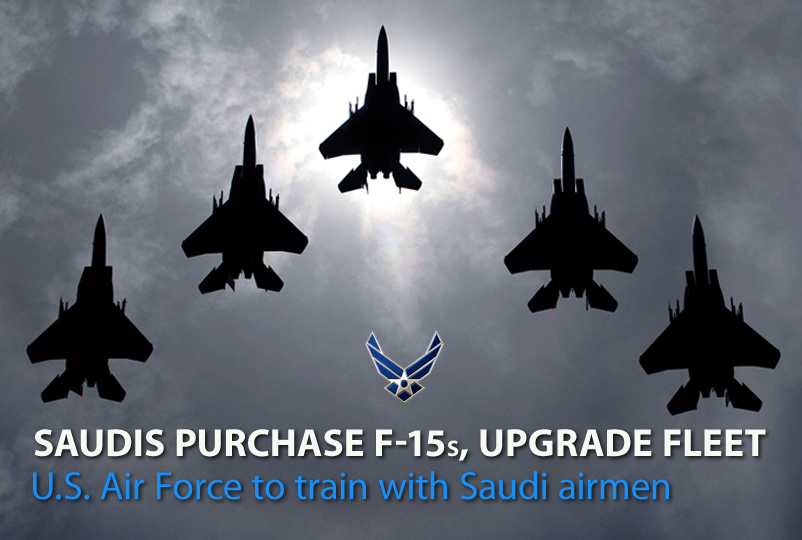
Oct 20/10: Air Force. The US DSCA announces [PDF] Saudi Arabia’s formal request for 84 new “F-15SA” fighters, upgrades for the RSAF’s 70 existing F-15S fighters to full F-15SA configuration, an array of advanced weapons to equip them, and long-term support that explicitly includes infrastructure and construction. The estimated cost is up to $29.432 billion.
Overall, the fighters appear to be very close to Singapore’s new F-15SGs, which are currently the most advanced Strike Eagles in the world. The DSCA does not detail the support personnel required, but it does spend time on the rationale for this sale, since this is the one that’s going to create any controversies in Congress:
“For the past twenty years the F-15 has been a cornerstone of the relationship between the U.S. Air Force (USAF) and the RSAF. The procurement of the F-15SA, the conversion of the F-15S fleet to a common configuration, and the CONUS (CONtinental US) training contingent will provide interoperability, sustained professional contacts, and common ground for training and support well into the 21st century.
The F-15SA will help deter potential aggressors by increasing Saudi’s tactical air force capability to defend KSA against regional threats. The CONUS-based contingent would improve interoperability between the USAF and the RSAF. This approach will meet Saudi’s self-defense requirements and continue to foster the long-term military-to-military relationship between the United States and the KSA. Saudi Arabia, which currently has the F-15 in its inventory, will have no difficulty absorbing the F-15SA aircraft into its armed forces.
The proposed sale of this service will not alter the basic military balance in the region.”
* 84 F-15 SA Strike Eagle fighters
* 193 F-110-GE-129 Improved Performance Engines. Saudi Arabia is shifting firmly toward the GE F110 for its future fleet, and away from Pratt & Whitney’s original F100. Each fighter requires 2 engines.
* 170 AN/APG-63v3 Active Electronically Scanned Array Radar (AESA) radar sets, which would equip all F-15S fighters as well. Answers a big pre-deal question. The USA is developing an APG-82v1 derivative to retrofit its own F-15E Strike Eagles, but the APG-63v3 is the most advanced exported radar for F-15s.
* 100 M61 Vulcan Cannons. The F-15’s 20mm gatling gun.
* 300 AIM-9X Sidewinder short range, infrared air-to-air missiles. AIM-9X is the most advanced version, and Saudi Arabia already has them.
* 25 Captive Air Training Missiles (CATM-9X). Seeker, no warhead or motor – used for training.
* 25 Special Air Training Missiles (NATM-9X). Fully live, but telemetry instead of a warhead.
* 500 AIM-120C/7 Advanced Medium Range Air-to-Air Missiles (AMRAAM). The C7 is the most advanced exportable version, and Saudi Arabia already has them.
* 25 AIM-120 CATMs. Seeker, no warhead or motor – used for training.
* 1,000 of Lockheed Martin’s 500 pound Dual Mode Laser/Global Positioning System (GPS) Guided Munitions (DMLGB).
* 1,000 of Lockheed Martin’s 2,000 pound DMLGBs
* 1,100 GBU-24 Paveway-III 2,000 pound Laser Guided Bombs, with penetrator warheads for use against hardened targets.
* 1,000 GBU-31Bv3 2,000 pound Joint Direct Attack Munitions (JDAM) GPS/INS guided bombs.
* 1,300 CBU-105D/B Sensor Fuzed Weapons (SFW)/Wind Corrected Munitions Dispenser (WCMD). These are GPS-guided cluster bombs that can destroy both troops and tanks. DID has a better name for them.
* 50 inert training CBU-105s
* 1,000 MK-82 500 pound General Purpose Bombs. These can be converted by using precision kits like Paveway, DMLGB, and JDAM.
* 6,000 MK-82 500 pound Inert Training Bombs
* 2,000 MK-84 2,000 pound General Purpose Bombs. These can be converted by using precision kits like Paveway, DMLGB, and JDAM.
* 2,000 MK-84 2,000 pound Inert Training Bombs
* 200,000 20mm Cartridges
* 400,000 20mm Target Practice Cartridges
* 400 AGM-84 Block II Harpoon missiles. The Block II has a GPS guidance mode, and can attack land targets as well as ships.
* 600 AGM-88B HARM missiles. Used to destroy enemy radar sites.
* 100 Link-16 MIDS/LVTs and spares. Link 16 offers all participating aircraft and ground platforms to share what they see and where they are, creating a common view of who’s where.
* 169 AN/AAS-42 Infrared Search and Track (IRST) Systems. IRST allows pilots to look for enemy aircraft using their infrared signatures, but because it’s passive, the target can’t detect the scan the way it can detect radar emissions.
* 158 AN/AAQ-33 Sniper advanced surveillance and targeting pods.
* 193 LANTIRN Navigation Pods (3rd Generation-Tiger Eye). Largely succeeded by the Sniper ATP, but Saudi F-15S aircraft use the twin-pod LANTIRN, and the navigation pod’s features are not copied in the Sniper.
* 10 of Goodrich’s DB-110 Reconnaissance Pods.
* 40 of L-3’s Remotely Operated Video Enhanced Receivers (ROVER). Allows equipped fighters to share more information with ground forces, and get targeting information from them.
* 80 Air Combat Maneuvering Instrumentation Pods. Used for combat training; transmits the position, velocity, etc. of the attached fighter to the central coordinators.
* The DSCA specified both 338 Joint Helmet Mounted Cueing Systems (JHMCS) and 462 JHMCS Helmets. JHMCS is a helmet-mounted sight that performs the same functions as a Head-Up Display for key information, weapons targeting, etc., but moves with the pilot’s head.
* 462 of ITT’s AN/AVS-9 Night Vision Goggles (NVGS).
* 169 Digital Electronic Warfare Systems (DEWS) for self-defense.
Under the contract, Saudi Arabia will take a step beyond existing modernizations of its F-15S fleet, and upgrade all 70 F-15S Strike Eagles to the F-15SA configuration.
The existing F-15 A-D Eagle fleet of air superiority fighters will remain unaffected. In addition, Saudi Arabia may order:
* Provision for US-based fighter training operations for a contingent of 12 F-15SA fighters, leaving 72 in Saudi Arabia.
* Construction, refurbishments, and infrastructure improvements of several support facilities for the F-15SA in-Kingdom and/or CONUS(CONtinental US) operations.
* RR-188 Chaff
* MJU-7/10 Flares
* Training munitions
* Cartridge Actuated Devices/Propellant Actuated Devices
* Plus communication security, site surveys, trainers, simulators, publications and technical documentation, personnel training and training equipment, and other forms of U.S. government and contractor support.
The prime contractors aren’t mentioned, but:
* Boeing (F-15, JHMCS, Harpoon, JDAM)
* GE (F110 engines)
* Lockheed Martin (DMLGB, LANTIRN, Sniper, IRST)
* Raytheon (AN/APG-63v3 radar, AIM-9X, AMRAAM, Paveway III, HARM)
* General Dynamics OTP (Basic bombs, Cannons, Ammunition)
Would form a partial list.
F-15S/SA request

with Arrowhead sensor
(click to view full)
Oct 20/10: The Saudi Royal Guard – see DSCA announcement [PDF]. The Royal Guard is pretty much what it sounds like: a force made up of troops whose tribes and members are considered most loyal to the King. They’re about to get AH-64 Block III Apaches, if this US DSCA announcement of the Saudis’ formal request leads to a contract. That contract could be worth up to $2.223 billion, when all services and support are included.
If a contract is signed, the Royal Guard may need up to 35 U.S. Government and 150 contractor representatives in Saudi Arabia, beyond the existing 250 U.S. Government personnel and 630 contractor representatives in Saudi Arabia supporting the modernization program. Also, this program will require multiple trips to Saudi Arabia involving U.S. government and contractor personnel to participate in annual, technical reviews, training, and one-week Program Reviews in Saudi Arabia.
This would be a high priority contract, within the constellation of Saudi Requests. The Royal Guard would receive:
* 10 Boeing AH-64D Apache Longbow Block III attack helicopters. This is the latest version, and Saudi Arabia could become its first confirmed export customer.
* 28 T700-GE-701D turboshaft engines
* 13 Modernized Targeting Acquisition and Designation Systems/Pilot
Night Vision Sensors. M-TADS/PVNS, also known as the AH-64D’s “Arrowhead” turret.
* 14 30mm Automatic Weapons. The Apaches use ATK’s M230 chain gun
* 7 AN/APG-78 Fire Control Radars with Radar Electronics Unit. The Apache Longbow’s mast mounted radar.
* 7 AN/APR-48A Radar Frequency Interferometer
* 640 AGM-114R Hellfire II Missiles. The -114R is the most modern version, with a triple-threat blast, armor defeating, and fragmentation warhead.
* 2,000 2.75″/ 70mm Laser Guided Rockets. It will be interesting to see which rockets they buy – they might be the big kickoff sale for Lockheed Martin’s DAGR, but the Raytheon/UAE LOGIR is also available, as is BAE/GD’s APKWS-II.
* 13 of Northrop Grumman’s AN/APR-39 Radar Signal Detecting Sets
* 13 of Goodrich’s AN/AVR-2B Laser Warning Sets
* 13 of BAE’s AAR-57v3/5 Common Missile Warning Systems
* 26 Improved Countermeasures Dispensers
* 26 Improved Helmet Display Sight Systems. IHDSS is the Apaches helmet-mounted sight.
* 14 AN/AVS-9 Night Vision Goggles
* 307 Combat Survivor Evader Locators (CSEL). Radios used by pilots, especially if they’re shot down.
* 6 Aircraft Ground Power Units.
* 1 BS-1 Enhanced Terminal Voice Switch
* 1 Fixed-Base Precision Approach Radar
* 1 Digital Airport Surveillance Radar
* 1 DoD Advanced Automation Service
* 1 Digital Voice Recording System
* Also included are trainers, simulators, generators, training munitions, design and construction, transportation, tools and test equipment, ground and air based SATCOM and line of sight communication equipment, Identification Friend or Foe (IFF) systems, GPS/INS, spare and repair parts, support equipment, personnel training and training equipment, publications and technical documentation, and U.S. Government and contractor support services. The Saudis usually require a lot of support from contractors, in part because it’s an opportunity for royal family members to take a cut.
The prime contractors will be:
* Boeing in Mesa, AZ (AH-64D, CSEL)
* Lockheed Martin Corporation in Orlando, FL (Arrowhead, Hellfire IIs, launchers)
* Lockheed Martin Millimeter Technology in Owego, NY (Longbow system)
* Longbow LLC in Orlando, FL. A Lockheed/Northrop-Grumman joint venture (Longbow system)
* General Electric Company in Cincinnati, OH (engines)
A number of other items above will be provided by sub-contractors.
Saudi Royal Guard

(click to view full)
Oct 20/10: Army Apaches. The US DSCA announces [PDF] Saudi Arabia’s formal request to grow its 12-helicopter AH-64 Apache attack helicopter fleet, adding 24 of the most modern AH-64D Block III variant, plus extensive support that may include construction activities, for a total cost of up to $3.33 billion.
The Royal Saudi Land Forces (RSLF) “will use the AH-64D for its national security and to protect its borders and vital installations. This sale also will increase the RSLF’s APACHE sustainability and interoperability with the U.S. Army, the Gulf Cooperation Council countries, and other coalition forces. Saudi Arabia will have no difficulty absorbing these helicopters into its armed forces.”
Perhaps that’s because implementation of this proposed sale may another 35 U.S. Government and 130 contractor representatives in Saudi Arabia, beyond the existing contingent of 250 U.S. Government personnel and 630 contractor representatives supporting the Saudis’ modernization program. Also, this program will require multiple trips involving U.S. government and contractor personnel to participate in annual, technical reviews, training, and one-week Program Reviews in Saudi Arabia.
The RSLF would buy:
* 24 Boeing AH-64D Apache Longbow Block III attack helicopters. This is the latest version, and Saudi Arabia could become its first confirmed export customer.
* 58 T700-GE-701D turboshaft engines
* 27 Modernized Targeting Acquisition and Designation Systems/Pilot
Night Vision Sensors. M-TADS/PVNS, also known as the AH-64D’s “Arrowhead” turret.
* 28 30mm Automatic Weapons. AH-64D Apaches use ATK’s M230 chain gun.
* 10 AN/APG-78 Fire Control Radars with Radar Electronics Unit. The Apache Longbow’s mast mounted radar.
* 10 AN/APR-48A Radar Frequency Interferometer
* 106 M299A1 Hellfire Longbow Missile Launchers
* 1,536 AGM-114R Hellfire II Missiles. The -114R is the most modern version, with a triple-threat blast, armor defeating, and fragmentation warhead.
* 24 Hellfire Training Missiles
* 4,000 2.75″/ 70mm Laser Guided Rockets. It will be interesting to see which rockets they buy – they might be the big kickoff sale for Lockheed Martin’s DAGR, but the Raytheon/UAE LOGIR is also available, as is BAE/GD’s APKWS-II.
* 27 of Northrop Grumman’s AN/APR-39 Radar Signal Detecting Sets
* 27 of Goodrich’s AN/AVR-2B Laser Warning Sets
* 27 of BAE’s AAR-57v3/5 Common Missile Warning Systems
* 54 Improved Countermeasures Dispensers
* 48 AN/AVS-9 Night Vision Goggles
* 307 Combat Survivor Evader Locators (CSEL). Radios used by pilots, especially if they’re shot down.
* 6 Aircraft Ground Power Units
* 1 BS-1 Enhanced Terminal Voice Switch
* 1 Fixed-Base Precision Approach Radar
* 1 Digital Airport Surveillance Radar
* 1 DoD Advanced Automation Service
* 1 Digital Voice Recording System
Also included are trainers, simulators, generators, training munitions, design and construction, transportation, tools and test equipment, ground and air based SATCOM and line of sight communication equipment, Identification Friend or Foe (IFF) systems, GPS/INS, spare and repair parts, support equipment, personnel training and training equipment, publications and technical documentation, and U.S. Government and contractor support services. The Saudis usually require a lot of support from contractors, in part because it’s an opportunity for royal family members to take a cut.
The prime contractors will be:
* Boeing in Mesa, AZ (AH-64D, CSEL)
* General Electric Company in Cincinnati, OH (engines)
* Lockheed Martin Corporation in Orlando, FL (Arrowhead, Hellfire IIs, launchers)
* Lockheed Martin Millimeter Technology in Owego, NY (Longbow system)
* Longbow LLC in Orlando, FL. A Lockheed/Northrop-Grumman joint venture (Longbow system)
A number of other items above will be provided by sub-contractors.
RSLF AH-64D attack helicopters

(click to view full)
Oct 20/10: Saudi National Guard. The US DSCA announces [PDF] Saudi Arabia’s formal request to buy helicopters, long-term support, and possibly even base construction, worth up to $25.6 billion.
Implementation of this proposed sale will require approximately 900 contractor representatives and 30 U.S. Government personnel on a full time basis in Saudi Arabia, for a period of 15 years. Also, this program will require multiple trips to Saudi Arabia involving U.S. government and contractor personnel to participate in annual technical reviews, training, and one-week Program Reviews in Saudi Arabia.
Items requested include:
* 36 Boeing AH-64D Apache Longbow Block III attack helicopters. This is the latest version, and Saudi Arabia could become its first confirmed export customer.
* 72 Sikorsky UH-60M Black Hawk Helicopters. The most current variant. Saudi neighbors Bahrain and the UAE have already ordered them.
* 36 Boeing AH-6i Light Attack Helicopters. A different branch of the same family tree that gave birth to the MD 530F. Nearby Jordan signed a Letter of Intent for the AH-6i in May 2010.
* 12 MD Helicopters MD-530F helicopters. Often used by law enforcement as an excellent light utility helicopter, though some countries operate militarized light attack variants. The 530F variant has longer rotor blades and other enhancements, so it performs better in the thinner air of hot or high altitude conditions. It doesn’t use MD’s patented NOTAR system.
* 243 T700-GE-701D turboshaft engines. The UH-60M and the AH-64D both use 2 engines for each helicopter.
* 40 Modernized Targeting Acquisition and Designation Systems/Pilot
Night Vision Sensors. M-TADS/PVNS, also known as the AH-64D’s “Arrowhead” turret.
* 20 AN/APG-78 Fire Control Radars with Radar Electronics Unit. The Apache Longbow’s mast mounted radar.
* 20 AN/APR-48A Radar Frequency Interferometer
* 40 Wescam MX-15Di (AN/AAQ-35) Sight/Targeting Sensors. Likely for the AH-6is.
* 52 30mm Automatic Weapons. AH-64D Apaches use ATK’s M230 chain gun.
* 40 GAU-19/A 12.7mm (.50 caliber) Gatling Guns. Can be used as door guns, or pylon-mounted on helicopters. Popular light helicopter weapon.
* 168 M240H Machine Guns. FN Herstal USA’s 7.62mm helicopter door guns, not used on Apaches.
* 421 M310 A1 Modernized Launchers. For Hellfire missiles.
* 158 M299 Hellfire Longbow Missile Launchers
* 2,592 AGM-114R Hellfire Missiles. The -114R is the most modern version, with a triple-threat blast, armor defeating, and fragmentation warhead.
* 171 of Northrop Grumman’s AN/APR-39 Radar Signal Detecting Sets
* 171 of Goodrich’s AN/AVR-2B Laser Warning Sets
* 171 of BAE’s AAR-57v3/5 Common Missile Warning Systems
* 318 Improved Countermeasures Dispensers
* 108 of EFW’s Improved Helmet Display Sight Systems. IHADSS is used by the Apache. The number involved indicates that they may have been picked for the AH-6is as well.
* 300 AN/AVS-9 Night Vision Goggles.
* 1,229 AN/PRQ-7 Combat Survivor Evader Locators (CSEL). Radios used by pilots, especially if they’re shot down.
* 18 Aircraft Ground Power Units.
* 4 BS-1 Enhanced Terminal Voice Switches
* 4 Digital Airport Surveillance Radars
* 4 Fixed-Base Precision Approach Radar
* 4 DoD Advanced Automation Service
* 4 Digital Voice Recording System
* Also included are trainers, simulators, generators, munitions, design and construction, transportation, wheeled vehicles and organization equipment, tools and test equipment, communication equipment, Identification Friend or Foe (IFF) systems, GPS/INS, spare and repair parts, support equipment, personnel training and training equipment, publications and technical documentation, and U.S. Government and contractor support services. The Saudis usually require a lot of support from contractors, in part because it’s an opportunity for royal family members to take a cut.

(click to see full)
The DSCA specifies the Saudi Arabian National Guard (SANG) as the AH-64D recipient, but is less clear about the other helicopters. The implicit message is that they’re part of the same FMS case to the same military entity, and the SANG could certainly make good use of the UH-60Ms, AH-6is, and MD 530Fs for “the defense of vital installations and will provide close air support for the Saudi military ground forces.” The DSCA adds that this sale will improve the SANG’s “Apache sustainability and interoperability with the U.S. Army, the Gulf Cooperation Council countries, and other coalition forces.” Saudi Arabia already operates some AH-64s and UH-60s, and the DSCA believes they will have no difficulty absorbing all of these helicopters into their armed forces. Given the level of contractor support included, that’s no surprise.
The prime contractors will be:
* Boeing in Mesa, AZ (AH-64D, AH-6i, CSEL)
* Lockheed Martin Corporation in Orlando, FL (Arrowhead, Hellfire IIs, launchers)
* Lockheed Martin Millimeter Technology in Owego, NY (Longbow system)
* Longbow LLC in Orlando, FL. A Lockheed/Northrop-Grumman joint venture (Longbow system)
* Sikorsky Aircraft West in Palm Beach, FL (UH-60M)
* MD Helicopters in Mesa AZ (MD 530F)
* General Electric Company in Cincinnati, OH (engines)
* ITT Aerospace/Communications in Fort Wayne, IN (night vision)
A number of other items above will be provided by sub-contractors.
Saudi National Guard request
Sept 14/10: LCS for Saudi Navy? Saudi Arabia may be interested in the Littoral Combat Ship as part of its rumored $60 billion weapons package. Saudi Arabia has focused on the General Dynamics/ Austal trimaran design before, but a Washington Post report says that:
“The official said the Saudis continue to have internal discussions about those purchases and are watching to see the outcome of a competition to build a new Littoral Combat Ship.”
Aug 14/10: The Wall Street Journal reports that adding UH-60 Black Hawk and AH-64 Apache helicopters, plus other equipment, to Saudi Arabia’s arms shopping list could push the eventual deal set as high as $60 billion. WSJ [subscription] | Bloomberg | Pittsburgh Post-Gazette | Israel’s Arutz Sheva | Jerusalem Post.
Aug 8/10: The Wall Street Journal reports that the US and Saudi Arabia are pursuing a $30 billion weapons deal, which could include up to 84 F-15 Strike Eagles. An order that size would keep the production line open for about 4 more years:
“After a round of talks in Washington late last month between Mr. Barak and top U.S. officials, including Defense Secretary Robert Gates, Israeli officials said they felt more comfortable about how the F-15s would be equipped. The U.S. argued to Mr. Barak that the proposed sale would strengthen moderates in the Gulf, ultimately bolstering Israel’s security. U.S. officials say the F-15s in the package will be “very capable” aircraft, comparable to the F-15s flown by South Korea and Singapore, which are among Asia’s most advanced militaries, said a senior U.S. defense official.”
See: WSJ [subscription] | Agence France Presse | Newsweek | St Louis Today.
Appendix A: Rumors, Questions & Competitors (2010)
Before the sales were finalized, a number of questions and political crosscurrents swirled around Saudi Arabia’s rumored and potential choices, as well as its alternatives if the USA balked.
Wings of Eagles – Which F-15s?

(click to view full)
Before October 2010, Saudi Arabia’s F-15 sale was the least clear aspect of the proposed deal. It was fairly clear that the Kingdom wanted F-15s. The question was what configuration of F-15, with what equipment, to replace which platforms.
The Panavia consortium’s swing-wing Tornado was designed for low level strike missions during the Cold War, and the Saudi fleet continues to receive upgrades. Their lifespan is finite, however, and replacements are reportedly being considered as a way of enhancing Saudi Arabia’s perceived and actual capabilities. Iran looms as a threat, and Saudi military operations near the Yemeni border have apparently led to requests for more advanced aircraft with better precision attack capabilities, to be delivered sooner rather than later.
Saudi Arabia currently operates about 87-96 strike-optimized Tornado IDS, and Scramble places them within 7, 66, 75 & 83 Squadrons, based at Dhahran on the east coast. A 2006 upgrade contract was intended to keep them in service to about 2020. The Tornado is notorious for its heavy maintenance requirements. On the other hand, that is not necessarily a disadvantage in a society where foreign subcontractors perform that work, and the contracts themselves are seen as lucrative opportunities for the Saudi elite.
The Kingdom also operates 153 F-15s: about 82 F-15 C/D air superiority fighters that may also be targeted for replacement, and 70 (of an original 72) newer F-15S Strike Eagles bought in 1999. The Saudi F-15S is an F-15E Strike Eagle variant with downgraded avionics, and a simplified Hughes APG-70 radar without computerized radar mapping refinements. Subsequent upgrades are adding higher-thrust GE F110 engines, Link-16 compatible datalinks, and Lockheed Martin’s Sniper Advanced Targeting Pods with excellent long-range surveillance capabilities, laser rangefinding and designation, and targeting geolocation capabilities.

(click to view full)
The F-15 Strike Eagle is a stable weapons system that provides excellent versatility in both air superiority and ground attack roles, with very good range for a fighter if conformal tanks are used. All Strike Eagles are not created equal, however, which makes quotes like F-15s that are “comparable to the F-15s flown by South Korea and Singapore” very ambiguous. There were at least 3 possible options:
F-15SG equivalent. Singapore currently flies the world’s most advanced operational F-15s, with GE F110 engines, integrated Infrared Search and Track capabilities, and an APG-63v3 AESA radar whose capabilities far outstrip the mechanically-scanned APG-70. Detailed mapping down to surveillance of man-sized targets, simultaneous air-air and air-ground modes, better range, and maintenance free operation would all offer significant advances over anything the Saudis or even the Israelis currently field. American F-15Es are being retrofitted with an advanced variant of this radar, the AN/APG-82v1. The resulting aircraft would be markedly better than the F-15S or Israel’s F-15I, but a step below the F-35As that Israel has approved for delivery in 2015-2017.
This is the path suggested by the F-15SA’s listed equipment, with the reported inclusion of BAE’s integrated DEWS (Digital Electronic Warfare System). Like the Singaporean fighters, F-15SAs will carry advanced Sniper ground surveillance and targeting pods, alongside Tiger Eyes IRST thermal imaging systems that offer long-range passive air-to-air targeting. A set of Goodrich’s popular DB-110 reconnaissance pods will round out the fighter fleet’s core capabilities. For F-15SAs derived from upgraded F-15S fighters, their internal electronics and mission computers may need another upgrade, and some structural life extension work may also be part of the program. Those details aren’t yet clear.
F-15SE Silent Eagle (No). Boeing is financing initial development of this stealth-enhanced Strike Eagle with internal weapon carriage options and fully digital fly-by wire, and was known to be looking for a launch customer and partner. A sale to Saudi Arabia would hardly be the first time that an advanced Western fighter reached production status thanks to a middle eastern order, though the USA’s experience with Iran and the F-14 offers a cautionary note. Boeing’s future F-15 program manager Brad Jones has previously commented that it’s not a question of how much stealth can be added to an airframe like the F-15 or F/A-18, but how much would be permitted for export to a given country.
The USA’s sensitivity concerning stealth technology, quiet concerns about Saudi Arabia’s long-term stability, and Israeli unease about an enemy with stealth capabilities, made this a tough and unlikely sale. The Saudis didn’t want, or didn’t get, this option.
F-15S+ equivalent (No). This option would essentially field new-build counterparts to Saudi Arabia’s upgraded F-15S fleet, with Link-16 capability, Sniper targeting pods, and F110 engines. The key difference would be the radar. The APG-70 is out of production, but there are reports that USA would like to offer the AN/APG-63v1, chosen by South Korea for its F-15Ks. The APG-63v1 has a fully digital back end, but uses a mechanically-scanned array like the APG-70’s up front. Its performance would be an improvement on the APG-70, while its back end reportedly gives operators the option of adding an AESA front end at a later date.
This might have offered a graceful way to finesse the issue of AESA capability with the Saudis – if the Saudis were inclined to accept it. They weren’t. In the end, they got their way.
The other controversy concerned weapons.
U.S. officials have said that said weapons systems deemed “not conducive to regional stability,” or likely to create serious issues with Israel or with Congress, are being excluded. That includes long-range, precision-guided “standoff systems” like cruise missiles. America has reportedly refused to provide the most advanced long-range strike missiles for the Saudis’ new F-15s, which would eliminate options like Lockheed Martin’s stealthy AGM-158 JASSM, or Boeing’s AGM-84K SLAM-ER anti-ship and land attack missile that will serve with South Korea’s F-15Ks.
The Saudis still got their share of precision weapons. Their request proceeded with GPS-guided JDAM bombs, and even dual laser/GPS guidance DMLGBs. Unlike existing RSAF Paveway laser-guided bombs, they are not affected by conditions like sandstorms, adding important short-range precision-strike against targets the F-15s can overfly. CBU-105 cluster bombs add another GPS-guided weapon that can decimate armored vehicles, and AGM-88 HARM missiles will make life very difficult for enemy radars. The Saudis even got AGM-84 Harpoon Block II missiles, with dual GPS and radar guidance and the ability to attack land or maritime targets over 100 miles away.
The Harpoon isn’t a stealthy weapon like Lockheed’s JASSM or MBDA’s Storm Shadow cruise missiles, and offers less range. The Saudis can live with that, since the RSAF’s Tornado fleet is receiving stealthy, long-range MBDA Storm Shadow missiles from Europe, and its advanced Eurofighters will eventually be Storm Shadow qualified as well. The Harpoon gives their F-15SA’s an acceptable medium range land strike capability, whose effectiveness against maritime targets fills an existing gap.
What’s the Buzz – Helicopters

(click to view full)
The helicopter buy is interesting, because 2006 and 2007-2009 reports had the Saudis modernizing their force with 130-150 French Eurocopter or Russian Mi-family helicopters, respectively. The French deal has been in limbo for a very long time, and the Russian deal has never been confirmed.
Initial reports concerning the prospective American deal revolved around 2 types: the UH-60/S-70 Black Hawk, and the AH-64 Apache attack helicopter. Both types are already in Saudi service.
Bell Helicopter’s 212 and 412 twin-Hueys, and single-engine 205 Hueys, currently form the biggest fraction of Saudi Arabia’s helicopter fleet. The RSAF also fields about 30 UH-60/S-70 Black Hawk helicopters, and seems interested in adding more. On the attack front, the Saudis field 12 AH-64A Apache helicopters, and a 2008 DSCA request involved another 12 AH-64D Apache Longbow Block IIs, but there has been no subsequent contract announcement.
Early reports correctly placed the potential UH-60 buy at around 72 machines, which would instantly make the Black Hawk the backbone of the Saudi helicopter fleet. Those reports did not specify which type, but earlier reports concerning a Eurocopter deal involved naval helicopters, which could result in a mixed UH-60/MH-60 deal.
The 1st question involves what type of Black Hawk the Saudis will want, for use on land. Gulf Cooperation Council neighbors Bahrain and the UAE have both ordered the latest UH-60M Black Hawks. Keeping up with the neighbors is an important tradition in the region, and the volume buying terms in the USA’s multi-year contracts are likely to make UH-60Ms the Saudis’ most attractive land option.
In the end, the official request specified UH-60Ms. What other possibilities were there?

(click to view full)
The MH-60S Seahawk naval utility helicopters, which has already been exported to Thailand, is the most likely naval helicopter buy. The MH-60S is already designated for search and rescue roles in the US Navy. Armed with Hellfire missiles and/or light gatling guns, they could decimate the fast patrol boats that Iran prefers, or provide capable patrols to help enforce actions like the quiet Saudi naval blockade around Yemen. If fitted with the AMCM system set, they become a potent force against the mines that Iran has used in the past to disrupt Gulf shipping. Those 4 roles (utility/ SAR/ scout-attack/ MIW) cover most of the Saudis’ naval needs, but if they are determined to counter Iranian submarines as well, a purchase of MH-60R anti-submarine helicopters was also possible. Fortunately for the Saudis, the USA’s umbrella MYP-VII helicopter contract also covers production of the MH-60R/S.
The 3rd question revolves around whether the Saudis wish to arm their UH-60s as additional battlefield support, using the “Battlehawk” kits under development by Sikorsky. The UAE had been expected to serve as the lead customer for the UH-60M Battlehawk Level 2/3 kits, which add precision-guided missiles and a 20mm cannon to the standard utility model, but a Saudi order could easily place them in that role instead. The DSCA requests leave that topic unclear.
They may not need the option, anyway.
The Wall Street Journal gave a figure of 60 AH-64D Apache Longbow helicopters in its more recent reports, which would grow the Saudi fleet to 72. In the end, the actual figure turned out to be 70 total, spread across the Royal Guard, Army, and National Guard. Most orders these days are for AH-64D Apache Block IIs or Block II upgrades, but it was always possible that the Saudi order would focus on the more advanced AH-64D Block III, becoming the type’s first export sale. It did, and they might.
Upgrades of the existing 12 Apaches to the same configuration would be an expected complementary sale, but is not mentioned.

(click to view full)
The other attack enhancement for Saudi forces came in the form of additional light helicopters.
Boeing has developed the AH-6i light attack and scout helicopter, as a thoroughly updated form of the AH-6J Little Bird used so successfully to support trapped US Special Operations forces in Mogadishu, Somalia. The Saudis may buy up to 36 of them, giving them a potent armed scout and urban warfare option. Of course, you’d have to fly them the way the “Night Stalkers” do, which is a pretty tall order.
The other unheralded addition was 12 of MD Helicopters MD-530F helicopters. MD has descended in a long and convoluted line from the same Hughes OH-6 Cayuse/ “Loach” helicopters that led to the AH-6i. Corporate shifts and sales have left MD Helicopters in a weakened market position, and attempts in the past few years to re-enter the military market hadn’t gone so well for them. The MD-530 is often used by law enforcement as an excellent light utility helicopter, though some countries like South Korea still operate militarized light attack relatives as a holdover from previous era military sales, and Boeing used it the MD-530F as the basis for its Unmanned Little Bird demonstrator. A successful sale to Saudi Arabia could offer MD Helicopters a useful market opening, and burnish its military and parapublic credentials.
Foreign Affairs: Considerations and Competitors

(click to view full)
The Saudis have long-standing relationships with America and its defense firms. That relationship frayed in the wake of 9/11, as 15 of the 19 attackers were Saudis, and the kingdom’s global financial support for Wahabbi preachers of jihad became a sore point. Iran’s nuclear weapons program, and its proxy wars to gain armed influence in the region, have helped paper over those wounds by putting the Saudis back on the front lines against a common foe. Saudi Arabia’s own internal struggles with al-Qaeda have also represented a form of progress for its American relationships.
In a world where people often buy arms from you because they want you to be their friend, and a region where shiny new equipment is often meant as a message to neighbors, these political winds bode well for American arms sales to the desert kingdom.
The Americans aren’t the Saudis’ only options, however. Nor is support for Saudi Arabia America’s only regional consideration. Pentagon Press Secretary Geoff Morrell responded to the Wall Street journal by saying that “Israel is not the only one with security concerns in the region, and we have responsibilities to other allies as well.” Which is a lot more diplomatic than: “Well, their Gulf neighbors are also a bit uneasy, and frankly, we wonder who’s going to be in charge there 10 years from now.”
Saudi choices are most clearly represented in its helicopter buys. If it chose not to buy 72 UH-60/MH-60s transports, 60 AH-64D attack helicopters, 36 AH-6i light scouts, and 12 MD-530F light utility helicopters (180 total), it could just as easily buy 120 Mi-17s with cargo and weapon capabilities, and 30 Mi-35 attack helicopters from Russia (150 total). Or turn to France for 54 NH90 TTH troop transports, 10 NH90 NFH naval helicopters, 32 AS 550 Fennec light scouts, 20 AS 532-A2 Cougar CSAR helicopters, 4 AS 565 Panther naval CSAR helicopters, and 12 Tiger attack helicopters (132 total).
Relations with France are somewhat cool at the moment, and Russia’s enabling role in Iran’s nuclear program may be an obstacle to improved Saudi relations, but it’s certain that either country would be delighted to sell the Saudis whatever they ask for. A Russian relationship would also offer the Saudis interesting political diversification, giving Saudi Arabia both a new lever with the Russians, and assured access to an friendly country who sells weapons with no strings attached.

(click to view full)
Likewise, a crashed deal for more American F-15s could have lead the Saudis to turn to the French for the Rafale, a versatile fighter with less range than the F-15, but more advanced features and weapons. An AESA radar is currently under development for the jet. In a similar situation, the neighboring UAE chose French diversification to co-develop the Mirage 2000v9 variant for service alongside its American F-16s. Since the Americans would not sell them long range strike weapons for their F-16s, they armed the Mirages with long range, stealthy “Black Shaheen” derivatives of MBDA’s Storm Shadow cruise missile, which has already been approved for Saudi Arabia’s Tornado IDS fleet. France’s GPS-guided, rocket-propelled AASM glide bombs would also be available to customers buying French aircraft.
Adding French Rafale fighter jets would force the Saudis to support a whole new set of equipment, and to buy a different set of aircraft weapons all the way down to fighter cannon ammunition. Since most support costs are outsourced by the Saudis no matter what they buy, and dealing with many kinds of equipment for similar roles has never been a consideration with the Saudis before, those issues aren’t likely to present significant obstacles. On the flip side, the Rafale currently has issues with precision attack missions, owing to delayed integration of its Damocles targeting pod. In the end this gap, and the lack of an AESA radar, might have made the Saudis more eager to do an F-15 deal for military as well as political reasons.
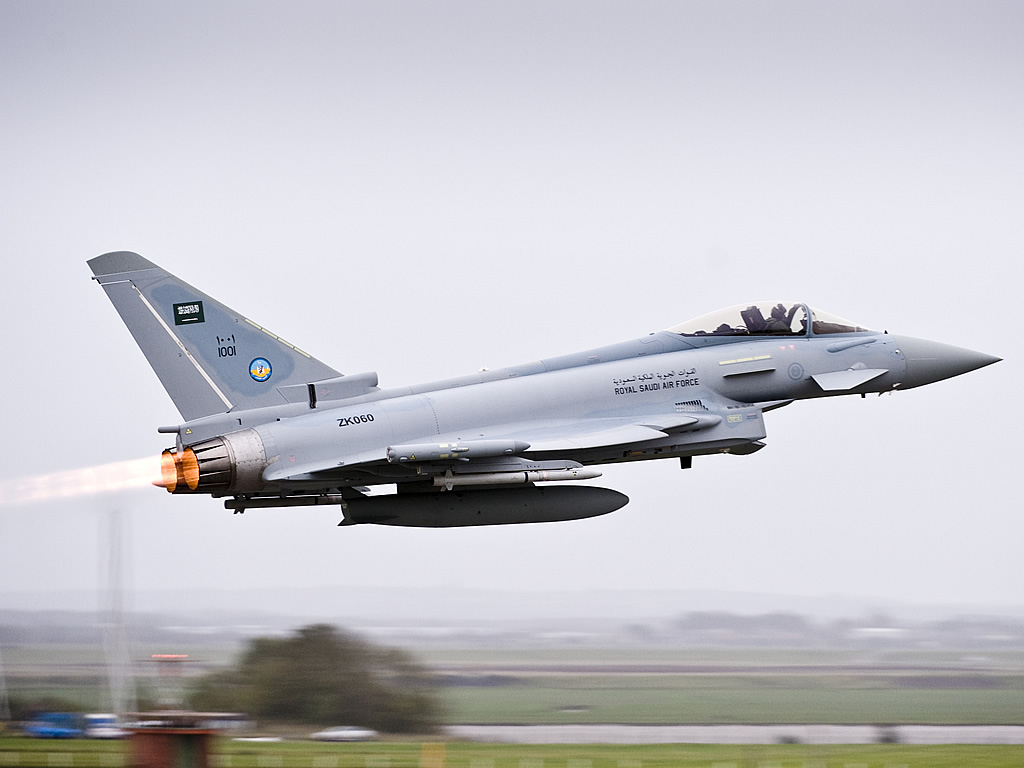
(click to view full)
A less drastic option could simply have involved a doubling of the RSAF’s Eurofighter Typhoon order, something that was reportedly discussed. The Wall Street Journal add reports from Saudi officials that a desire to avoid dependence on American permissions was partially behind the 2007 BAE deal for 72 Eurofighters, which have become the kingdom’s top-end air superiority fighters. Long-range MBDA Meteor air-air missiles, and an AESA radar, are both slated as future upgrades for global Eurofighter customers.
Typhoons slated for more of a strike role would still use the existing set of IRIS-T and AMRAAM air-air weapons common to the existing Typhoon and/or F-15 fleets, while options like the Taurus KEPD 350 long range cruise missile, Storm Shadow cruise missile, Brimstone anti-armor missile, and possibly even Raytheon UK’s dual-guidance laser/GPS Paveway IV bombs would all be available to replace equipment types the USA does not have, or might decline to sell. Lockheed Martin’s Sniper ATP surveillance and targeting pod would require an integration program, however, as the Saudis cannot use the RAFAEL/Northrop Grumman LITENING pod currently qualified on the type. On the support side, the Saudis already have a complete set of support agreements with BAE, who is building a maintenance & training facility in Saudi Arabia.
A more esoteric option could have involved taking a cue from Algeria and Malaysia, by buying Russian SU-30MKA/M variants. These fighters compare very favorably to American F-15s, with better aeronautical performance, similar versatility, and similarly impressive range. They even come with French avionics and targeting pods. That option was far less likely for the Saudis, however, because the Russians are known for offering poor support capabilities, and Saudi Arabia needs partners with the structures and experience to handle most of their support needs.
Additional Readings & Sources
Readers with corrections or information to contribute are encouraged to contact editor Joe Katzman. We understand the industry – you will only be publicly recognized if you tell us that it’s OK to do so.
* Tribune Libanaise – The Geopolitics of Weapons Procurement in the Gulf States. Excellent analysis, available via an archived version of the June 22/06 article.
* DID – Saudi Shopping Spree: A Hardened, Networked National Guard. The SANG is nothing like its American counterpart; it’s a de facto extension of the Royal family and a linchpin of the Saudi regime’s internal security.
Key Equipment: Platforms
* Army Technology – Boeing AH-6i Light Attack / Reconnaissance Helicopter, United States of America.
* DID – AH-64E Apache Block III: Guardians of the Battlefield. New variant and its capabilities explained.
* F-15E.INFO – F-15SA Differences.
* DID – The 2006 Saudi Shopping Spree: Pimp My (F-15S) Ride. The 2010 DSCA request is a step beyond these upgrades, but upgraded F-15S+ won’t be full fly-by-wire planes like the F-15SA. Otherwise, they’ll be very similar when their refit is done.
* DID – F-15s Looking for the AESA Edge. Explains the advantages of AESA technology, and the different models on offer for F-15s. The USAF is in the middle of a major fleet retrofit, whose radars will be ahead of Saudi Arabia’s.
* DID – Singapore’s RSAF Decides to Fly Like An Eagle. Referred to in this article. The F-15SG was the most advanced F-15, but elements like fly-by-wire and DEWS will put the new F-15SAs ahead.
* US DISA – Global Command & Control System – Joint (GCCS-J). More is explained in this article’s Nov 19/13 entry.
* NGC – Joint Threat Emitter (JTE). A mobile multi-radar system that radiates at realistic power levels, reacting to attempted jamming, employing IFF technologies, and tracking pilots’ reactions to its own efforts. It can simulate Anti-Aircraft Artillery radar systems, and Surface-to-Air missiles up to modern high-end threats.
* Global Security – Light Armored Vehicle (LAV). Goes into all of the specific variants, too.
* DID FOCUS – Sikorsky’s $8.5-11.7B “Multi-Year 8” H-60 Helicopter Contract. Includes all H-60M/R/S variants, and foreign sales like Saudi Arabia.
* DID – Saudi Shopping Spree: 24 UH-60L Black Hawk Helicopters. These were additional UH-60s for the Saudi Army (RSLF). The Ministry of the Interior also operates some Black Hawk machines, including new S-70i variants. The 2010 request involves UH-60Ms for the Saudi National Guard.
Key Equipment: Weapons & Ancillaries
* DID FOCUS – The C-130J: New Hercules & Old Bottlenecks. RSAF could order up to 25 C-130J-30s and KC-130J tankers.
* BAE – Digital Electronic Warfare System (DEWS). All-digital system (DRFM, digital RWR) includes all-aspect, broadband radar warning; locating threatening emitters; and managing multispectral RF/IR countermeasures. Mounted on F-15s.
* DID FOCUS – Ships Ahoy! The Harpoon Missile Family. Includes dual mode GPS/radar Harpoon Block II and GPS/IIR SLAM-ER cruise missiles. Can be used against ships or land targets, which is why they made the Israelis so nervous.
* DID – US Hellfire Missile Orders, FY 2011-2014. Explains the different AGM-114 missile variants.
* DID – Hydra-70 Rockets: From Cutbacks to the Future of Warfare. They can be enhanced later by additions like APKWS, DAGR, and TALON that turn them into precision-guided weapons.
* DID Spotlight – Heat Vision: US Teen Series Fighters Getting IRST. Using a modified centerline tank, though a slimmer, dedicated SpectIR pod can also be amounted to to F-15s, enhancing their aerial defense and ballistic missile launch detection capabilities. Saudi F-15SAs will receive IRST of their own, but it will be the older AAS-42 Tiger Eyes pod bought by South Korea and Singapore.
* DID FOCUS – JDAM: A GPS-INS Add-on Adds Accuracy to Airstrikes. It took a lot of negotiating before the Saudis were allowed to buy these, due to concerns expressed by Israel.
* DID FOCUS – JHMCS: Fighter Pilots’ “Look & Shoot” Helmets Changing Aerial Warfare. Their presence makes a big difference in the RSAF’s F-15s; it isn’t clear if their Eurofighters have this capability yet.
* Designation Systems – Raytheon (Texas Instruments) AGM-154 JSOW. Also a popular export weapon. This article explains the variants.
* MD Helicopters – MD530F. They’re also partnered with Boeing for the AH-6i.
* US Marine Inc – MKV Patrol Boats.
* Textron – Sensor Fuzed Weapon (SFW). CBU-105, a GPS-guided anti-armor cluster bomb.
* DID Spotlight – AIM-9X Block II & Beyond: The New Sidewinder Missiles. The RSAF was an early buyer of the AIM-9X block II.
* Boeing – Small Diameter Bomb. They make the GPS-guided GBU-39/ SDB-1.
* Designation Systems – Raytheon (Hughes) BGM-71 TOW.
News & Views
* Flight Global (Apr 3/13) – Boeing and USAF will have to recertificate entire F-15SA flight envelope. Because it’s the 1st fully fly-by-wire variant of the aircraft.
* Saudi Arabia’s Arab News (Sept 17/10) – The Saudi-US arms deal.
* Aviation Week (Aug 12/10) – New Saudi F-15S Could Be An Impressively Advanced Strike Fighter. The article mentions the desired ability to defend against ballistic missiles, using Raytheon’s NCADE AMRAAM variant. NCADE does offer that option, but it’s infrared guided – no AESA radar is required.
* World Politics Review (Aug 12/10) – French-Saudi Relations: One Step Forward, Two Steps Back. The latest controversy surrounds a June 2010 Le Figaro article that quoted the Saudi king telling the French defense minister that “neither Iran nor Israel has a right to exist.” The Saudis later denied the statement [in French], though it would appear to be a serviceable description of their underlying beliefs. Relations with France eventually improved somewhat in 2013; by 2014, Saudi Arabia was quietly working with Israel on a number of regional security issues.
* San Francisco Examiner (Jan 13/10) – Saudi Arabia’s untested military finds the going slow against Yemen’s battle-hardened rebels. More precision weapons will help somewhat.
* DID (last update Nov 18/09) – Saudi Rumors of Rafale: Stalled? The Eurofighter win appeared to be the end. The Rafale could have become a live option again if the F-15 sale fell through, but that was never likely, and didn’t happen.
* DID (Aug 25/09) – Saudis May Go Russian As France Loses Out. Refers to a reported helicopter deal. In the end, they bought from the USA.